
RHR Blog
Animal-Assisted Therapy: Healing Through the Herd
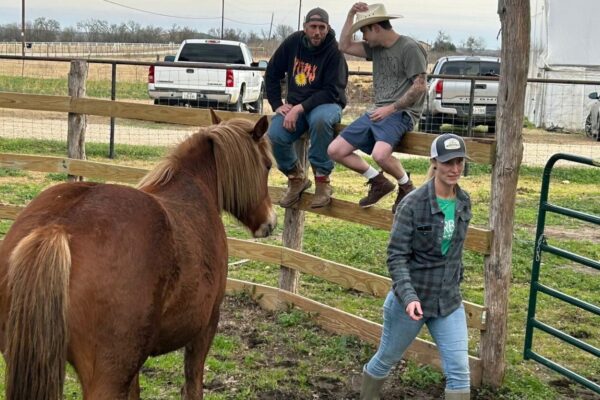
How caring for rescued animals helps men in recovery find something they lost.
Picture a morning in the barn. Still dark. The air smells like hay and earth. A man who, a few weeks ago, couldn’t be trusted with anything is standing next to a horse, learning to breathe slower.
The horse isn’t doing anything dramatic. It’s just standing there. Present. Waiting. Something is happening in that silence that no workbook exercise has ever produced.
At Ranch House Recovery, animal-assisted therapy isn’t a supplemental activity. It’s a core pillar of our Regenerative Recovery model. Our men describe the time they spend with our horses, donkeys, and chickens as some of the most transformative hours of their stay. To understand why, you have to understand what addiction takes from a man, and what animals uniquely give back.
What Addiction Steals
Addiction erodes a man’s sense of self in specific, predictable ways.
It takes trust: a man who has broken every promise to himself and everyone he loves loses faith in his own word. It takes responsibility: the pursuit of the substance eventually crowds out everything else. It takes connection: shame and the demands of active use push people away and make real intimacy feel impossible. And it takes a sense of competence: the evidence of one’s own dysfunction accumulates into a belief that one isn’t capable of taking care of anything, including oneself.
These losses are the actual work of recovery. The substance is the symptom. The wounds underneath are what must heal.
What Animals Give Back
A Clean Slate
Animals don’t know your history. They don’t know what you did before you came to the ranch. They respond entirely to who you are in this moment: how you approach, how consistent you are, how patient you’re willing to be. For men carrying profound shame about their past, that clean slate is not a small thing. It’s the door back in.
Honest Feedback
Horses are exquisitely sensitive to emotional states. They read body language, breathing patterns, and energy in ways that humans rarely match. A man who approaches a horse while internally tense but outwardly calm will find the horse is not fooled. That immediate, honest feedback builds self-awareness in a way that talk therapy alone can’t. And self-awareness is the foundation of everything else in recovery.
Unconditional Connection
Our animals are rescued. Many of them have experienced neglect and abandonment themselves. They know what it is to have been hurt. Yet they extend a remarkable openness to the men who care for them. The relationship isn’t conditional on past behavior. It requires only showing up, consistently and gently, day after day.
For men whose capacity for human connection has been damaged by addiction, learning to receive care without earning it is a crucial step.
Purpose and Responsibility
Our animals need to be fed, watered, and checked on every day. They need this regardless of how a man is feeling, whether it’s a hard morning or he didn’t sleep well. This non-negotiable responsibility is therapeutic in the deepest sense. A man who shows up because the animals need him is practicing recovery, whether he thinks of it that way or not.
Purpose, the sense that your presence and effort matter to something outside yourself, is one of the most powerful protectors against relapse. Animals make that purpose tangible and immediate.
The Parallel We Don’t Have to Name Out Loud
Our animals are rescued. So are our men, in their own way.
Watching an animal that was once abandoned learn to trust again, to allow care, to relax into safety: that’s a mirror many of our residents find profoundly moving. If that level of damage can be worked through, maybe the same is possible for them.
“The horse doesn’t care what I used to be. It only cares if I show up today.”
Ranch House Recovery Resident
What the Science Says
Animal-assisted therapy has a growing body of research behind it. Studies consistently show that interactions with animals lower cortisol (the primary stress hormone), reduce blood pressure, and
activate the release of oxytocin, the neurochemical tied to bonding and trust. These effects matter a great deal in recovery, where the nervous system has been dysregulated by prolonged substance use.
Research also shows that animal-assisted interventions improve emotional regulation, reduce depression and anxiety, and build social skills. All outcomes that directly support lasting recovery.
A Day With the Animals at Ranch House
Animal care is woven into the daily rhythm at Ranch House. Morning animal care. Evening check-ins. Feeding, watering, grooming, training, and just spending time in the presence of creatures who ask very little and give a great deal.
Over time, relationships form. A man begins to notice how a particular horse responds to him. Which chickens will eat from his hand? What it takes to earn a donkey’s trust. These small, quiet, specific relationships are the texture of healing here. The substance of what happens in between the formal sessions, out in the barns and pastures of a working Texas ranch.
“I’ve never felt like I mattered to anything. Then I started taking care of that donkey every morning, and something changed. He needed me.”
If you or a man you love is looking for something different, we’re here. Call (512) 525-8175 or contacts us.