
RHR Blog
12-Step Addiction Recovery in Texas: How It Works in 2026
The 12 steps are 90 years old this year. Bill Wilson and Dr. Bob Smith met in Akron in 1935, and the model they built has since spread to more than 180 countries, served tens of millions of people, and quietly become the most widely practiced framework for addiction recovery on earth. It’s also one of the most misunderstood.
If you’re researching 12-step addiction recovery in Texas right now, you’ve probably already encountered the basic confusion: Is it a religion? Is it a therapy? Does it actually work? Is it compatible with medication-assisted treatment? With modern clinical care? With evidence-based medicine?
This guide walks through what 12-step recovery actually is, what the research says about it, how it fits into a modern Texas treatment program, and how to know whether the spiritual and community elements are the right fit for you or a loved one. If you’re in immediate crisis, call SAMHSA’s National Helpline at 1-800-662-HELP (4357). It’s free, confidential, and available 24/7.
What the 12 steps actually are
The 12 steps are a structured sequence of personal and interpersonal work that people in recovery move through, usually with the help of a sponsor. They include taking honest inventory of one’s life, making amends for harm caused, developing a personal sense of meaning and spiritual practice (in whatever form that takes), and committing to ongoing service to others in recovery. The work is usually done in community: meetings, sponsor relationships, and a fellowship that extends outside the meeting room.
Alcoholics Anonymous is the original 12-step program. Narcotics Anonymous, Cocaine Anonymous, Heroin Anonymous, Crystal Meth Anonymous, and dozens of other adaptations apply the same framework to different substances. There are also non-substance fellowships (Al-Anon for family members of alcoholics, Adult Children of Alcoholics, and others). The structure is fundamentally the same.
The official Alcoholics Anonymous website has the original Twelve Steps and Twelve Traditions, the Big Book, and meeting finders. AA itself is not a treatment center, doesn’t charge fees, and has no opinion on what specific clinical treatment a person should pursue. It’s a recovery fellowship.
What the research says about 12-step effectiveness
For decades, 12-step recovery was treated as cultural folklore by much of the academic medical community. That has changed.
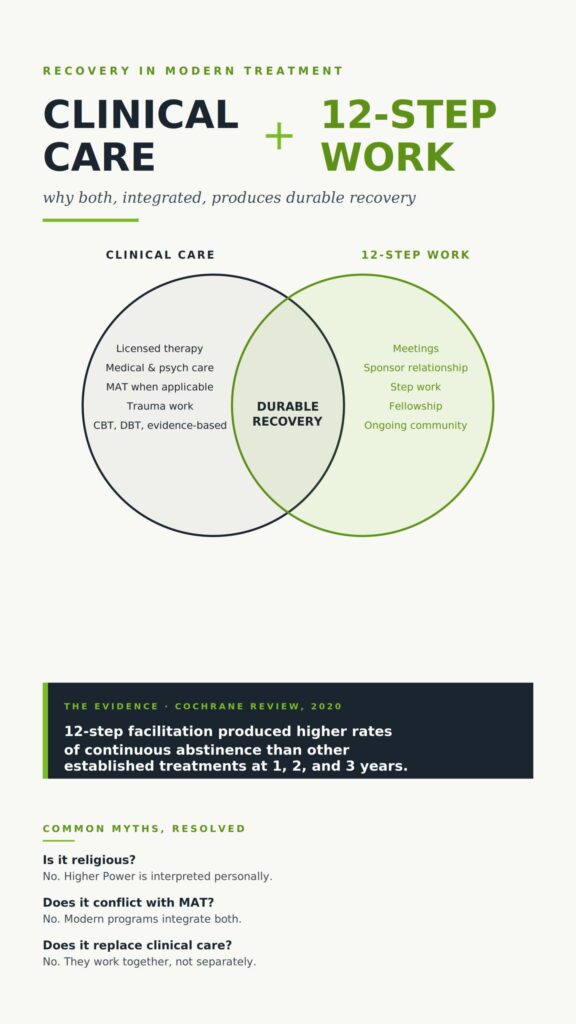
In 2020, the Cochrane Collaboration published a systematic review of Alcoholics Anonymous and 12-step facilitation programs. Cochrane reviews are considered among the most rigorous evidence syntheses in medicine. The finding: AA and 12-step facilitation produced higher rates of continuous abstinence than other established treatments at the one-year, two-year, and three-year marks for people with alcohol use disorder. It was the first systematic review to give 12-step recovery this level of credentialed empirical support.
The National Institute on Drug Abuse recognizes 12-step facilitation as an evidence-based clinical approach alongside CBT, motivational interviewing, and contingency management. It’s not folk medicine. It’s a tested intervention with a substantial outcome literature.
What 12-step recovery is especially good at is producing the long-term, durable, community-supported recovery that’s hardest to achieve through clinical treatment alone. The meetings don’t end at discharge. The sponsor relationship doesn’t end at discharge. The fellowship doesn’t end at discharge. This is part of why the model has survived for nearly a century.
The spiritual question
The biggest source of confusion about 12-step work is the “spiritual” language. Steps 2, 3, 5, 6, 7, and 11 reference a “higher power” or “God as we understood him.” For some people, especially those coming from secular or skeptical backgrounds, this is a stopping point.
A few things worth knowing:
- AA’s own foundational text is explicit that the higher power can be conceived in whatever way works for the individual: the group itself, the natural world, the principles of the program, or a traditional religious conception. The framework is intentionally non-doctrinal.
- A substantial portion of long-term 12-step members, particularly in urban and coastal areas, identify as agnostic, atheist, or non-religious and have found ways to work the steps that don’t require any specific theological commitment.
- The “spiritual awakening” the steps describe is generally interpreted as a fundamental shift in self-understanding, values, and relationships, not necessarily a religious conversion.
That said, some Texas programs are explicitly Christian and integrate Christian theology directly into their version of 12-step work. Others are deliberately ecumenical. Knowing which type of program you’re considering matters.
12-step recovery vs. Christian rehab vs. spiritual programs
These terms get used interchangeably in marketing but mean different things:
12-step programs follow the AA/NA framework, which is non-denominational and accommodating of varied spiritual or non-religious frameworks.
Christian rehab programs integrate Christian theology, Bible study, prayer, and pastoral care as core treatment components. Some use the 12 steps; many use distinct frameworks like Celebrate Recovery (which is explicitly Christian and uses a Christ-centered adaptation of the steps).
Spiritual recovery programs for men is a broader category that can include 12-step, Christian, Eastern (mindfulness-based), or eclectic approaches that prioritize meaning-making, contemplative practice, and identity reconstruction as part of recovery.
The right fit depends on the person. Someone with a strong existing Christian faith may do best in an explicitly Christian program. Someone with a complicated history with organized religion may do better in a non-denominational 12-step framework. Someone for whom the spiritual language is a barrier may do better with SMART Recovery or a clinically-driven program with 12-step participation as one option among several.
How 12-step recovery fits into a clinical treatment program
A good residential treatment program in Texas typically integrates 12-step participation as one component among several. The clinical work happens in licensed therapy sessions. The medical work happens with the medical and psychiatric staff. The 12-step work happens in meetings, in step work with a sponsor, and in the recovery community.
The integration matters because each piece does something the others can’t. Clinical therapy addresses trauma, co-occurring mental health conditions, and the psychological underpinnings of the addiction. Medical care manages withdrawal, MAT where appropriate, and co-occurring physical conditions. 12-step work provides the community, the framework for ongoing recovery, and the practical structure (sponsor, meetings, step work) that continues after discharge.
A program that’s purely 12-step with no licensed clinical work isn’t a clinical treatment program. A program that’s purely clinical with no recovery community connection isn’t preparing people for the long-term work. The integration is the point.
You can see how this looks in practice at Ranch House Recovery’s 12-step program in Texas, which combines daily 12-step work with licensed clinical care, family work, and the experiential modalities of ranch-based recovery.
The MAT question
One common misconception is that 12-step recovery is incompatible with medication-assisted treatment (MAT) for opioid use disorder. This was true of some traditional AA culture decades ago and is still occasionally true of individual meetings or sponsors. It is not true of mainstream 12-step recovery in 2026.
NA’s official literature explicitly does not take a position on MAT, and most contemporary clinicians integrating 12-step recovery with treatment for opioid use disorder do so with no clinical or philosophical conflict. The combination of buprenorphine maintenance and active 12-step participation produces outcomes that are very hard to beat for severe opioid use disorder. If a treatment program tells you that you have to choose between MAT and 12-step recovery, that’s a program operating on outdated dogma rather than current evidence.
What a 12-step-informed residential day looks like
A residential treatment program with integrated 12-step work typically has:
- Morning structure that often includes a meditation or reading from recovery literature.
- Individual or group therapy with licensed clinicians during the clinical day.
- A daily 12-step meeting (in-house, off-site, or both).
- Step work done with a sponsor or in groups, depending on phase of treatment.
- Service activities in the community.
- Family work that often parallels the family’s own engagement with Al-Anon or similar fellowships.
You can see how this translates into a specific weekly schedule on our programming page, which lays out a typical week including clinical, experiential, and 12-step components.
How to find 12-step recovery in Texas
A few starting points:
- AA Texas and NA Texas regional directories maintain meeting lists statewide, accessible through the meeting locator on the main Alcoholics Anonymous website referenced earlier.
- The federal FindTreatment.gov treatment locator includes filters for treatment philosophy and is a non-commercial alternative to lead-generation sites.
- Most Texas residential treatment programs that incorporate 12-step recovery will say so explicitly on their website and will be transparent about how they balance clinical work and 12-step participation.
Where Ranch House Recovery fits
Ranch House Recovery is a long-term residential addiction treatment program for men in the Austin area. The 12 steps are foundational to the model, integrated with licensed clinical care, therapeutic farming, animal-assisted recovery work, and the daily structure of a working ranch. The program is non-denominational and works with men from a wide range of spiritual and religious backgrounds, including men with no prior religious framework.
For the thinking behind why we built the program this way, our philosophy page is the most honest two-minute read on the site. To see what a day-by-day residential stay looks like, the residential program page walks through the structure.
The bottom line
The 12 steps work for an enormous number of people. They don’t work for everyone, and they don’t replace clinical care. But for the right person, in an integrated treatment program, the combination of licensed clinical work and active 12-step participation produces durable recovery at rates that are very hard to match through clinical work alone.
If you’re considering whether a 12-step-integrated residential program is the right fit for you or your loved one, the conversation starts with a phone call. Reach our admissions team here when you’re ready. If we’re not the right fit, we’ll say so and try to point you to a program that is.d try to point you to a program that is.