Living the 12 Steps on a Ranch: How Ranch House Brings the Steps to Life

At Ranch House, the Steps aren’t discussed. They’ve lived.
A lot of men come to us having heard of the Twelve Steps. Some have sat through meetings. Some have worked the Steps with a sponsor. Some have the whole thing memorized.
And still, they relapsed.
Because knowing the Steps and living the Steps are two entirely different things. That gap between what a man understands in his head and what he actually does when the day gets hard is often where recovery breaks down.
At Ranch House, we closed that gap by design.
Why the Steps Get Reduced to Theory
The Twelve Steps were never intended as an intellectual exercise. They were created by desperate men who had tried everything else and found that working through a specific set of practices produced an inner transformation nothing else had. The original understanding was simple: the Steps have to be worked, not just understood.
But in many modern treatment settings, the Steps become content. Something to learn about, discuss, and check off. This happens because of time pressure, because clinical frameworks tend to favor cognitive understanding over experiential change, and because most treatment environments don’t have the physical space or community depth to let the Steps become a lived reality.
Ranch House was built, in part, to solve that problem.
Step One: Live Every Morning
Step One admitting powerlessness over addiction isn’t a one-time declaration here. It’s the orientation every morning.
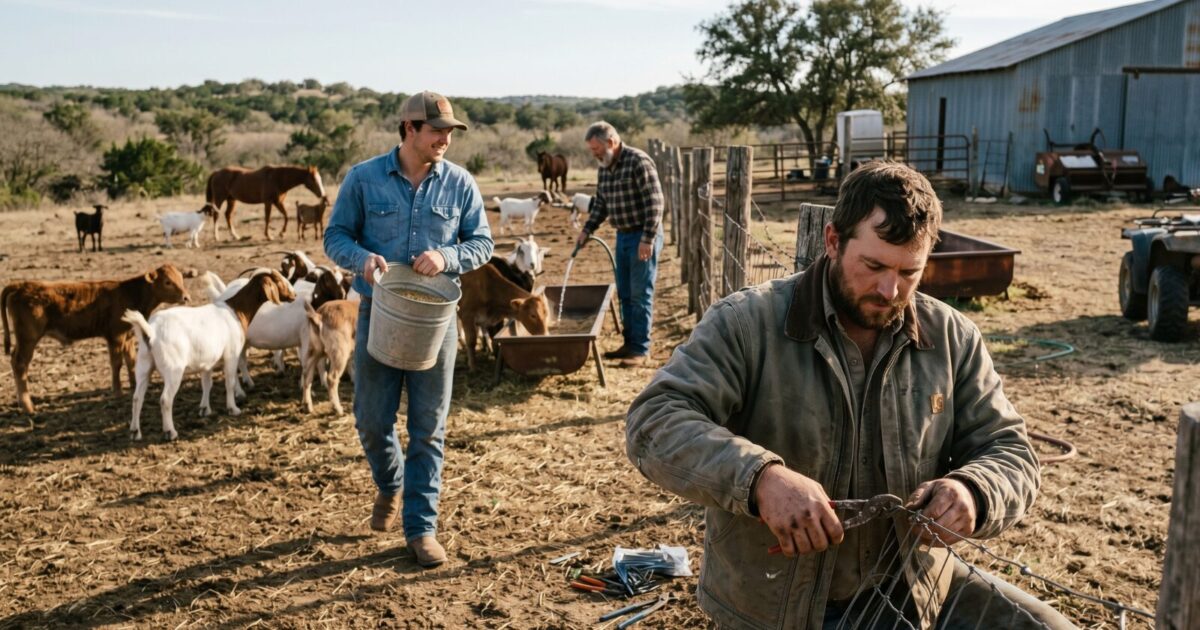
Our men wake up on the ranch in early recovery. Often uncomfortable. Often facing cravings or difficult emotions. And they show up anyway. The farm requires it. The animals need to be fed regardless of how anyone is feeling.
That daily experience is not just discipline. It’s a lived practice of Step One: the old way of managing life through control and willpower is gone. In its place, a different set of principles takes hold.
Steps Two and Three: Surrender as Daily Practice
These Steps ask a man to come to believe in a power greater than himself, and to turn his will and his life over to that power. In most program settings, these get journaled about and moved past.
At Ranch House, they’re practiced in the rhythm of the farm and the community. A man who wakes up, cares for animals that depend on him, and participates in a community where his actions affect everyone around him is practicing Steps Two and Three in his body. Not just his mind.
The ranch teaches surrender not as passivity, but as the active choice to participate in something larger than oneself.
Steps Four and Five: Honesty With Roots
The Fourth and Fifth Steps, taking a searching and fearless moral inventory and sharing it with another person, require a quality of honesty most men in early recovery haven’t practiced consistently in years.
The community at Ranch House creates the conditions that make this possible. When a man has been living alongside the same group of brothers for weeks or months, eating together, working together, navigating conflict together, the relationships that form are deep enough to hold the truth.
Men who would never share their Fourth Step with a stranger find they can share it with a peer mentor who has been walking beside them through daily life.
Steps Six and Seven: Becoming Willing
Step Six asks a man to become entirely ready to have his defects of character removed. Step Seven asks him to humbly request that removal.
These are the Steps that most programs rush past. They’re not dramatic. They don’t involve action in the obvious sense. But they are where the inner shift actually happens, and they require something that early recovery rarely allows: stillness.
Life on the ranch creates the conditions for that stillness. There is time here, in the rhythm of farm work and morning practice, to sit with the question of who you’ve been and whether you’re willing to be different. Not just to understand it intellectually. To feel it. To mean it.
We’ve watched men reach Step Six having never actually asked themselves whether they wanted to let their character defects go. Some of those defects, the control, the pride, the isolation, kept them safe for years. Releasing them takes more than a moment of insight. It takes the willingness that only grows through repeated honest practice.
At Ranch House, that practice is available. Every day.
Steps Eight and Nine: Amends as a Way of Living
At Ranch House, these aren’t items on a checklist. They’re part of the continuous fabric of community life. Men who live together inevitably cause small harms: a thoughtless word, a broken agreement, a failure of consideration. Our culture treats these daily occasions as practice for the larger amends work. Real-time, with real people, in a real community.
Our Service Work Saturday program carries this spirit outward. Men doing direct service for Elgin neighbors and local nonprofits is a living expression of making amends, rebuilding their relationship with the world around them.
Steps Ten and Eleven: The Daily Maintenance
Step Ten, continuing to take personal inventory and admitting when wrong, is the Step that keeps recovery from being a one-time event. It’s the practice of staying current: with yourself, with the people around you, with what is actually true today.
At Ranch House, Step Ten happens in real time. When a man snaps at a housemate, he doesn’t carry it. He addresses it. When he notices resentment building or dishonesty creeping in, he names it in a meeting with a mentor, in the daily reflection that ends each evening. The inventory isn’t a quarterly exercise. It’s a daily posture.
Step Eleven, seeking through prayer and meditation to improve conscious contact with a higher power, is where our spiritual practices come into full view. Yoga, breathwork, sound baths, the Wim Hof method, sweat lodge ceremonies, morning meditation: these are not extras layered on top of the program. They are Step Eleven made physical.
Many men arrive at Ranch House sceptical of anything that sounds like meditation or prayer. By week three, most of them are the ones who show up first. Because something happens when you practice these things consistently inside a community that takes them seriously. The noise quiets. The direction becomes clearer. The sense that there is something worth staying sober for, something larger and more real than the next craving, begins to feel true.
That’s Step Eleven. Not as a concept. As an experience.
Step Twelve: The Whole Point
Carrying the message to others and practicing these principles in all our affairs: this is what the entire Ranch House model is built around.
Our peer mentorship program is a direct expression of Step Twelve. Men further along in recovery walk alongside men just beginning. They share their experience, strength, and hope. Not as a professional authority. As brothers who have been there.
Many of our staff members are themselves in recovery. They don’t stand apart from residents. They participate in the work, the service, the spiritual practices, and the community.
That’s what Step Twelve looks like when it becomes a way of life.
“We’re not teaching the Steps here. We’re living them. Every day, in everything.”
— Brandon Guinn, Founder of Ranch House Recovery
The Daily Schedule as a Twelve-Step Life
Morning animal care. Group activities. Therapy sessions. Farm work. Evening meetings. Communal meals. Saturday service. This schedule isn’t designed to keep men busy. It’s designed to make Twelve Step living a daily reality rather than a weekly meeting.
Every aspect of the day is an opportunity to practice the principles. Honesty in conversation. Humility in work. Service in the community. Surrender in the face of difficulty. Gratitude for the smallest things.
The Steps are not seven sessions in a workbook. They are the texture of a life lived differently.
“I’d ‘worked’ the Steps twice before. This was the first time I actually lived them.”
— Ranch House Graduate
Ready to experience the Steps in a new way? Call (512) 525-8175 or contact us.