
RHR Blog
Addiction and Depression in Men: Why They Happen Together and How Treatment Addresses Both

Common questions
Why do addiction and depression occur together in men?
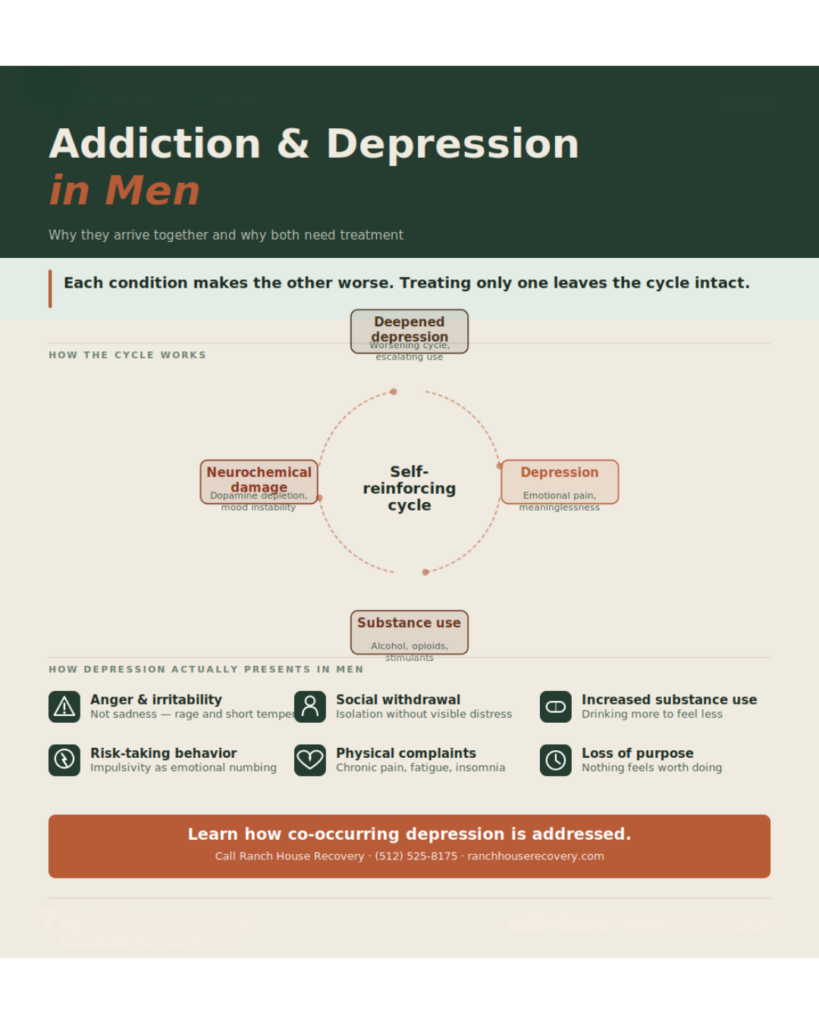
Depression and addiction reinforce each other through shared neurobiological pathways. Alcohol and other substances temporarily suppress emotional pain, reinforcing use, while simultaneously worsening depression over time through neurochemical changes. Depression increases the drive to self-medicate; substance use deepens depressive states. Without integrated treatment addressing both, the cycle is self-perpetuating.
How does depression present differently in men?
Male depression frequently does not match the cultural template of visible sadness. In men, depression commonly presents as anger and irritability, risk-taking behavior, increased substance use, social withdrawal without expressed distress, chronic physical complaints including pain and fatigue, and loss of interest in things that previously mattered.
Can you treat addiction without treating depression?
Treating addiction without addressing co-occurring depression leaves the primary emotional driver of use intact, creating a gap that is difficult to sustain in recovery. Research consistently shows integrated treatment, addressing both conditions simultaneously, produces significantly better long-term outcomes than sequential models.
Does Ranch House Recovery treat co-occurring depression?
Yes. Every Ranch House Recovery resident undergoes comprehensive mental health screening at admission. The treatment team includes licensed therapists and access to psychiatrists for medication management when clinically appropriate. The Regenerative Recovery model's structure, purpose, animal care, and community connection actively counter depressive symptoms throughout the residential stay.
Depression and addiction are the two most common co-occurring conditions in adult men seeking residential treatment. They often arrive together because they feed each other: depression increases the likelihood of substance use as self-medication, and chronic substance use produces and deepens depressive states.
When both are present, treating only one rarely works. This page explains why, how depression presents differently in men, and what treatment looks like when both conditions need to be addressed simultaneously.
How Depression and Addiction Reinforce Each Other
Substances like alcohol, opioids, and stimulants interact directly with the brain’s reward and mood regulation systems. Alcohol is a central nervous system depressant that may temporarily blunt emotional pain but increases depression over the medium term. The initial relief reinforces use. The subsequent worsening of depression increases the drive to drink. This cycle is self-perpetuating.
Opioids create intense but short-lived relief followed by a neurochemical rebound. Stimulants produce euphoria followed by crashes that can deepen depressive states. Over months and years of heavy use, the brain’s ability to generate positive emotion without substances becomes significantly impaired.
How Depression Presents Differently in Men
Depression in men does not always look like sadness. In men, depression frequently manifests as:
- Anger, irritability, and short temper
- Risk-taking behavior
- Increased substance use
- Social withdrawal without visible distress
- Physical complaints including chronic pain, fatigue, and sleep disruption
- Loss of interest in things that previously mattered
Because these presentations don’t match the cultural template of depression, they are often not recognized as depression by the man himself, his family, or even some clinicians. A man who is angry and drinking heavily may be depressed, and the anger is the depression.
Why Treating Only the Addiction Is Insufficient
If a man has been using alcohol to manage depression for five years, treating the alcohol use without addressing the depression creates a recovery gap that is difficult to sustain. The emotional pain that drove the drinking does not disappear at discharge.
Research on co-occurring disorders consistently shows that integrated treatment, addressing both the addiction and the co-occurring mental health condition simultaneously, produces better outcomes than sequential treatment. Sequential models, treating one then the other, leave a treatment gap that frequently results in relapse.
Ranch House Recovery’s clinical model includes individualized therapy with access to licensed therapists and psychiatrists. See our programming page for details.
Screening and Assessment at Admission
Every Ranch House Recovery resident undergoes a comprehensive intake assessment that includes mental health screening. Identifying depression, anxiety, trauma history, and other co-occurring conditions at the outset allows the treatment team to build a plan that addresses the full picture rather than the presenting substance use alone.
Self-report screening tools, clinical interviews, and psychiatric consultation when indicated are all part of the assessment process. The goal is to arrive at an accurate clinical picture as early as possible.
What Treatment Looks Like at Ranch House Recovery
The Regenerative Recovery model addresses the physical, emotional, and spiritual dimensions of recovery simultaneously. Daily structure, purposeful work on the farm, animal-assisted therapy, mentorship, and community connection create conditions where depressive symptoms are actively countered by engagement, purpose, and belonging.
Learn more about our animal-assisted therapy program.
Medication management, when clinically appropriate, is available through Ranch House’s clinical network. The decision to use medication is made collaboratively between the resident and their treatment team. Antidepressant medications, when indicated, are started with enough lead time to reach therapeutic effect before discharge.
What Recovery From Depression Looks Like Over Time
Men who complete residential treatment for co-occurring depression and addiction frequently describe the experience of depression beginning to lift as one of the most unexpected and motivating aspects of recovery. The return of the capacity to feel pleasure, connection, and engagement, which had been suppressed by both depression and substance use, is itself a powerful reason to maintain sobriety.
Aftercare planning for co-occurring depression includes ongoing therapy, medication management when applicable, 12-step engagement, and a structured daily routine that supports mood stability.
Call to learn more about how co-occurring depression is addressed within our residential program.
Call Ranch House Recovery at (512) 525-8175.

About the Author
Brandon Guinn
Founder & CEO, Ranch House Recovery
Brandon Guinn founded Ranch House Recovery, a community-centered program for men recovering from addiction on a working ranch in Elgin, Texas. As a father whose family was touched by addiction, he built the program around daily structure, honest work, and lasting community.
Read Brandon’s full bio