
RHR Blog
Long-Term Drug Rehab in Austin: Why 30 Days Isn’t Enough for Most Addictions
The 28-day rehab model is one of the most consequential accidents in the history of American healthcare. It started in the 1950s with a few state hospitals that organized their alcoholism treatment around a four-week schedule, and it became the industry standard when insurance companies later codified it as a benefit cap. The number was never based on clinical research. It was based on what was administratively convenient.
Sixty years later, most of the rehab industry still defaults to 28 or 30 days. The research, meanwhile, has been telling a different story for decades.
This guide walks through what the evidence actually says about length of stay, why long-term drug rehab in Austin and elsewhere produces meaningfully better outcomes than short-term programs, and what extended residential treatment actually involves day-to-day. If you or someone you love is researching this decision right now, it’s the most important variable to get right.
If you’re in immediate crisis, call SAMHSA’s National Helpline at 1-800-662-HELP (4357). It’s free, confidential, and available 24/7.
What the research actually says
The National Institute on Drug Abuse’s Principles of Drug Addiction Treatment puts it directly: “Generally, for residential or outpatient treatment, participation for less than 90 days is of limited effectiveness, and treatment lasting significantly longer is recommended for maintaining positive outcomes.”
That single sentence carries decades of outcome research behind it. Studies on treatment length have shown a roughly linear relationship between time in care and one-year sobriety outcomes, with the gains continuing to compound through and beyond the 90-day mark. The National Library of Medicine archive at NCBI hosts the foundational Treatment Improvement Protocols underlying this work, including the consistent finding that early dropout is one of the strongest predictors of poor outcome.
The reasons for the length-of-stay effect are neurobiological as much as behavioral. The brain changes addiction produces (particularly in the prefrontal cortex, the reward system, and stress-response circuitry) don’t reverse on the 30-day insurance timeline. They reverse over months. Time isn’t a luxury in this equation. Time is the active ingredient.
What “long-term rehab” actually means
The terminology is loose, so it’s worth being specific:
30-day residential is what most people mean when they say “rehab.” It’s the industry default, driven by insurance benefit structures more than clinical need.
60-day residential adds another month to the same model. For some people this is sufficient. For others it’s a partial answer.
90-day residential lines up with what NIDA’s research identifies as the effective floor. Sobriety outcomes at the one-year mark improve substantially compared to 30-day programs.
Long-term residential (90+ days) runs from three months to a year, sometimes longer. Some programs offer a continuous extended stay; others use a phased model that combines residential, transitional, and sober-living components. This is the level of care that addiction research has consistently shown to produce the best outcomes for chronic, severe substance use disorders, particularly involving fentanyl, methamphetamine, or polysubstance use.
Extended-care or therapeutic-community models can run six months to two years and incorporate work, education, and structured community living as core treatment components.
The right length isn’t the longest available. It’s what matches the severity of the addiction, the strength of the support system the person is returning to, and the work they actually need to do.
Why short-term rehab fails for most fentanyl and polysubstance addictions
The drug supply has changed. According to the CDC, illicitly manufactured fentanyl is now the leading driver of overdose deaths in the United States, and it’s increasingly mixed with stimulants like methamphetamine and cocaine in patterns that didn’t exist a decade ago.
Treatment protocols built for 1990s heroin addiction or 1980s cocaine addiction don’t map cleanly onto a 2026 fentanyl-meth polysubstance addiction. The withdrawal is longer and more dangerous. The post-acute withdrawal syndrome (PAWS) that follows initial detox can last weeks to months, characterized by mood instability, anhedonia, sleep disruption, and craving spikes. A 30-day residential stay can carry someone through detox and into early stabilization. It rarely carries them through the full PAWS window, let alone into stable recovery.
This is the core mismatch: insurance models are paying for 30 days of treatment while the underlying biology requires 90 to 180 days of stable, supported recovery to durably reset.
What a day looks like in long-term residential treatment
Marketing copy across the industry describes residential days in similar terms: “individualized care,” “evidence-based therapy,” “holistic programming.” What the actual day looks like varies enormously between programs.
A long-term residential day at a serious clinical program tends to include:
- Morning structure. Wake time, breakfast, and a meditation or 12-step reading is common. Some programs build in physical work, animal care, or other experiential activity from the start of the day.
- Individual or group therapy with a licensed clinician (LCSW, LPC, LCDC, LMFT, or psychologist).
- Process groups focused on the specific work of that phase of treatment, whether early-recovery stabilization, trauma work, family-of-origin issues, or relapse prevention planning.
- Skills-based groups on emotion regulation, communication, recovery planning, and life skills.
- Experiential modalities that vary by program: equine therapy, therapeutic farming, art therapy, adventure-based interventions, mindfulness practice, and others.
- 12-step or alternative recovery meetings (SMART Recovery, Refuge Recovery, faith-based options) most days.
- Recreation and physical activity, which has its own substantial evidence base for early recovery.
- Evening reflection, journaling, and community time.
You can see how this translates into a specific residential schedule on Ranch House Recovery’s programming page, which lays out a typical week in detail.
What changes between week 4 and week 12
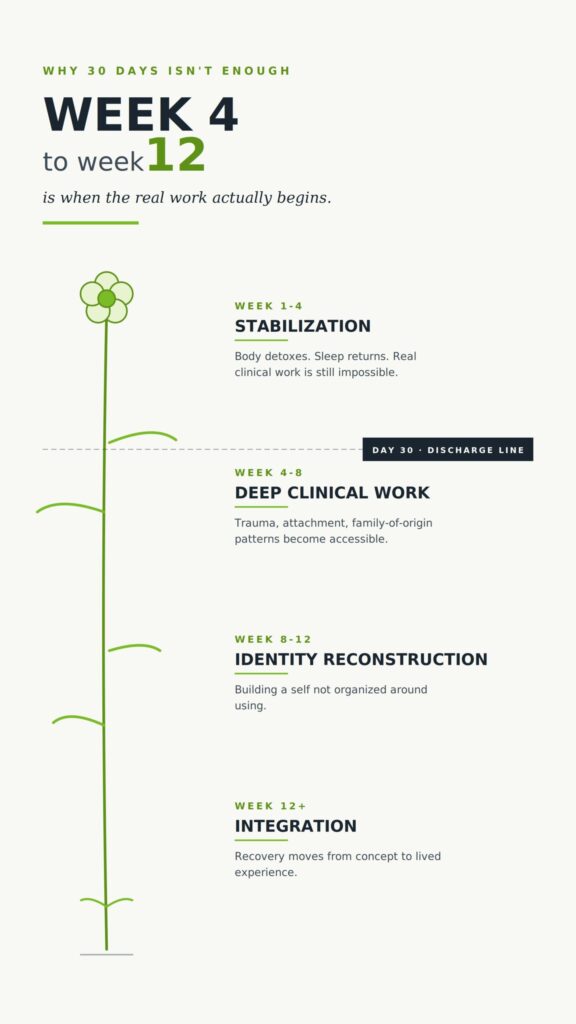
The biggest argument for long-term residential is what actually happens to the work between week 4 and week 12 of a stay. The first month of residential treatment is largely about stabilization: getting the body off the substance, learning the recovery basics, building enough emotional regulation to function. The deeper clinical work (trauma processing, attachment patterns, family-of-origin issues, identity reconstruction) often can’t even begin until the person is past the initial stabilization phase.
Programs that discharge at 30 days are discharging people right at the point where the real work becomes possible. Long-term residential keeps them in the structure during the months where the most durable change happens.
This is why our long-term residential program in Austin is built around extended length of stay as a default rather than an exception. The structure assumes that lasting recovery requires more than an insurance benefit period.
How insurance works for longer stays
The honest answer: insurance coverage for long-term residential is harder to get than 30-day coverage. Most commercial plans will authorize an initial 14 to 28 days of residential care, then require ongoing utilization review for continued days. Skilled programs document medical necessity in ways that get more days authorized. Some programs use a combination of insurance for the initial stay and cash-pay or sliding-scale options for extended care.
A few things worth knowing:
- The federal Mental Health Parity and Addiction Equity Act requires most commercial insurance to cover substance use care at parity with medical care. Denials of medically necessary residential extensions are often appealable.
- Verification of benefits should be free and pre-admission. Real programs do this in writing.
- Some programs offer in-house financing or sliding-scale arrangements for extended stays.
- Faith-based and non-profit options sometimes provide long-term care at significantly reduced cost, though typically with waitlists.
The federal FindTreatment.gov tool can help identify programs that accept various payment types.
Who is long-term rehab right for
Long-term residential isn’t always the right answer. It tends to be the right answer when:
- The person has a moderate-to-severe substance use disorder, particularly involving fentanyl, methamphetamine, or polysubstance use.
- They have prior failed treatment attempts at shorter levels of care.
- They have significant co-occurring mental health conditions that need stabilization alongside addiction treatment.
- The home environment is high-risk for relapse (using partners, using social circles, easy access to substances).
- They need to physically separate from a specific context (a job, a city, a relationship) that is part of the addiction system.
It tends to be less necessary when the addiction is at an earlier stage, the person has strong external supports, the home environment is stable and recovery-supportive, and outpatient or shorter-term options can plausibly hold.
A skilled admissions team or clinician can help sort which category a specific person falls into. That call should be a fit conversation, not a sales conversation.
What recovery looks like after a long-term stay
Long-term residential isn’t a destination. It’s the foundation. People completing extended residential treatment typically step down through some combination of sober living, intensive outpatient (IOP), peer support groups, individual therapy, and family work. The 12 to 24 months after residential discharge are when the recovery becomes durable.
Programs that treat long-term residential as the “end” of treatment are programs that misunderstand the chronic, relapsing nature of addiction. Programs that build aftercare into the stay from intake forward are programs that understand what they’re treating.
Where Ranch House Recovery fits
Ranch House Recovery is a long-term residential addiction treatment program for men, located on a working ranch outside Austin. The model is intentionally extended-stay: long enough for the brain to actually start healing, long enough for the deeper clinical work to begin, and structured around physical labor, time in nature, animal-assisted recovery work, the 12 steps, and licensed clinical care.
If you want to see how the model translates into a daily program, the residential program page walks through what life on the ranch looks like. For the thinking behind why we built the program this way, our philosophy page is the most honest two-minute read on the site.
The bottom line
Thirty days isn’t a clinical recommendation. It’s an insurance default. The research has been clear for decades that meaningful recovery from a serious addiction takes longer than that. Long-term residential rehab in Austin (or anywhere) is the model that lines up with what addiction actually is and how brains actually heal.
If short-term programs have already been tried and didn’t hold, that isn’t a personal failure. It’s often a sign that the treatment length never matched the severity of the problem.
When you’re ready to have a real conversation about whether long-term residential is the right next step, you can reach our admissions team. If we’re not the right fit, we’ll say so and try to point you to a program that is.hab in Texas
Texas has good programs and bad programs and a lot of programs in the middle. The state’s size means you have real choice, which is a good thing if you use the choice well. The framework above (level of care, length of stay, setting, gender, clinical model, insurance, aftercare) is how a clinician would compare options. Use it.
And remember: the goal isn’t to find the program with the prettiest website or the most amenities. The goal is to find the program that gives a specific person, with a specific history, the best chance at lasting recovery. That fit conversation, done honestly, is the difference between 30 wasted days and a real recovery.
When you’re ready to have that conversation about Ranch House Recovery, you can reach our admissions team here. If we’re not the right fit, we’ll say so and try to point you to a program that is.