
Men's recovery · Texas · Substances
7-OH Addiction in Texas: What Families Should Know
Published October 30, 2026 · Updated November 2, 2026 · With insight from Cristy De La Rosa and Jonathon Stewart, Director of Admissions and Business Development · How we write and review content

A Texas mother went public this month about her nineteen-year-old son, whose death was attributed to 7-OH and kratom toxicity. Her story has put a name in front of many families for the first time. This guide explains what 7-OH is, what the law currently says, and what to do if someone you love is using it.
What is 7-OH?
7-OH (7-hydroxymitragynine) is an opioid-acting compound found in trace amounts in the kratom leaf. The products sold in Texas smoke shops and gas stations are concentrated or lab-made, often as gummies, shots or tablets. 7-OH acts on the same brain receptors as morphine, so regular use can lead to tolerance, dependence and opioid-type withdrawal.
The U.S. Food and Drug Administration has described 7-OH as an opioid that can be more potent than morphine, and the National Institute on Drug Abuse notes that it activates mu-opioid receptors and can slow breathing in laboratory studies. That is the part families most need to hear: whatever the packaging says, this is an opioid problem, and it is handled like one.
Why 7-OH is in the Texas news this month
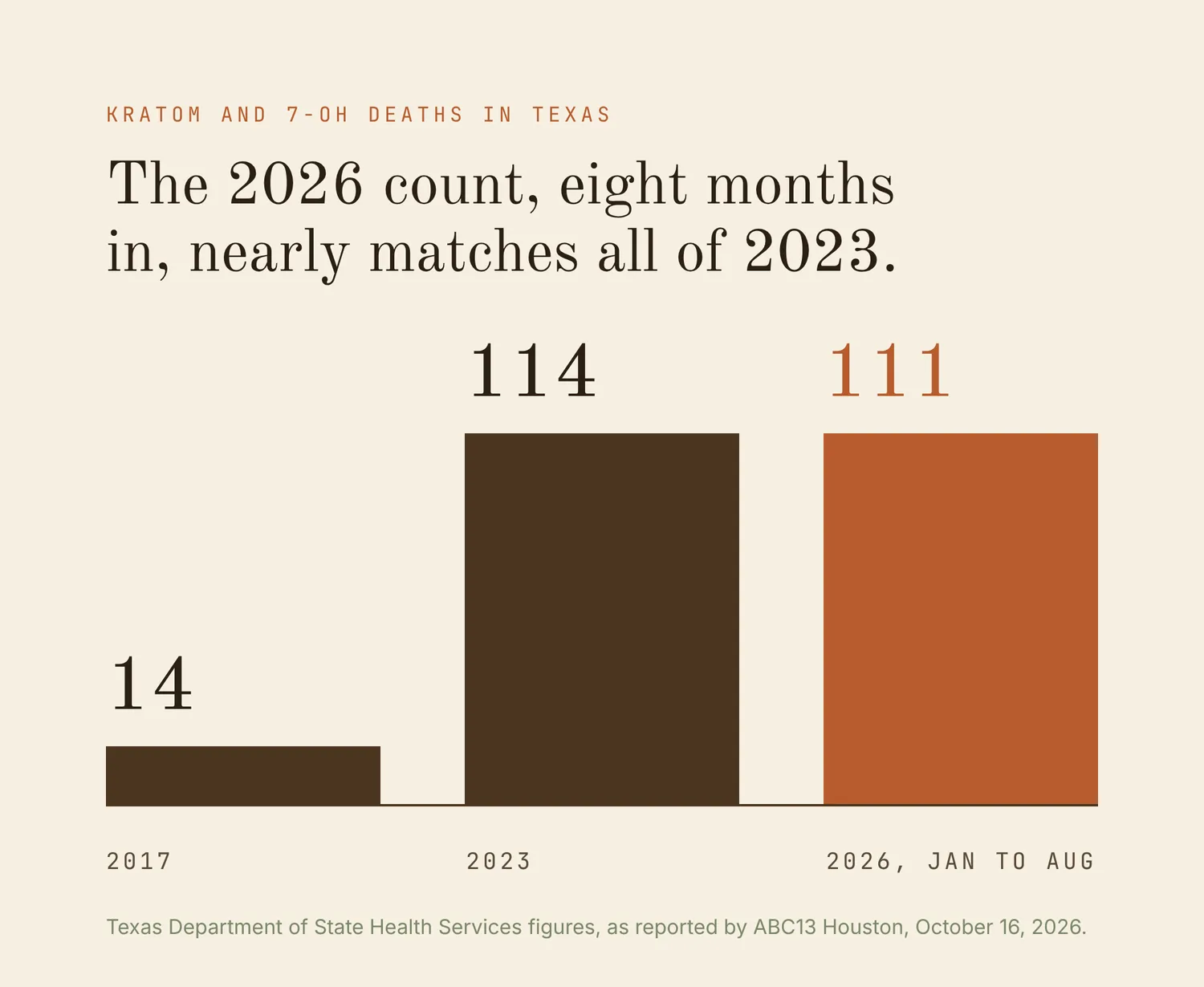
On October 16, ABC13 Houston reported that Rae Heath, whose son Jonas died in April, is working with lawmakers on a bill she calls Jonas's Law. As described, it would treat kratom extracts and synthetic 7-OH as Schedule I controlled substances, add felony penalties for unauthorized sellers and require overdose reporting. Bill filing for the next Texas session opens in November. The same report cited state health figures showing 111 kratom and 7-OH deaths in Texas from January through August 2026, against 114 in all of 2023 and 14 in 2017.
Texas already limits 7-OH to 2 percent of a kratom product's alkaloids under the Texas Kratom Consumer Health and Safety Protection Act, and the Attorney General has sued online sellers whose products tested at 86 to 96 percent 7-OH. Federally, the Drug Enforcement Administration published notice in July of its intent to temporarily place 7-OH above a set threshold in Schedule I. Three related lab-made compounds were placed in Schedule I on August 26, but as of the Congressional Research Service's October 6 update, the 7-OH order itself had not been finalized.
The law is moving. A man's body does not wait for it. Whether a product is legal on the day he buys it says nothing about the dependence he may already have.
Kratom leaf and 7-OH products are not the same thing
Families often hear “it's just kratom” and relax. The distinction matters. Kratom leaf contains a small natural amount of 7-OH. The products drawing attention now are built around 7-OH itself, concentrated or synthesized, and the DEA found servings ranging from 1 to 700 milligrams, which means a person cannot know what he is taking from one package to the next.
If kratom leaf is the bigger part of the picture, our library guide to kratom dependence covers it in depth. When kratom has been mixed with other store-bought opioids, read why kratom and tianeptine together are riskier and what “gas station heroin” usually means.
Signs a family may notice
The pattern
It often starts with a reasonable-sounding purpose: sleep, a sore back, energy for a long shift, or getting off something else. Over weeks the purpose fades and the schedule takes over. He needs more for the same effect, uses sooner than he planned, keeps a supply in the truck, and gets irritable or restless when he runs out.
The products
Look for small foil packs, brightly colored gummies, small shot bottles or tablets labeled 7-OH, 7-hydroxy or a brand name, and receipts from smoke shops or online sellers. Texas health officials have warned that some of these look like candy, which is also a risk to younger children in the house.
When he tries to stop
Withdrawal can look like other opioid withdrawal: aches, sweating, stomach trouble, anxiety, poor sleep and strong cravings. Those symptoms are a common reason men go back to the product, which is why willpower alone is a weak plan here.
Why stopping 7-OH alone is a poor plan
Opioid withdrawal is miserable, and it also lowers tolerance. A man who stops for a few days and then returns to his old amount can overdose. Overdose signs are the ones you would expect from any opioid: slow or stopped breathing, blue lips, pinpoint pupils, and a person you cannot wake. Naloxone can reverse opioid effects, and Houston drug intelligence officers told ABC13 that a single 7-OH overdose has needed several doses.
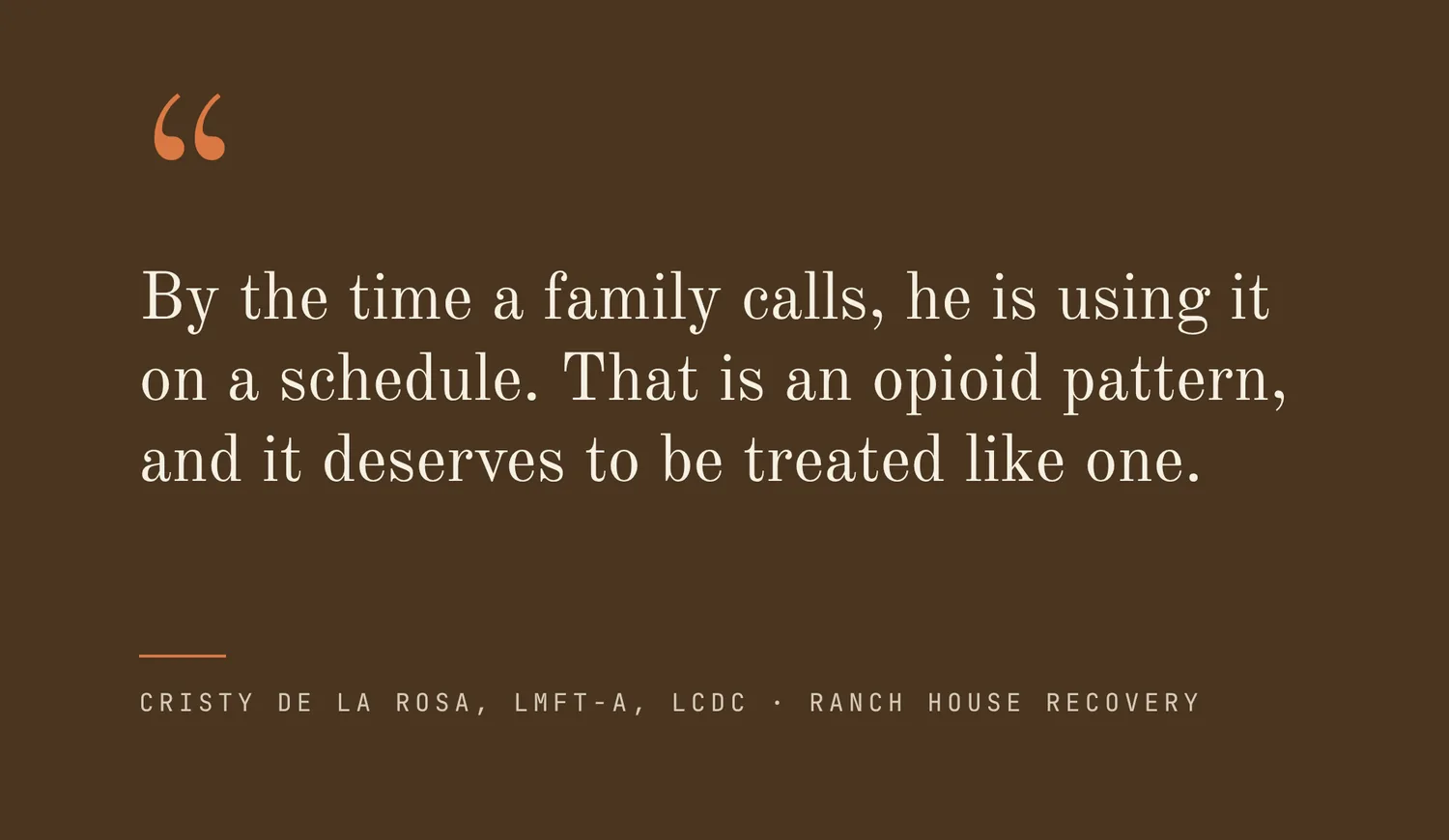
“Families tell me it started as something from the gas station that was supposed to help him sleep or get through a shift,” says Cristy De La Rosa, LMFT-A, LCDC, an advisor and therapist to Ranch House Recovery. “By the time a family calls, he is using it on a schedule. That is an opioid pattern, and it deserves to be treated like one.”
Physicians have treated dependence on kratom compounds with medications used for other opioids, including buprenorphine, and Michigan Medicine reports rising demand for that care. NIDA cautions that no medication is yet approved specifically for kratom-related problems, so the decision belongs to a physician who knows the whole picture. For the medical background, see our guide to opioid and fentanyl addiction.
The order of care: medical first, then the longer work
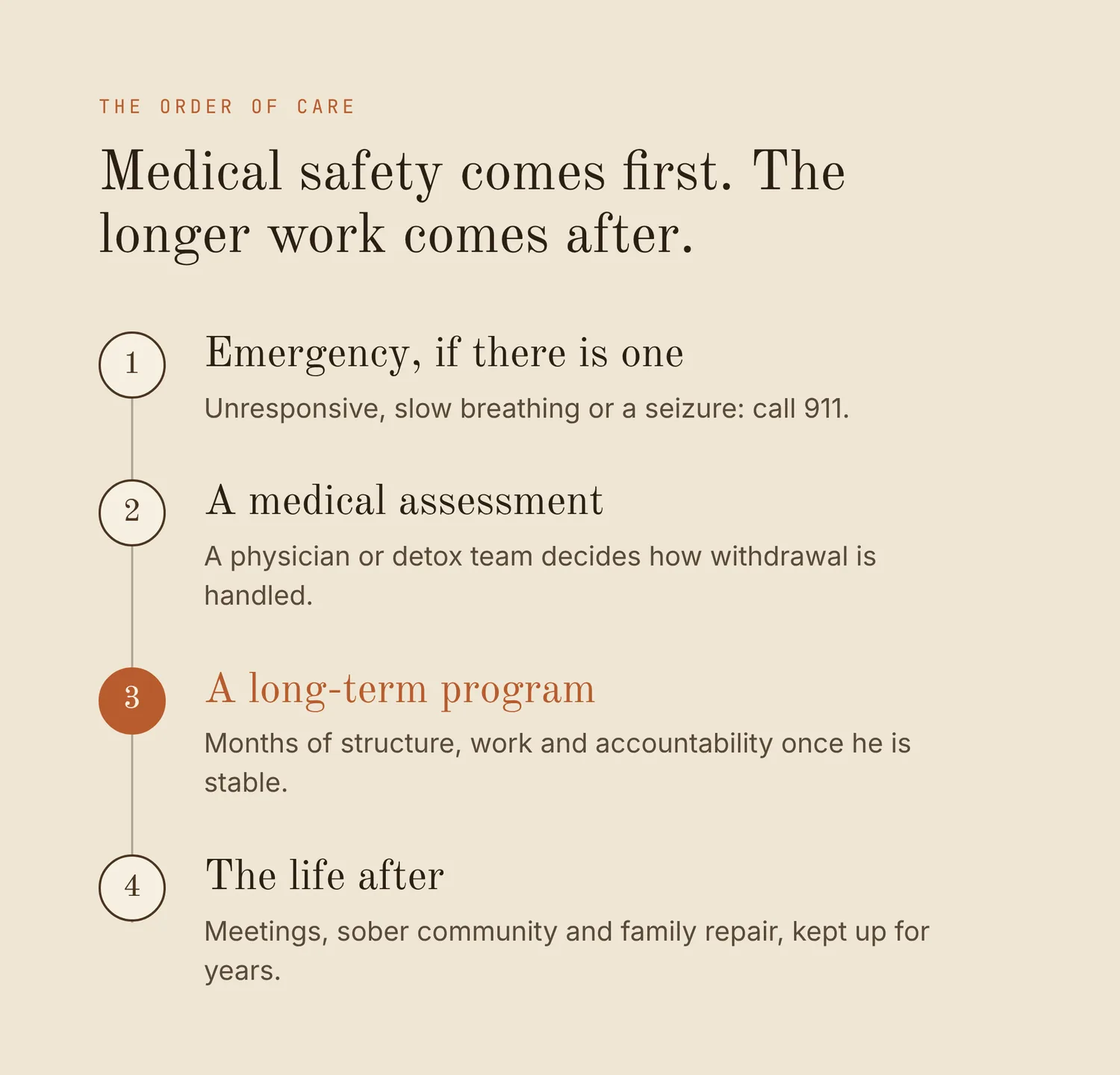
Ranch House Recovery is a long-term men's recovery program on a working ranch in Elgin, east of Austin. It is not a detox and it is not where withdrawal is managed. That order is deliberate. Our overview of detox in Austin explains the medical step, and levels of care, explained shows how the pieces fit.
“Please do not try to manage 7-OH withdrawal at the kitchen table,” De La Rosa says. “Get a medical assessment first. The long work of recovery starts after his body is stable, not instead of it.”
Once he is stable, the question changes from how to stop to why a daily habit grew around a product from a store shelf, and what has to change so he does not need it again. That is the work of a long-term program near Austin: months of structure, honest work, and accountability among other men doing the same thing.
What a family in Central Texas can do this week
- If there is an emergency, call 911. For a mental health crisis, call or text 988.
- Ask a professional, not the store. Poison Help (1-800-222-1222) and the SAMHSA National Helpline (1-800-662-4357) can point you to care.
- Book a medical assessment with his physician or a detox program before anyone tries to stop.
- Talk once, plainly, when he is sober. Our guide on supporting without enabling can help you prepare.
- Look at what comes next. The Find Care tool and our Central Texas guides map the options around Austin.
“When a family calls us about 7-OH, the first thing we ask is whether he has been medically assessed,” says Jonathon Stewart, Director of Admissions and Business Development. “If he has not, we help them think through that step first. A program like ours comes after.”
Common questions
Is 7-OH an opioid?
It acts like one. 7-OH binds to the same mu-opioid receptors as morphine, and federal health officials describe it as an opioid. Regular use can bring tolerance, dependence and opioid-type withdrawal.
Is 7-OH legal in Texas?
Texas caps 7-OH at 2 percent of a kratom product's alkaloids, and the state has sued sellers whose concentrated products tested far above that cap. A federal Schedule I order has been proposed, and Texas lawmakers are expected to see new bills when filing opens in November.
Can you stop taking 7-OH on your own?
It is not a safe plan. Withdrawal is hard to push through alone, and returning to an old amount after a break raises overdose risk. Get a medical assessment first; a physician can decide how withdrawal should be managed.
Does Ranch House Recovery treat 7-OH withdrawal?
No. Ranch House Recovery is a long-term men's recovery program, not a detox. Men come to the ranch after they are medically stable, for the longer work of rebuilding a life without the substance.
Sources
- Hatfield, M. and Rafique, S. Grieving Texas mom fights to ban drug feds call “gas station heroin”. ABC13 Houston, October 16, 2026.
- Drug Enforcement Administration. Temporary Placement of 7-Hydroxymitragynine Above a Specified Threshold in Schedule I, notice of intent. Federal Register, July 6, 2026.
- Congressional Research Service. Temporary Control of 7-Hydroxymitragynine (7-OH) and Other Kratom-Related Substances Under the Controlled Substances Act. October 6, 2026.
- U.S. Food and Drug Administration. FDA Takes Steps to Restrict 7-OH Opioid Products Threatening American Consumers. July 29, 2025.
- Texas Department of State Health Services. Public Health Officials Warn People Not to Use 7-OH Products. September 2, 2025.
- Office of the Texas Attorney General. Attorney General Paxton Sues Kratom Retailers Selling Products Containing Nearly Fifty Times Legal Limit.
- National Institute on Drug Abuse. Kratom.
- Michigan Medicine. What's the latest on 7-OH and kratom availability and addiction care? August 26, 2026.
This article is general education, not medical advice. It does not give dosing or taper guidance. If someone is in danger, call 911. For a mental health crisis, call or text 988. Clinically reviewed by Cristy De La Rosa, LMFT-A, LCDC, ADHD-CCSP on October 30, 2026. How we write and review content.