The Brotherhood Factor: Why Community Is the Most Powerful Force in Men’s Recovery

Ask a man who has genuinely recovered from addiction what made the difference, and most of the time the answer is not a therapy technique, a medication, or a particular book. It is people. A sponsor who answered the phone at midnight. A peer in recovery who said ‘me too’ at exactly the right moment. A community that expected better from him and believed he was capable of it even when he did not believe it himself.
This is not sentiment. It is science. Research on addiction recovery consistently identifies social connection and community support as among the most powerful predictors of long-term sobriety. Loneliness and isolation, conversely, are among the most reliable predictors of relapse. The community you are embedded in, the relationships that hold you, challenge you, and know your name, may matter more than any individual element of formal treatment.
At Ranch House Recovery, this understanding is not just acknowledged, it is architected into the program from the ground up.
The Opposite of Addiction Is Connection
Ranch House founder Brandon Guinn is fond of quoting an insight from addiction science that has resonated widely in recovery communities: ‘The opposite of addiction is not sobriety, it is connection.’ This idea, rooted in the work of psychologist Bruce Alexander and popularized more broadly, captures something essential about why people use substances in the first place.
Substances fill a void. For many men, that void is relational, a lack of genuine intimacy, belonging, and being known. When a man can drink or use alone in a room and feel temporarily full, it is often because he has no other reliable source of the connection that human beings are wired to need. Treatment that removes the substance without addressing the void leaves a man vulnerable. Treatment that helps him build a real connection gives him something to be sober for.
How Ranch House Builds Brotherhood
Living together, working together
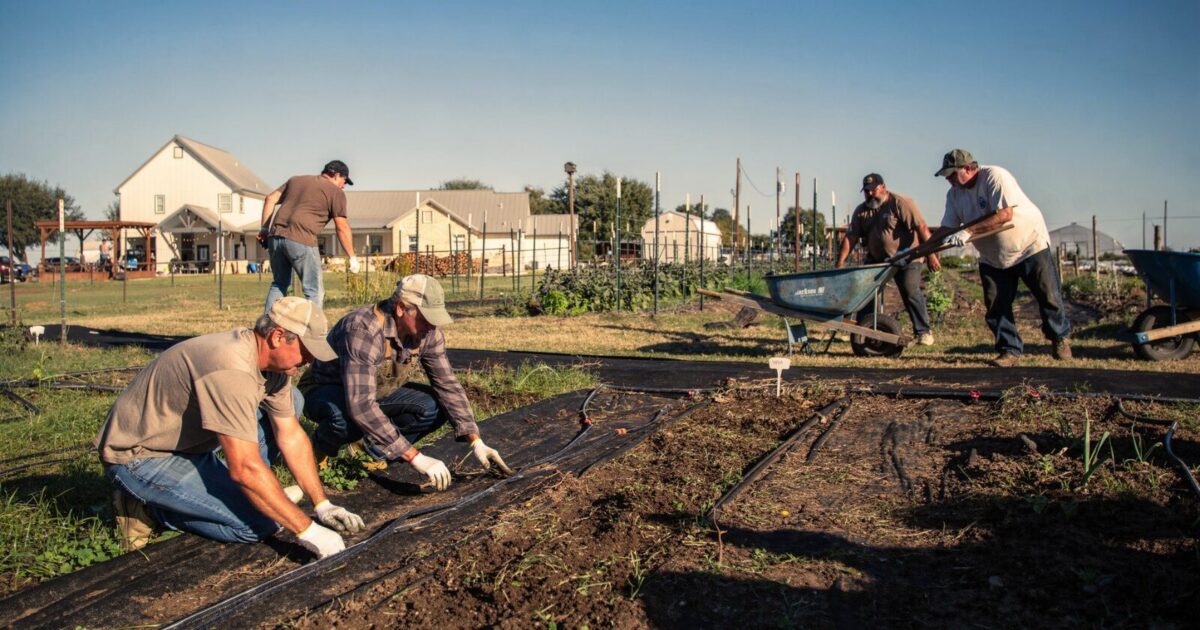
The most fundamental community-building element at Ranch House is simply this: men live together. They share space, meals, morning routines, farm work, and evening meetings. They are present to each other’s good days and bad days, their small victories and difficult moments. There is no way to live in close quarters with other people for thirty, sixty, or ninety days without knowing them and being known.
This is qualitatively different from attending group therapy sessions several times a week in an outpatient setting. Shared daily life creates the kind of intimacy that makes honest conversation possible, that gives accountability its teeth, and that allows men to witness each other’s transformation in real time.
Small community, deep relationships
Ranch House maintains an intentionally small number of beds. This is a deliberate choice that reflects a core conviction: recovery happens in relationship, and relationship requires specificity. In a program of eight or ten men, everyone knows everyone. Staff know every resident by name, history, and current struggle. Residents know each other’s patterns, support each other’s breakthroughs, and notice when someone is pulling back.
This intimacy would not be possible in a larger facility. The smallness is a feature, not a limitation.
Peer mentorship
Each resident at Ranch House is paired with a peer mentor, a man further along in his own recovery who has walked a similar path. The mentor relationship is distinct from the therapeutic relationship with a counselor or psychiatrist: it is a relationship between peers, grounded in shared experience rather than professional expertise.
The mentor can say things that a therapist cannot: ‘I was exactly where you are. Here is what I did. Here is what did not work. Here is what I wish someone had told me.’ This transmission of experience from one man to another is the ancient heart of recovery, what AA has practiced for nearly ninety years, formalized at Ranch House into a structured program that ensures every resident has this kind of guide.
Service Work Saturday
Every Saturday, Ranch House residents go into the Elgin community to do service, helping local families with yard work, assisting nonprofits, and supporting parks and recreation department projects. This weekly practice of service extends the community of recovery outward, connecting men at Ranch House to their neighbors and the broader world.
Service work builds community in two directions simultaneously: inward (shared experience and shared purpose among the men doing it) and outward (relationships with and responsibility toward the broader community). It also addresses one of the most corrosive effects of addiction: the experience of being a taker, a burden, someone who consumes without contributing. Service reverses that experience directly.
The Culture of Honesty
Community is only as powerful as the honesty it contains. A group of men performing recovery, saying the right things, maintaining the right appearances, is not a community in any meaningful sense. It is a room full of people pretending together, which ultimately reinforces the very skills addiction has already overdeveloped.
Ranch House works hard to create a culture in which honesty is expected, modeled, and safe. Staff members who are themselves in recovery model this by speaking openly about their own journeys. The Twelve Step framework provides a structure and language for honest self-examination. The daily intimacy of communal life makes performance increasingly difficult and authenticity increasingly accessible.
The men who graduate from Ranch House consistently describe this culture of honesty as one of the most significant gifts of their time there, the experience of being genuinely known and accepted, for the first time, without the armor of performance.
What Men Carry With Them
When a man leaves Ranch House Recovery, he does not leave the community behind. The relationships formed on the ranch with fellow residents, with mentors, with staff, are often among the most durable friendships of a man’s life. Men who have spent sixty or ninety days living, working, struggling, and growing together carry those bonds with them.
Many Ranch House graduates stay in close contact with each other. Some become mentors themselves, returning to the program to walk alongside the next generation of men. The community extends through time, becoming something the founders of AA understood intuitively: recovery is not a solo project. It is a collective one.
A Place to Belong
Ranch House Recovery was built to be a place where men belong not conditionally, not based on performance, not contingent on never struggling. A place where the whole person is welcome: the history, the wounds, the capacity for growth, the slow, nonlinear, profoundly human process of becoming someone who can live fully and honestly.
If you are looking for that kind of community for yourself or for a man you love, we are here. Call (512) 525-8175 or contact us.