
RHR Blog
Best Rehabs in Texas: How to Choose the Right Program in 2026

Texas is a big state. From El Paso to Beaumont, you’re looking at roughly 800 miles of distance and a treatment landscape that ranges from luxury Hill Country facilities to state-funded community programs to ranch-based men’s residential treatment outside Austin. If you’re searching for rehabs in Texas right now, the size of the menu is part of what makes the decision hard.
This guide is built to make it easier. Not by ranking facilities (“best of” lists in this industry are mostly paid placements), but by giving you the framework an experienced clinician or recovery professional would actually use to compare programs across the state. By the end, you’ll know which questions narrow the field fast and which “differences” between programs don’t matter as much as the marketing suggests.
If you or someone you love is in crisis right now, call SAMHSA’s National Helpline at 1-800-662-HELP (4357). It’s free, confidential, and available 24/7 in English and Spanish.
The Texas treatment landscape in 2026
Texas has the second-largest population in the country and a corresponding number of treatment facilities. The state is also at the front end of a long, painful overdose curve that’s only recently started to bend.
According to the Texas Department of State Health Services, Texas drug-related fatalities peaked in 2023 and declined modestly in 2024. The state has lost more than 76,000 lives to drug overdoses since 1999. Fentanyl, which barely existed in the Texas drug supply a decade ago, is now the dominant driver of overdose mortality, even though Texas’s per-capita rate remains lower than many other states. CDC data showed 5,489 overdose deaths in Texas in 2022 alone. Methamphetamine and polysubstance use are not far behind.
That context matters when you’re choosing a rehab. Treatment that worked in 1995 (largely 12-step focused, 28 days, minimal medical involvement) is not enough for a 2026 fentanyl or polysubstance addiction. Programs that haven’t updated their clinical model in the last decade are programs to be cautious about.
How rehabs in Texas actually differ
The marketing language across Texas rehab websites is nearly identical: “evidence-based,” “holistic,” “individualized,” “trauma-informed,” “dual-diagnosis capable.” Underneath the language, the real differences fall into about seven categories.
1. Level of care
The clinical hierarchy goes detox, residential, partial hospitalization (PHP), intensive outpatient (IOP), and standard outpatient. Most reputable programs offer two or three of these. A facility that offers “all five” usually does some of them well and some only on paper. Decide what level of care the person actually needs before you start calling programs, not after. A clinician or a credible admissions team can help you figure that out in one phone call.
2. Length of stay
The single most predictive factor of treatment outcome is how long someone stays in care. The National Institute on Drug Abuse is clear on this: less than 90 days of treatment is of limited effectiveness, and longer stays produce better long-term results. Many Texas programs default to 30 days because that’s what most commercial insurance benefits cover. The research doesn’t agree with the insurance industry on this point. If a facility you’re considering can’t accommodate a longer length of stay when clinically appropriate, that’s a meaningful limitation.
3. Setting and environment
Rehabs in Texas range from urban high-rise treatment centers to ranch and farm-based settings to coastal facilities. The setting matters more than people realize. Distance from the using environment (the same friends, bars, dealers, neighborhoods where the addiction took hold) is a treatment variable in its own right. So is what the daily schedule actually involves. A program where residents spend their days indoors in groups looks very different from one where the day includes structured outdoor work, animal care, or experiential therapy.
4. Gender-specific vs. coed
A growing body of clinical research supports gender-specific treatment for many people in early recovery, particularly for men with trauma histories or for women with histories of intimate partner violence. Single-gender programs allow the work to go deeper faster because clients aren’t navigating the social dynamics of a mixed environment. Coed programs work for some people too. The question is what fits the person’s history.
5. Clinical model
12-step focused, CBT-heavy, faith-based, holistic-experiential, harm-reduction-oriented, MAT-friendly or MAT-skeptical. These are real distinctions, not marketing categories. Ask a program: what is your clinical model in one sentence? If they can’t answer, they don’t have one.
6. Insurance and cost
Most Texas residential programs work with commercial insurance (Aetna, Blue Cross Blue Shield, Cigna, United, Humana, and others) for some portion of the stay. Cash-pay rates for a 30-day residential stay typically range from $15,000 to $45,000. Higher-amenity programs go higher. Lower-cost faith-based and non-profit programs exist but tend to have longer waitlists. Texas Medicaid coverage for private adult residential treatment is limited; state-funded options are available through Texas Health and Human Services regional referral centers.
7. Aftercare and continuity
The 90 days after residential discharge are statistically the highest-relapse window in recovery. Programs that take this seriously build aftercare into the treatment plan from day one. Programs that don’t will sell you a 30-day stay and hand you a list of phone numbers on your way out. The difference shows up in one-year outcomes.
The “best rehab in Texas” question
People search “best rehab in Texas” with the reasonable assumption that one program is objectively better than another. The honest answer is that the best program in Texas is the one that’s the best fit for the specific person, their substance use history, their co-occurring conditions, their family situation, their insurance, and the environment they need to get away from to get well.
A 24-year-old man with a fentanyl addiction wrapped around the Austin nightlife scene needs a different program than a 52-year-old woman with a decade of high-functioning alcohol use disorder and significant medical complications. There is no single “best” facility that serves both well.
What you can look for, instead of “best,” is real. Real licensed clinicians on staff. A real clinical model the staff can explain. Real aftercare planning. Real alumni who’ll pick up the phone if you ask to talk to one. The questions below help separate real from marketing.
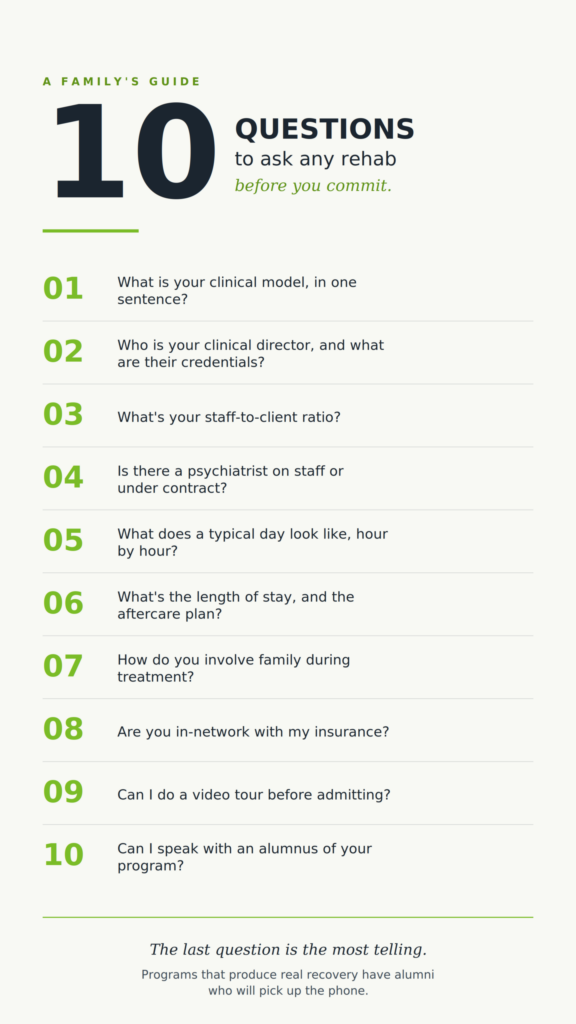
Questions to ask any Texas rehab before you commit
Print this and use it on every call.
- What is your clinical model, in one sentence?
- Who is your clinical director, and what are their credentials?
- What’s your staff-to-client ratio? How many of the people on staff are licensed clinicians?
- Is there a psychiatrist on staff or under contract?
- What’s your typical length of stay? What happens after the residential piece ends?
- How do you involve family during treatment?
- Are you in-network with my insurance? Can you verify benefits before admission, in writing?
- Can I do a video tour of the facility?
- Can I speak with an alumnus of your program?
- What does a typical day look like, hour by hour?
The last two are the ones programs with something to hide will resist hardest.
Red flags across the Texas rehab market
Twenty years of experience in the field produces a fairly consistent list:
- Aggressive sales tactics on the intake call. Real admissions teams answer questions. They don’t run scripts.
- Promises of specific outcomes. No ethical program promises sobriety.
- Refusal to disclose the clinical director’s name and credentials.
- Pressure to admit “today” because “we have one bed left.” Sales tactic.
- Offers to fly you in for free. Sometimes legitimate, often a sign of a facility that needs to fill beds for insurance reasons. As a safer starting point, the federal government maintains FindTreatment.gov, a non-commercial treatment locator that doesn’t sell your contact information to whoever bids highest.
- Stock photography and zero photos of the actual facility. Real programs show their building, their staff, and (with permission) their clients.
- Badmouthing other programs. Healthy programs don’t need to do this.
How insurance actually works in Texas
A few specifics worth knowing:
- Verification of benefits should be free, pre-admission, and ideally in writing. A facility that pressures you to admit before benefits are confirmed is planning to bill you, not your insurer.
- In-network vs. out-of-network can mean a difference of tens of thousands of dollars on a single stay. Always ask.
- Medical necessity criteria drive what insurance will and won’t authorize. A program that knows how to document medical necessity will get more days of care authorized than one that doesn’t.
- Parity rights matter. Most commercial insurance plans are required by federal law to cover substance use treatment at parity with medical care. If your insurer is denying medically necessary residential care, the denial is often appealable.
- Texas Medicaid does not generally cover private residential treatment for adults. State-funded options exist but typically involve waitlists and limited program selection.
Where Ranch House Recovery fits in the Texas market
Ranch House Recovery is a residential addiction treatment program for men, located on a working ranch in the Austin area. We are one specific kind of program: long-term, men-only, ranch and farm-based, integrating 12-step recovery, evidence-based clinical care, animal-assisted work, therapeutic farming, and a daily structure built around the research on what actually produces durable recovery. We are not the right fit for every person searching for a Texas rehab. The clinical-fit conversation is the first call.
If you want to see how the model translates into a residential program, our Austin addiction treatment page walks through the overall approach, and the residential program page covers what a day on the ranch looks like. For the thinking that runs underneath all of it, our philosophy page is the most honest two-minute read on the site.
The bottom line on choosing a rehab in Texas
Texas has good programs and bad programs and a lot of programs in the middle. The state’s size means you have real choice, which is a good thing if you use the choice well. The framework above (level of care, length of stay, setting, gender, clinical model, insurance, aftercare) is how a clinician would compare options. Use it.
And remember: the goal isn’t to find the program with the prettiest website or the most amenities. The goal is to find the program that gives a specific person, with a specific history, the best chance at lasting recovery. That fit conversation, done honestly, is the difference between 30 wasted days and a real recovery.
When you’re ready to have that conversation about Ranch House Recovery, you can reach our admissions team here. If we’re not the right fit, we’ll say so and try to point you to a program that is.