
RHR Blog
What Makes Addiction Treatment Effective? Lessons From Long-Term Recovery Research
A research-based look at what actually drives lasting recovery, and why a completion certificate is not the same as a changed life.
Effective is a slippery word in addiction treatment. Almost every program uses it. Far fewer define it. And the way a program defines success tends to decide everything else about how it operates, from how long people stay to what happens the day they leave.
So it is worth slowing down on the question that families rarely get a straight answer to. What actually makes addiction treatment effective? Not effective on paper, or for the length of a brochure. Effective in the way that matters, which is whether someone is still well a year later, and the year after that. The research on long-term recovery has a fairly consistent answer, and it looks different from the thirty-day model many people still picture.
What “effective” actually means
Start with the measuring stick. Completing a program is not the same as recovering from a disease. A person can finish every group session, earn the certificate, and relapse within weeks. That is not necessarily a failure of effort. Often it is a sign that the program measured the wrong thing.
The more honest measures look past discharge day: sustained reduction or abstinence, yes, but also the things that make a life. Stable housing. Work. Repaired relationships. Fewer emergency room visits. The ability to handle a hard week without coming apart. The National Institute on Drug Abuse frames addiction as a chronic, treatable disease, with relapse rates of roughly 40 to 60 percent, similar to diabetes and hypertension. By that standard, effectiveness is not a single clean finish line. It is how well the disease is managed over time.
That comparison is worth taking seriously, because it changes what counts as success. No one calls insulin a failure when a person with diabetes has a bad stretch. They adjust the plan and keep going. Yet in addiction, a return to use is often treated as proof that treatment did not work, or that the person did not try hard enough. A more accurate read is that recovery, like any chronic condition, is measured over years and managed with adjustments, not won or lost in a single episode of care.
Time is the variable people underestimate
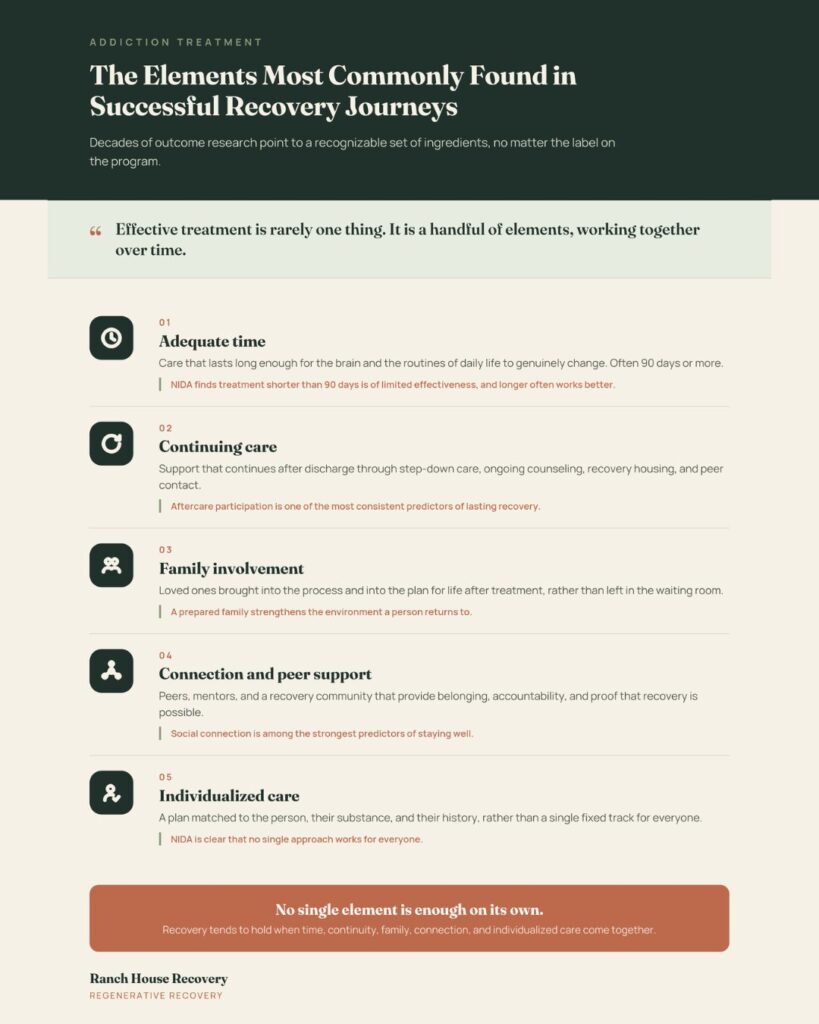
If there is one finding that has held up across decades, it is this. Length matters. NIDA’s long-standing position is that for residential or outpatient treatment, stays shorter than 90 days tend to be of limited effectiveness, and that longer often works better.
The reason is not bureaucratic. It is biological and behavioral. The brain changes slowly, and the routines that replace using a substance take real time to set. A month is often just long enough to stabilize someone and surface the deeper work, not to finish it. When programs run short, it is usually because that length fits how care has historically been paid for, not because the science points there. Recovery does not keep to a billing cycle.
The familiar thirty-day program is a useful case study. It feels decisive, and it is easier to commit to than something longer. But the changes that protect against relapse, in impulse control, stress regulation, and decision-making, continue well past the first month. A program that ends right as that work gets underway can leave a person stabilized but not yet steady. That is not an argument that everyone needs the same length. It is an argument that length should be set by the person’s progress, not by a default number on a calendar.
Continuing care is where recovery is won or lost
If time matters, what happens after the intensive phase matters even more. The transition out of treatment is the most fragile moment in the whole process, and it is the point where fragmented systems fail people most often. Someone finishes a residential stay, returns to the same pressures with no bridge in place, and is back in crisis before the next appointment.
Research on therapeutic communities consistently finds that two factors predict recovery more than almost anything else: how long someone stays, and whether they stay connected to aftercare afterward. Continuing care can take many forms, including step-down programming, ongoing counseling, recovery housing, and regular contact with peers. The common thread is simple. Treatment is built as a continuum, not a single event with an expiration date.
In practice, strong continuing care looks unglamorous. A scheduled step down from residential to a less intensive level rather than a hard stop. A named point of contact who follows up in the first risky weeks. A plan for housing and daily structure before discharge, not after. A standing connection to a recovery community so support does not depend on the person, at their most vulnerable, having to build it from scratch. Programs that think this way treat the first ninety days after discharge as part of the treatment, because that is when the data says relapse is most likely.
Family belongs inside the process, not in the waiting room
People do not recover in a vacuum, and they do not return to one either. They go home to families, partners, and households that were shaped by the addiction and will shape what comes next. Effective programs treat that reality as part of the work rather than an afterthought.
That can mean family therapy, education for loved ones about what recovery actually requires, and help rebuilding trust that addiction eroded. It also means giving families a role that does not end the moment the person comes home. When support systems understand the process, they become part of the structure that holds recovery in place. When they are left outside it, they can unintentionally undermine it.
There is also a benefit that programs sometimes overlook: families need recovery too. Living with a loved one’s addiction leaves its own wounds, including resentment, fear, and patterns of enabling that built up over years. Helping a family heal is not a courtesy. It is part of building an environment the person can actually return to. A household that has done its own work is far better equipped to support recovery than one simply waiting for the patient to be fixed and sent back.
Recovery support and recovery capital
Researchers have a useful term for the resources a person can draw on in recovery: recovery capital. It includes internal resources like coping skills and motivation, and external ones like relationships, stable housing, employment, and community. The broader your recovery capital, the better your odds.
Social connection is one of the strongest pieces. Studies of social recovery find that relationships and community can be decisive, and that being strong-willed alone is not what separates people who stay well from those who do not. Peers, mentors, mutual-aid groups, and recovery communities give people something willpower cannot manufacture: belonging, accountability, and proof that recovery is possible. This is also where the appeal of community-based models comes from, and why the strongest programs build connection in on purpose.
It also reframes a common worry. Families sometimes fear that their loved one is too dependent on a group, a sponsor, or a recovery community. The research points the other way. Drawing on outside support is not weakness. It is recovery capital working as intended. The goal is not to make someone strong enough to recover entirely alone. It is to surround them with enough support that they rarely have to.
The gap behind the question
There is a harder backdrop to all of this. Effectiveness only matters if people can reach care at all, and most do not. According to the federal government’s most recent national survey, roughly 80 percent of people who needed treatment for a substance use disorder in 2024 did not receive it. Cost, stigma, and a shortage of quality options all play a part. An effective system is not only one that helps the people who walk through the door. It is one more people can actually walk through.
There is no single best program
One more finding runs through all of this, and it is the least convenient for anyone selling a formula. No single approach works for everyone. The right length of stay, the right role for medication, the right balance of clinical and community support, all of it depends on the person, their substance, their history, and what they are returning to. Effectiveness is partly a matter of fit.
This is why a program’s willingness to individualize is itself a quality signal. A center that runs every person through the identical track, regardless of circumstance, is optimizing for its own convenience. One that assesses carefully and adjusts the plan, including how long care lasts and what it includes, is taking the evidence seriously. The same research that tells us what generally works also tells us that the details have to be matched to the individual.
What this means if you are weighing options
Put the research together and a short, practical set of questions emerges for anyone comparing programs. How long is the typical course of care, and why? What happens after the intensive phase, and who stays in contact? What role does the family play? How does the program define and measure success, and over what time frame?
Put the research together and a short, practical set of questions emerges for anyone comparing programs. How long is the typical course of care, and why? What happens after the intensive phase, and who stays in contact? What role does the family play? How does the program define and measure success, and over what time frame?
These are the questions the evidence rewards. They are also the questions the Regenerative Recovery model is built to answer, by pairing clinical care with the time, community, and continuity that long-term recovery seems to require. For families in Central Texas, a residential program near Austin should be able to walk through each one without reaching for a slogan.
The honest version of effective
Effective treatment is not a thirty-day miracle. It is adequate time, care that continues past discharge, families brought into the work, a community worth belonging to, and a plan matched to the person rather than the calendar. None of that is flashy. All of it is supported by decades of research. The programs that take it seriously are the ones whose results tend to hold.
About the Author
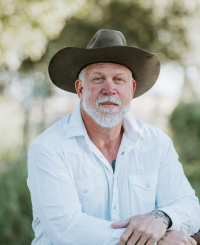
Brandon Guinn
Founder & CEO, Ranch House Recovery
Brandon Guinn founded Ranch House Recovery, a community-centered program for men recovering from addiction on a working ranch in Elgin, Texas. As a father whose family was touched by addiction, he built the program around daily structure, honest work, and lasting community.
Read Brandon’s full bio