Ranch Rehab: How a Working Ranch Changes the Way Recovery Works

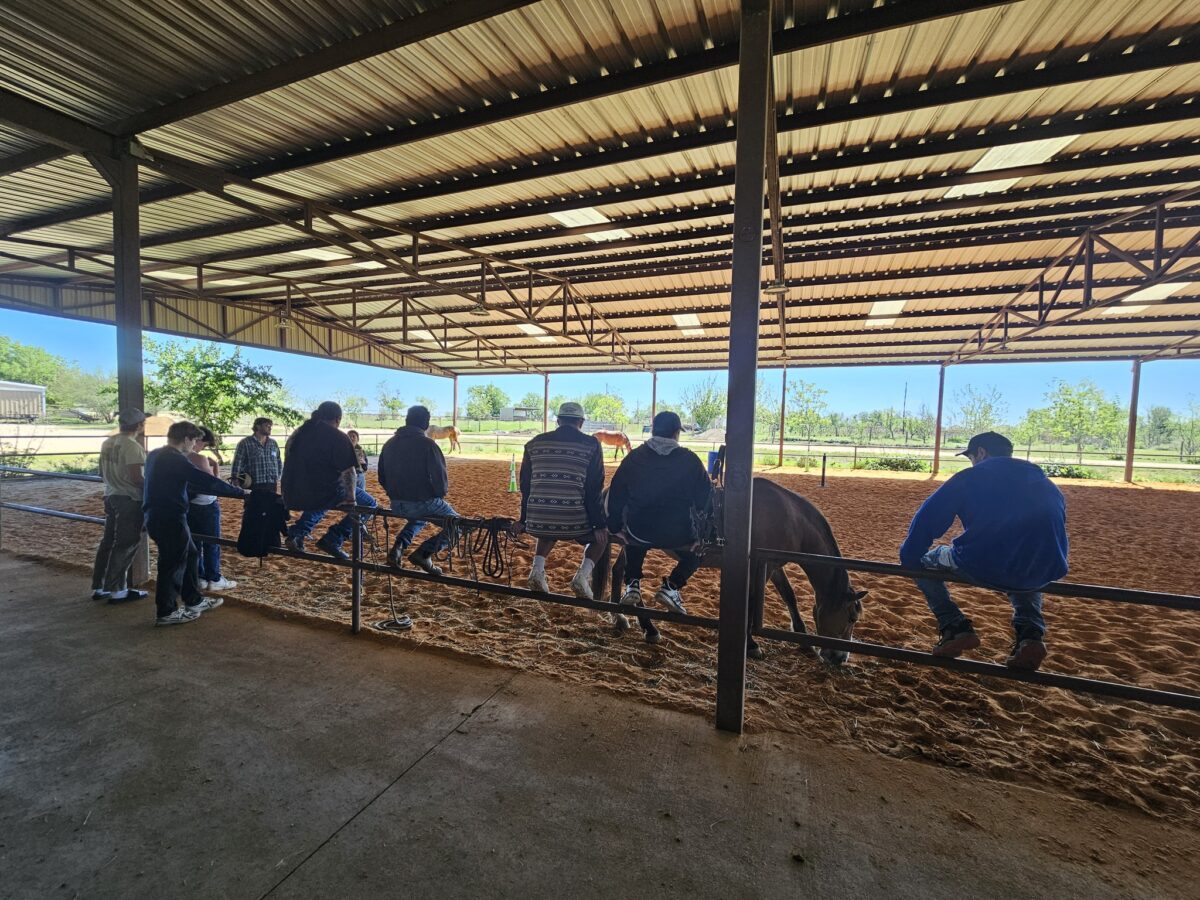
There’s a particular kind of stillness on a working ranch at sunrise. The horses are eating. The chickens are out. The men in the bunkhouse are getting up to start a day of structured work that begins before the sun is fully up and continues until evening, with therapy, recovery meetings, and farm tasks woven through it. Most of them came here because nothing else had held.
Ranch rehab isn’t a marketing aesthetic. It’s a treatment model. The people who design and run ranch-based programs are making specific clinical choices about setting, daily structure, and experiential modalities that change what recovery work looks like and how it lands.
This guide explains what a ranch rehab actually is, what the research says about the underlying modalities, why this model tends to work especially well for men in early recovery, and how to evaluate a ranch-based program if you’re considering one. If you or someone you love is in immediate crisis, call SAMHSA’s National Helpline at 1-800-662-HELP (4357). It’s free, confidential, and available 24/7.
What is a ranch rehab?
A ranch rehab is a residential addiction treatment program located on a working ranch, where the daily structure incorporates farm and ranch activities (animal care, gardening, physical labor, time outdoors) as integrated parts of the clinical work. It is not a vacation. It is not a cosmetic add-on to a standard treatment program. The setting and the daily structure are themselves clinical interventions.
Real ranch rehabs combine:
- Licensed clinical care including individual therapy, group therapy, and medical and psychiatric oversight.
- A working agricultural environment with real responsibilities, real animals, and real outdoor work.
- Distance from the using environment, which in itself is a treatment variable.
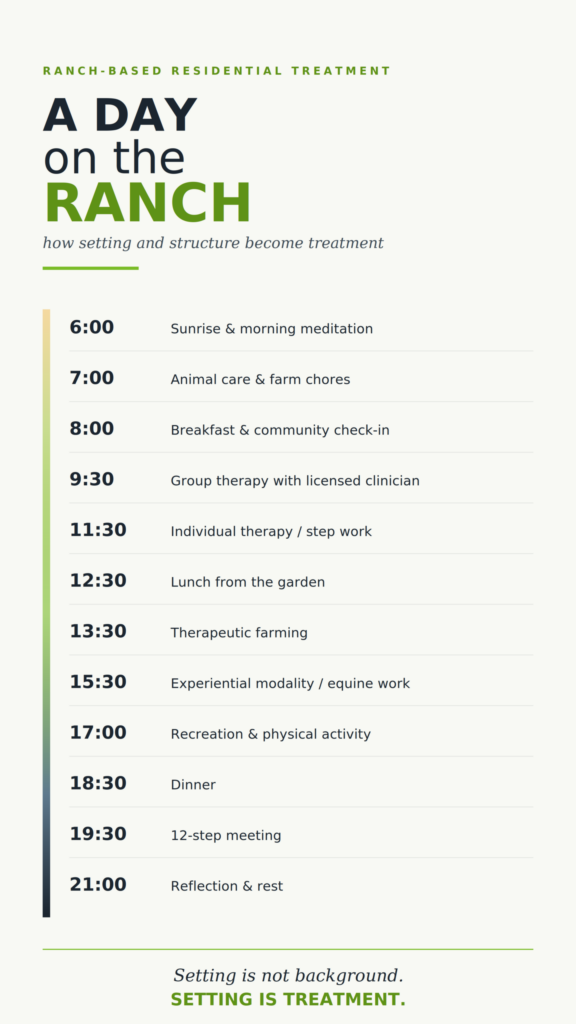
- An integrated daily structure that combines clinical hours with physical work and recovery practice.
- A community model where residents work, eat, and recover together over weeks or months.
The model has roots that go back to the therapeutic-community tradition of the 1960s and 1970s, with some lineage further back to farm-based recovery communities in the 19th and early 20th centuries. It is not new. What’s new is the integration with modern, evidence-based clinical care.
Why setting matters in addiction treatment
Most of the rehab industry treats setting as an amenity. The clinical reality is that setting is a treatment variable.
Three reasons:
1. Physical separation from the using environment. Addiction is partly a brain-and-body condition and partly a learned set of cues, contexts, and relationships. A person who detoxes and goes home to the same neighborhood, the same friends, the same routines is exposed to cue-driven relapse triggers continuously. A residential ranch setting physically removes those cues for the months when the brain is most vulnerable.
2. Structure and circadian regulation. Early recovery brains do badly with unstructured time. A working ranch imposes structure by definition: animals need to be fed at specific times, work has to happen during daylight, sleep patterns get pulled back into alignment with the sun. The National Institutes of Health’s research on sleep, circadian rhythms, and addiction has documented how badly substance use disrupts sleep architecture, and how much sleep regularization matters for early recovery.
3. The neurobiology of nature exposure. A growing body of research shows measurable effects of time in green and natural environments on stress hormone levels, mood, attention, and self-regulation. None of this is the whole story of recovery. But for a population coming out of months or years of chronic stress dysregulation, these effects are not trivial.
What therapeutic farming and animal-assisted work actually do
Two of the signature modalities of ranch rehab are therapeutic farming and animal-assisted recovery work. Both have legitimate clinical use and a growing evidence base.
Therapeutic farming
Therapeutic farming for addiction involves structured, supervised participation in growing food and tending land as part of a treatment program. The clinical mechanisms are pretty grounded: physical exertion, exposure to natural light, the rhythm of seasonal and daily tasks, the visible cause-and-effect relationship between effort and outcome (you plant a tomato; in a few months you eat a tomato), and the experience of caring for something that responds to your care.
For people in early recovery, particularly men, who often arrive at treatment with a profoundly damaged sense of self-efficacy, the experience of successfully growing food matters more than it sounds like it should.
Animal-assisted recovery work
Animal-assisted therapy in addiction recovery uses interaction with horses, dogs, livestock, and other animals as part of clinical work. Equine-assisted therapy in particular has a substantial research base. Working with horses requires emotional regulation in a way that’s hard to fake, demands clear nonverbal communication, and creates relational experiences that are often the first safe, non-judgmental connections a person in early recovery has had in years.
The American Heart Association’s published work on the human-animal bond summarizes some of the broader cardiovascular and stress-regulation effects of animal interaction, which underlie why the work translates well to a clinical recovery setting.
Neither modality replaces standard evidence-based clinical care. Both add something that group therapy in a windowless room can’t reach.
Why ranch rehab works particularly well for men
This is a generalization, but a clinically common one: men in early recovery often arrive at treatment with a specific set of features that ranch-based work happens to address well.
- Difficulty with verbal-only therapy. Many men, especially those new to recovery, have a hard time accessing or articulating emotional content in traditional talk-therapy formats. Working alongside another man on a fence repair, or on the care of a horse, often opens the verbal channel that direct questioning can’t.
- A damaged relationship with productive work. Active addiction usually destroys someone’s ability to complete tasks, follow through, and feel competent. Daily ranch work, done in community, repairs that.
- Physical restlessness. Sitting in groups all day is hard for a population whose nervous systems are dysregulated. Combining clinical work with physical activity makes the clinical work land better.
- Identity reconstruction. Recovery requires building a self that isn’t organized around using. Ranch work, animals, the natural world, and a community of other men in recovery give that new self something concrete to be organized around.
This isn’t to say ranch rehab is the right fit for every man. It isn’t. Some men do better in urban, more clinically intensive settings. Some need a setting closer to family. The fit conversation matters.
What separates real ranch rehab from cosmetic ranch rehab
Not every program with horses and a barn is a ranch rehab in the clinical sense. The distinction matters. Markers of a real, clinically integrated ranch program:
- Licensed clinicians on staff with master’s or doctoral-level credentials (LCSW, LPC, LCDC, LMFT, psychologist).
- A clinical model the staff can describe in one sentence. Buzzword salad is a yellow flag.
- The agricultural and animal work is integrated into the clinical day, not parallel to it. If equine therapy is a once-a-week activity surrounded by an otherwise standard treatment program, the ranch part is decorative.
- An extended length of stay. Real ranch programs typically aren’t 30-day stays. The work the setting enables takes longer than 30 days to do.
- Verifiable photos and tours. Real ranches show their actual ranch.
- A specific clinical population they serve well. Programs that try to be everything for everyone usually aren’t great for anyone.
For a longer comparison of ranch-based vs. conventional rehab models, our ranch rehab overview walks through what the day-to-day actually looks like and how the clinical model integrates.
What it costs and what insurance covers
Ranch rehab pricing is roughly in line with other residential treatment in Texas, with cash-pay rates for a 30-day stay typically running $15,000 to $45,000, and longer stays priced proportionally. Most reputable ranch programs work with commercial insurance for some portion of the stay, with the same caveats that apply industry-wide: verify benefits in writing, understand in-network vs. out-of-network, and don’t admit before benefits are confirmed.
The federal FindTreatment.gov treatment locator can help identify accredited programs and verify they take particular payment types. The National Institute on Drug Abuse’s Principles of Drug Addiction Treatment is the most authoritative single resource on what to look for in any treatment program regardless of setting.
Questions to ask any ranch rehab before you commit
- Who is your clinical director, and what are their credentials?
- What’s your staff-to-client ratio? How many are licensed clinicians?
- How is the ranch and farm work integrated with the clinical work, specifically?
- What’s your typical length of stay? What does aftercare look like?
- Is there a psychiatrist on staff or under contract?
- Can I do a video tour of the actual ranch?
- Can I speak with an alumnus of your program?
- What insurance do you take? Can you verify my benefits in writing pre-admission?
Where Ranch House Recovery fits
Ranch House Recovery is a long-term residential addiction treatment program for men, located on a working ranch outside Austin. The model is integrated by design: licensed clinical care, 12-step recovery, therapeutic farming, animal-assisted work, and a daily structure built around the way men in early recovery actually heal. We are not the right fit for every person searching for ranch rehab. The fit conversation is the first call.
For the thinking behind why we built the program this way, our philosophy page is the most honest two-minute read on the site. When you’re ready to talk about whether the program is the right fit for you or your loved one, you can reach admissions here.
The bottom line
Ranch rehab works because the setting and the daily structure are themselves part of the treatment, not background scenery. The work, the animals, the land, and the community of other men in recovery give clinical work something to land in that a conference room with fluorescent lights cannot.
If short-term, conventional treatment hasn’t held, the variable to change isn’t usually the willpower of the person in recovery. It’s the model. For the right person, in the right phase of recovery, a real ranch rehab can be the change that finally takes.t Ranch House Recovery, you can reach our admissions team here. If we’re not the right fit, we’ll say so and try to point you to a program that is.