
RHR Blog
Alcohol Withdrawal and Detox: What Men Need to Know Before Starting Treatment

Common questions
Is alcohol withdrawal dangerous?
Yes. Alcohol withdrawal is one of the few withdrawal syndromes that can be fatal. Heavy, long-term drinkers face risk of seizures and delirium tremens (DTs), a life-threatening syndrome involving severe confusion, fever, rapid heart rate, and extreme agitation. Medical supervision is strongly recommended for any man with a history of heavy, prolonged drinking.
What is the alcohol withdrawal timeline?
Early symptoms including tremors, sweating, nausea, and anxiety typically begin 6 to 24 hours after the last drink. The highest-risk window for seizures is 24 to 72 hours. Delirium tremens, if it occurs, typically begins between 72 hours and one week. Post-acute withdrawal symptoms including insomnia, anxiety, and mood instability can persist for weeks to months.
Who is at highest risk for severe alcohol withdrawal?
Risk is elevated for men who have been drinking heavily and consistently for more than a year, consume more than 8 to 10 drinks per day, have a history of prior alcohol withdrawal seizures or DTs, are over age 40, or have underlying cardiovascular or neurological conditions. Prior successful home withdrawal does not eliminate future risk.
What is CIWA-Ar and how is it used in alcohol detox?
The Clinical Institute Withdrawal Assessment for Alcohol (CIWA-Ar) is a standardized scale used in medically supervised detox settings to track withdrawal symptom severity and guide medication dosing. Benzodiazepines are typically administered on a symptom-triggered or scheduled basis based on CIWA-Ar scores to reduce excitatory rebound and prevent seizure.
Alcohol withdrawal is one of the few withdrawal syndromes that can be fatal without medical supervision. It is also one of the most underestimated. Men who have been drinking heavily for months or years often expect to handle withdrawal the same way they have endured other physical discomforts: by toughing it out.
That instinct has killed men. This page explains why alcohol withdrawal is medically different, what the timeline looks like, who is at highest risk, and why medically supervised detox is the safe pathway into residential treatment.
Why Alcohol Withdrawal Is Medically Different
Alcohol acts on the central nervous system as a depressant. With prolonged heavy use, the brain adapts by upregulating excitatory activity to compensate for the constant suppression of inhibitory activity. When alcohol is removed suddenly, that excitatory rebound can be severe.
For most people, alcohol withdrawal is uncomfortable but manageable. For a meaningful percentage of heavy, long-term drinkers, it can progress to seizures and a condition called delirium tremens (DTs), which carries a risk of death without medical intervention.
The distinction between which withdrawal will be manageable and which will be life-threatening is not always predictable in advance. Prior withdrawal seizures, years of heavy drinking, and underlying medical conditions increase the risk. But seizures have occurred in men without those risk factors.
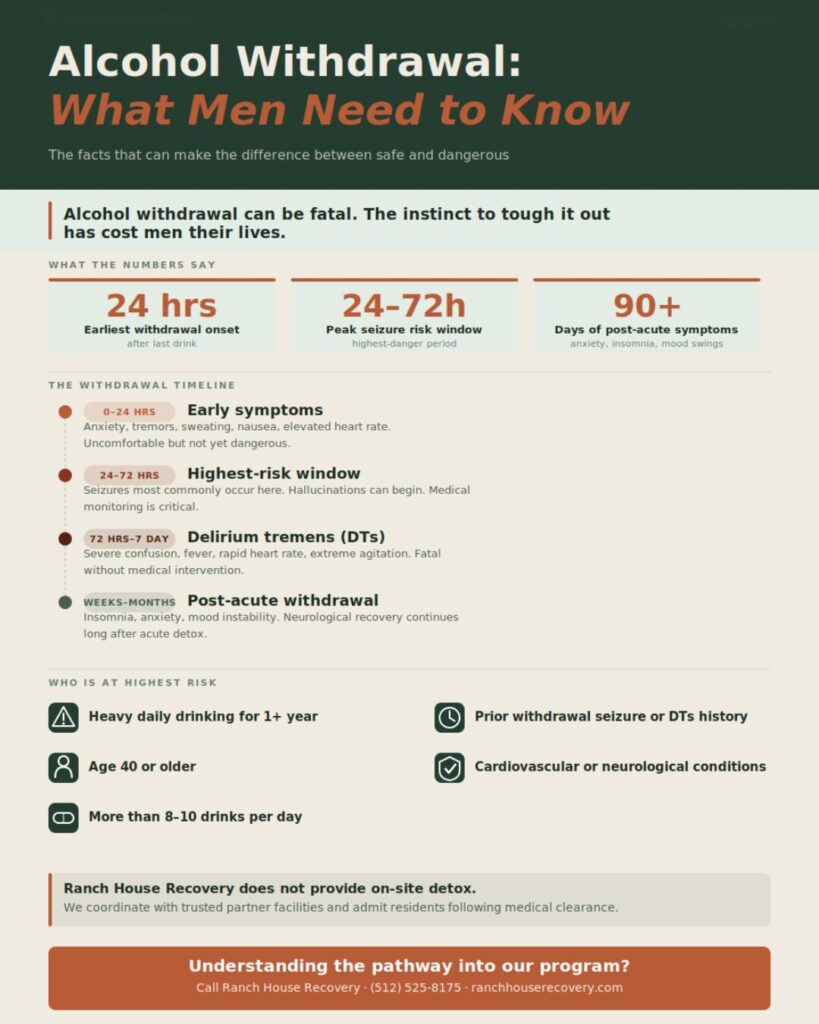
Alcohol Withdrawal Timeline
6 to 24 Hours After Last Drink
Early symptoms include anxiety, tremors, sweating, nausea, headache, and elevated heart rate and blood pressure. This phase is uncomfortable but not typically dangerous. Many men have experienced these symptoms and pushed through them, which can build a false confidence about their ability to handle full withdrawal.
24 to 72 Hours
This is the highest-risk window. Seizures, if they occur, most commonly happen in this period. Hallucinations, both visual and auditory, can occur in some patients. Medical monitoring is most critical here. A grand mal seizure during unmonitored alcohol withdrawal can result in injury, aspiration, or death.
72 Hours to One Week
Delirium tremens, the most severe form of alcohol withdrawal, typically begins in this window if it is going to occur. Symptoms include severe confusion, fever, rapid heart rate, and extreme agitation. DTs requires immediate medical intervention. The mortality rate for untreated DTs is significant.
Post-acute withdrawal symptoms including insomnia, anxiety, irritability, and mood instability can persist for weeks to months after acute withdrawal resolves.
Who Is at Highest Risk
The risk of severe alcohol withdrawal is elevated for men who:
- Have been drinking heavily and consistently for more than a year
- Consume more than 8 to 10 drinks per day on average
- Have a history of previous alcohol withdrawal seizures
- Have experienced DTs in the past
- Have underlying medical conditions, particularly cardiovascular or neurological
- Are over the age of 40 with a long drinking history
Why Men Downplay the Risk
Men disproportionately minimize physical symptoms and are more likely to attempt alcohol withdrawal without medical support. The cultural expectation that discomfort should be endured rather than managed, combined with shame about needing medical help, drives this pattern.
Deciding to detox at home from alcohol is a decision that has cost men their lives. The discomfort of supervised detox is temporary. The consequences of an unsupervised seizure are not.
What Medically Supervised Alcohol Detox Involves
In a supervised setting, withdrawal severity is measured using the Clinical Institute Withdrawal Assessment for Alcohol (CIWA-Ar), a standardized scale that tracks symptoms and guides medication dosing. Benzodiazepines are typically administered on a symptom-triggered or scheduled basis to reduce excitatory rebound and prevent seizure.
Nutritional support is also provided, as alcohol use disorder is frequently accompanied by thiamine deficiency. Thiamine (vitamin B1) replacement is standard because deficiency contributes to Wernicke encephalopathy, a serious neurological complication.
Detox as the Gateway to Treatment
Medical detox creates the stability required to begin residential treatment. Ranch House Recovery does not provide on-site detox, but we coordinate with trusted partner facilities and admit residents following medical clearance. The work of lasting recovery begins at Ranch House after detox is complete.
See our full residential program.
Ready to understand the pathway into our program?
Call Ranch House Recovery at (512) 525-8175.

About the Author
Brandon Guinn
Founder & CEO, Ranch House Recovery
Brandon Guinn founded Ranch House Recovery, a community-centered program for men recovering from addiction on a working ranch in Elgin, Texas. As a father whose family was touched by addiction, he built the program around daily structure, honest work, and lasting community.
Read Brandon’s full bio