
RHR Blog
How Detox Works Before Residential Rehab and What Happens After

Common questions
What is the difference between detox and rehab?
Medical detox is the supervised process of clearing substances from the body and managing withdrawal safely. It addresses physical stabilization only. Residential rehab addresses the behavioral, psychological, and spiritual dimensions of addiction. Detox is a prerequisite for residential treatment when medically required, it is the first step, not the whole process.
How long does detox take?
Detox timelines vary by substance. Alcohol detox typically takes 5 to 7 days. Opioid and fentanyl detox takes 5 to 10 days for acute symptoms, though fentanyl can be longer. Benzodiazepine detox is managed through a slow taper lasting 1 to 2 weeks or more. Post-acute withdrawal symptoms can persist for weeks to months regardless of substance.
Does Ranch House Recovery provide detox?
Ranch House Recovery does not provide on-site medical detox. Residents who require medically supervised detox are referred to trusted partner facilities. Ranch House Recovery coordinates the intake process in parallel so that admission to the residential program is ready as soon as the resident receives medical clearance.
Do all substances require medical detox before residential rehab?
No. Alcohol and benzodiazepines carry seizure risk during withdrawal and require medical supervision. Opioids including fentanyl are not typically life-threatening but carry high relapse risk without clinical support. Stimulants and marijuana typically do not require medical detox, though early abstinence can involve significant psychological discomfort.
Detox and rehab are two different things. They are often confused, and that confusion leads families to mistake one for the other or to assume a detox program has resolved an addiction problem when it has only addressed the first medical phase.
This page clarifies what detox actually is, what to expect during it, how the timeline varies by substance, and how the transition into a residential program like Ranch House Recovery works.
What Detox Is and What It Is Not
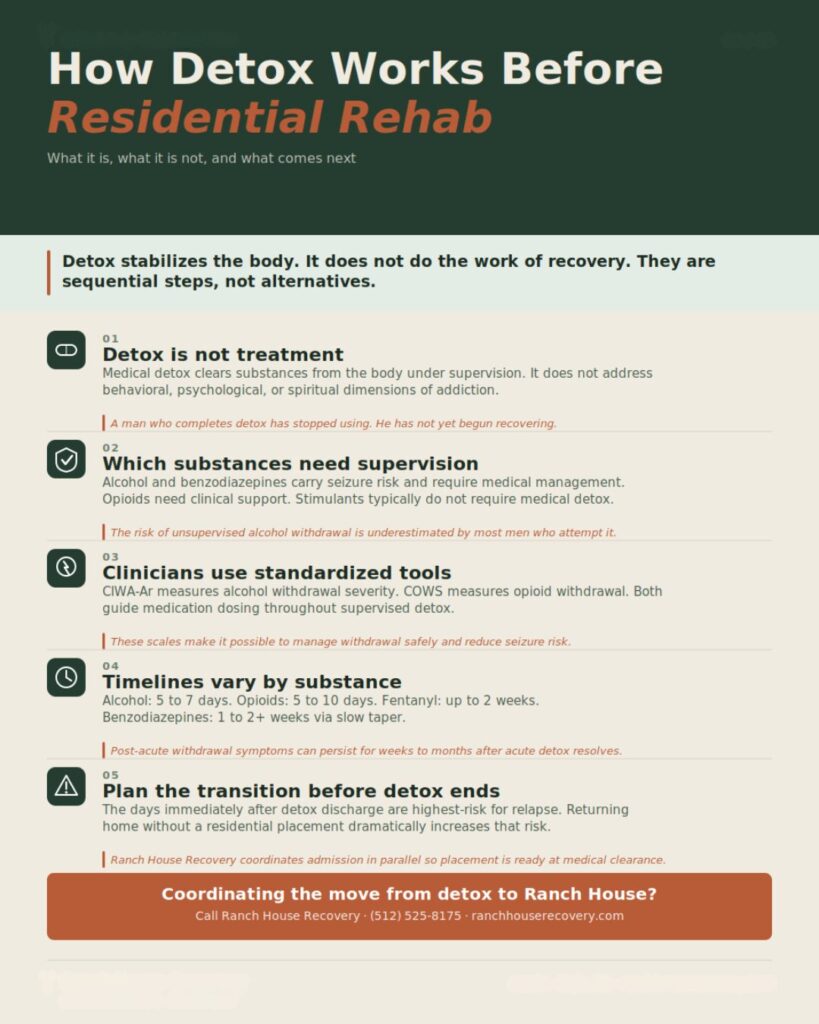
Medical detox is the supervised process of clearing substances from the body. Its purpose is physical stabilization and safety management during withdrawal. It is typically conducted in a medical facility or dedicated detox center with 24-hour clinical monitoring.
Detox is not addiction treatment. It does not address the behavioral, psychological, or spiritual dimensions of addiction. A man who completes detox has stopped using substances under medical supervision. He has not yet done the work of recovery. The two are sequential steps, not alternatives.
Ranch House Recovery does not provide on-site medical detox. Residents who require medically supervised detox are referred to trusted partner facilities and transition into our residential program once they are medically cleared.
Learn more about our residential program.
When Detox Is Required
Not every substance requires medical detox. The substances that carry the most significant medical risk during withdrawal are:
- Alcohol: withdrawal can include seizures and a life-threatening condition called delirium tremens (DTs). Medical supervision is strongly recommended for heavy, prolonged alcohol use.
- Benzodiazepines (Xanax, Valium, Klonopin): withdrawal carries seizure risk similar to alcohol and should be medically managed.
- Opioids including fentanyl: withdrawal is rarely life-threatening but is intensely uncomfortable and associated with early relapse without support.
Stimulants and marijuana typically do not require medical detox, though they may involve significant psychological discomfort and cravings during early abstinence.
What Medically Supervised Detox Looks Like
In a medically supervised detox setting, a physician or nurse practitioner conducts an intake assessment that includes substance history, medical history, vital signs, and a clinical evaluation of withdrawal severity using standardized tools such as the CIWA-Ar for alcohol or the COWS scale for opioids.
Medication is administered as indicated to manage symptoms and reduce risk. For alcohol withdrawal, benzodiazepines are typically used to prevent seizure. For opioid withdrawal, buprenorphine or methadone may be initiated. For benzodiazepine withdrawal, a careful taper protocol is established.
Monitoring continues around the clock throughout the acute withdrawal period, with vital signs, symptom scales, and neurological checks conducted at regular intervals.
Detox Timelines by Substance
Alcohol
Acute alcohol withdrawal typically begins within 6 to 24 hours of the last drink and peaks around 24 to 72 hours. Medically supervised detox for alcohol usually lasts 5 to 7 days, though post-acute withdrawal symptoms can persist for weeks.
Opioids and Fentanyl
Opioid withdrawal onset depends on the substance. Short-acting opioids begin withdrawal within 8 to 24 hours. Fentanyl can have a more extended and unpredictable timeline due to its storage in fatty tissue. Acute withdrawal typically resolves within 5 to 10 days with medical management.
Benzodiazepines
Benzodiazepine detox is typically managed through a slow taper and may take 1 to 2 weeks or longer depending on the drug, dose, and duration of use. Abrupt cessation of high-dose benzodiazepine use without medical supervision carries a significant seizure risk.
What Happens After Detox
Medical clearance from detox is the starting point for residential treatment, not the endpoint of care. At Ranch House Recovery, residents who have completed detox through a partner facility are admitted to the residential program in Elgin, Texas for 30-day, 60-day, or 90-day programming.
The work of Regenerative Recovery begins at admission: 12-step engagement, therapeutic farming, animal-assisted therapy, mentorship, spiritual practice, and the structured daily community that builds durable recovery.
Learn more about therapeutic farming for addiction recovery.
Common Mistakes in the Detox-to-Rehab Transition
The period immediately following detox discharge is one of the highest-risk windows for relapse. Common mistakes include:
- Returning home for a waiting period before starting residential care. Physical craving is most acute in the days immediately following detox, and an unstructured home environment creates risk.
- Treating detox as treatment. A man who feels better after detox may underestimate how much clinical work remains. The relief from acute withdrawal symptoms is not recovery.
- Failing to line up the next level of care before detox discharge. The transition should be planned before detox begins, not after it ends.
Coordinating the Transition
Ranch House Recovery’s admissions team coordinates directly with detox partners to manage the transition into residential care. If you or a family member is currently in or planning detox, call us to begin the intake process in parallel so that placement at Ranch House is ready when medical clearance is granted.
Call Ranch House Recovery at (512) 525-8175.

About the Author
Brandon Guinn
Founder & CEO, Ranch House Recovery
Brandon Guinn founded Ranch House Recovery, a community-centered program for men recovering from addiction on a working ranch in Elgin, Texas. As a father whose family was touched by addiction, he built the program around daily structure, honest work, and lasting community.
Read Brandon’s full bio