
RHR Blog
Why Environment Matters More Than Most People Realize During Addiction Recovery

Recovery gets framed as a test of willpower. The research keeps pointing somewhere else: to the people, places, and routines around a person.
When recovery works, we credit willpower. When it falters, we blame its absence. It is a tidy story, and a misleading one. Decades of research suggest that the environment around a person, the people, the places, the daily rhythm, shapes recovery at least as much as individual resolve. Sometimes more.
That is not an excuse. It is leverage. Because while willpower is hard to manufacture on demand, an environment can be changed. Understanding how setting influences recovery is one of the most practical things a person or family can learn.
Recovery is not only willpower
The willpower model runs deep, partly because it feels intuitive and partly because it lets everyone else off the hook. But research on how people actually recover tells a more relational story. One body of work on social relationships and recovery found that being strong-willed alone did not reliably separate those who stayed well from those who did not. Environmental and relational factors did much of the work.
This reframes relapse, too. A return to use after leaving a structured setting is often less a collapse of character than a predictable response to dropping someone back into the exact conditions that fed the addiction. Same triggers. Same stress. Same people. The environment does not cause the choice, but it stacks the deck.
The willpower framing carries a hidden cost. It loads the entire weight of recovery onto the individual and treats setbacks as moral verdicts. That is not only unkind. It is inaccurate, and it can be counterproductive, because shame tends to drive people back toward the very behavior they are trying to leave. Seeing environment clearly does the opposite. It turns recovery from a private test of grit into something a person, a family, and a community can build together.
Peer influence cuts both ways
People are the most powerful feature of any environment. In recovery, that cuts in both directions. A community of peers who are also working toward recovery provides accountability, belonging, and living proof that change is possible. Returning to a social circle built around using does the opposite, often quietly and quickly.
This is why social connection shows up so consistently as a predictor of sustained recovery. The networks a person belongs to either reinforce the new life or pull them back toward the old one. Good programs take this seriously, surrounding people with peers and mentors rather than leaving connection to chance.
Done well, this is deliberate design, not luck. People in recovery living and working alongside others on the same path create a kind of social gravity that pulls in the right direction. Shared meals, shared responsibilities, and shared milestones build the relationships that later become a person’s recovery network. The aim is for someone to leave with more than skills. They leave with people, the part of the environment that travels home with them.
Stress, the nervous system, and place
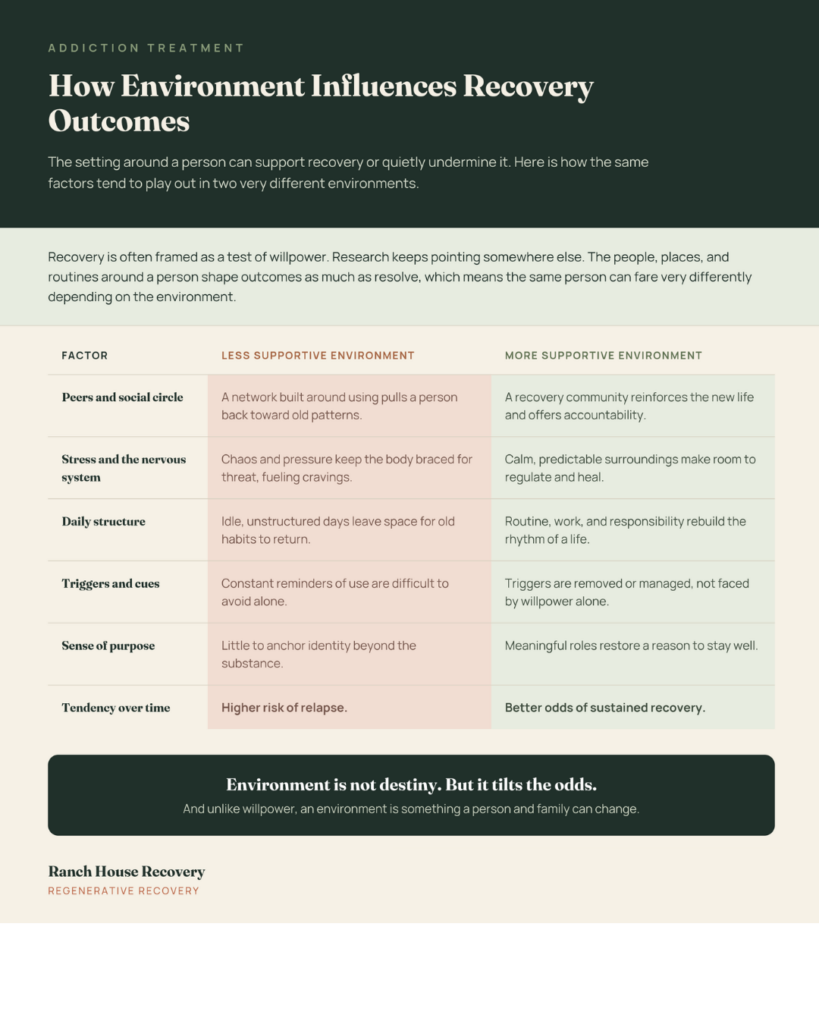
Environment is not only social. It is physiological. Chronic stress is one of the most reliable drivers of relapse, and chaotic, high-pressure surroundings keep the nervous system braced for threat. A calmer, more predictable setting does something specific: it gives the body room to regulate, which makes the hard internal work of recovery possible in the first place.
It also explains why removing the substance is rarely enough on its own. The Centers for Disease Control and Prevention is direct that detox alone, without continued treatment and support, raises the risk of relapse and overdose. Clearing a substance from the body in a setting that has not changed is setting someone up to face the same storm with fewer defenses.
The pieces that calm a nervous system are often the least dramatic ones. Regular sleep. Steady meals. A schedule a person can rely on. Time outdoors and physical work. None of these is a treatment by itself, and none replaces clinical care. Together, though, they lower the baseline level of stress a person is carrying, which makes cravings less overwhelming and good decisions more reachable. An environment that quietly handles the basics frees up the energy recovery actually demands.
Structure, routine, and the working-land idea
If a good environment lowers stress and surrounds people with the right peers, it can do even more when it gives them something to do. Structure, routine, and shared responsibility turn an environment from a place someone passes through into an active part of treatment.
This is the logic behind therapeutic communities, where length of stay and aftercare consistently predict recovery, and behind models built around land and work. At a working recovery ranch, daily tasks, animals, and a real routine are not scenery. They are the environment doing therapeutic work, rebuilding the rhythm of a life alongside the clinical care that keeps recovery grounded in evidence.
Work also does something subtler. Addiction tends to hollow out a person’s sense of identity and usefulness. Caring for an animal that depends on you, finishing a task that visibly matters, being counted on by other people, all of it rebuilds the part of a person that recovery ultimately rests on. Purpose is not a reward for getting well. For many people it is part of how getting well happens, and an environment that supplies it day after day is doing real clinical work, not just keeping people busy.
None of these forces works in isolation. A calmer setting makes the peer relationships easier to form. The peer relationships make the routine feel worth keeping. The routine and the work restore the sense of purpose that makes the whole thing matter. This is why environment is more than the sum of its parts, and why swapping a chaotic setting for a supportive one can shift outcomes even when the person and the underlying disorder have not changed. The surroundings either compound in the person’s favor or against them.
Recovery capital and the recovery ecosystem
Researchers describe the external resources that support recovery as recovery capital, and they increasingly think about it as an ecosystem rather than a single program. Stable, substance-free housing is one of the most studied pieces. A systematic review of recovery housing describes it as the most widely available form of recovery support infrastructure, and notes that intensive support for residents with low recovery capital can improve engagement and retention.
Tellingly, some research finds that the recovery social capital of a person’s home environment, not just their individual traits, predicts whether they relapse. Context matters. The surrounding web of housing, community, mutual aid, and relationships is not a backdrop to recovery. It is part of the treatment.
Thinking in terms of an ecosystem changes the questions worth asking. Instead of only “is this person motivated,” it becomes “what does this person have access to.” Safe housing. A community that supports recovery rather than threatens it. Work or purpose. Relationships that pull in the right direction. When those resources are thin, even a highly motivated person faces long odds. When they are rich, recovery has something to stand on. The most forward-looking programs measure and build these resources on purpose rather than hoping they fall into place after discharge.
Building a supportive environment after discharge
The practical takeaway is hopeful, because environment is something people can shape. After an intensive program, the questions that matter are concrete. Who will be around day to day? What does a normal week look like, and does it have structure? Are there triggers built into the living situation that can be changed? Is there a recovery community within reach?
For families in Central Texas weighing where care should happen, this is worth asking about directly. A residential program near Austin should be able to explain not only what happens during treatment, but how it helps people build a livable environment for afterward. The plan for the environment is part of the plan for recovery.
Sometimes shaping the environment means real change: a different living situation, distance from a social circle organized around using, a new daily structure that did not exist before. None of that is easy, and it is rarely about willpower. It is logistics, support, and honest conversations about what a person can realistically return to. Treatment that ignores this hands someone hard-won skills and then sends them straight back into the conditions that overwhelmed those skills in the first place. Treatment that takes it seriously helps build a setting where staying well is not a daily act of heroism.
The setting is part of the cure
Environment is not the whole story. Clinical care, individual effort, and time all matter. But pretending environment is a minor detail sets people up to fail and then blames them for it. The more useful view is also the more compassionate one. Change the surroundings, and the right choices get easier. That is not a loophole around personal responsibility. It is how recovery actually tends to work.
About the Author
Brandon Guinn
Founder & CEO, Ranch House Recovery
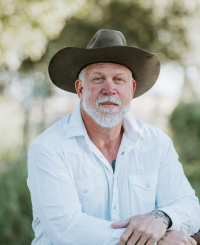
Brandon Guinn founded Ranch House Recovery, a community-centered program for men recovering from addiction on a working ranch in Elgin, Texas. As a father whose family was touched by addiction, he built the program around daily structure, honest work, and lasting community.
Read Brandon’s full bio