
RHR Blog
A Family Member’s Guide to Supporting Someone in Residential Rehab

When someone you love enters residential rehab, the mix of relief, worry, and uncertainty is real. This guide is for the family member who wants to support recovery without accidentally undermining it.
What happens in the weeks and months after admission is shaped significantly by how family members navigate their role. This guide covers what to expect, how to stay involved appropriately, how to avoid the patterns that undermine recovery, and how to prepare for the transition home.
What to Expect During the First Days
The first few days involve significant adjustment. Your family member is navigating physical changes from early sobriety, a new environment and community, and the beginning of clinical work. Communication is limited by design during this phase. This can feel difficult and sometimes alarming to family members.
Trust that the program is providing the structure and support they need. The restriction on communication in early days is not punitive. It is clinical. It gives the resident space to begin engaging with treatment without managing family dynamics simultaneously.
Family Involvement at Ranch House Recovery
Ranch House Recovery encourages family involvement in the recovery process at the appropriate stages. Family therapy sessions are available to help rebuild trust, improve communication, and address patterns that may have contributed to the addiction.
See our residential program page for more on family communication.
Regular updates from the care team help families stay informed without disrupting the therapeutic environment. Family visits are part of the healing process and are encouraged at appropriate stages of treatment. Visit scheduling is coordinated with the clinical team to time them for maximum therapeutic benefit.
How to Support Without Enabling
Support means maintaining connection, expressing love, and reinforcing the value of recovery. Enabling means actions that remove consequences or allow continued problematic behavior to continue without natural consequences. The line between them is not always obvious.
During residential treatment:
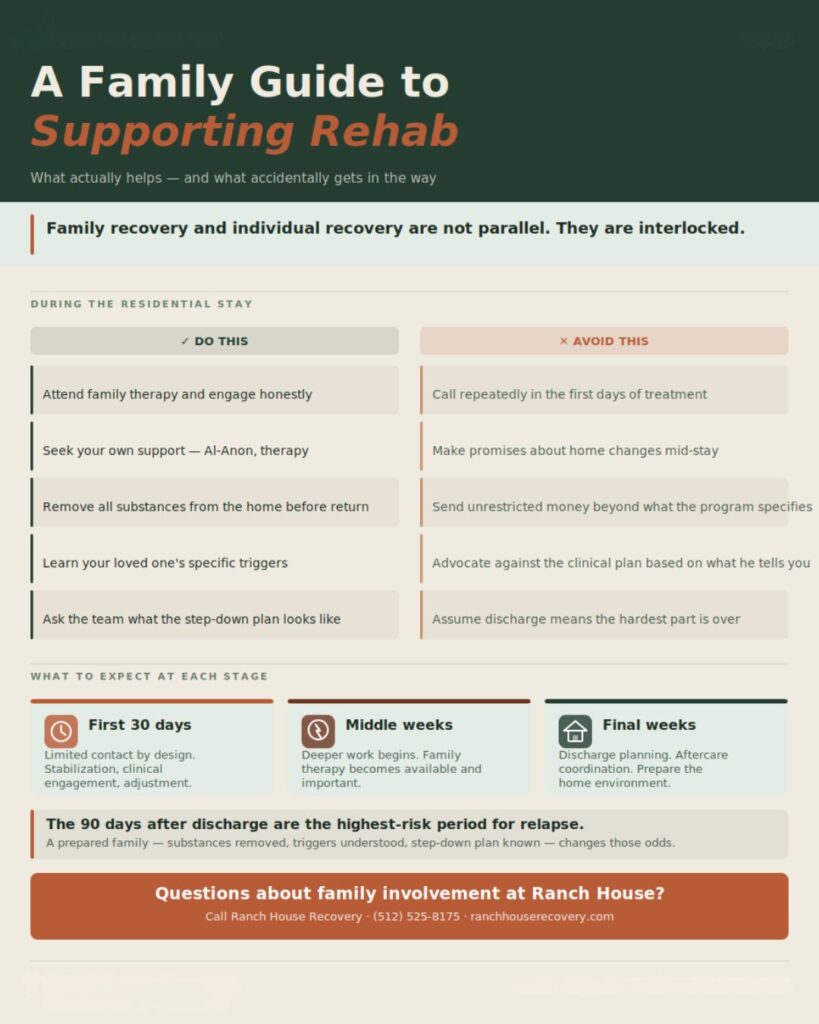
- Attend family therapy sessions and engage honestly with what is discussed
- Do not send money beyond what the program has specified as appropriate
- Do not make promises about what will change at home before the work of treatment is done
- Seek support for yourself through Al-Anon, therapy, or family programs
- Resist the urge to manage the treatment process or advocate for changes to the clinical plan based on what the resident tells you during calls
Taking Care of Yourself During the Process
Family members are often deeply exhausted by the time their loved one enters treatment. Years of managing the consequences of addiction, covering situations, maintaining family stability, and living in a state of chronic worry leave family members depleted.
The residential stay is an opportunity for the family member to do their own work. Al-Anon offers community with people who understand this experience from the inside. Individual therapy can help you untangle the patterns that have developed over years of living with addiction. Family therapy within the residential program addresses the relationship system directly.
Understanding Stages of Recovery
Recovery happens in stages. The first 30 days are typically focused on stabilization: clearing the body, adjusting to sobriety, beginning clinical work. In the middle weeks, deeper personal work happens. Toward the end of a residential stay, the focus shifts to integration and preparation for what comes next.
Family members often experience their own parallel stages: relief in the early weeks, sometimes impatience or uncertainty in the middle, and anxiety about the transition home as discharge approaches.
Preparing for the Return Home
The 90 days after residential treatment are the highest-risk period for relapse. Family members can actively support a safe recovery environment by:
- Removing substances from the home before the resident returns
- Understanding the step-down plan, including any ongoing outpatient commitments
- Learning what triggers are most relevant for their family member
- Establishing clear communication about expectations without issuing ultimatums
- Attending family therapy to work through the specific dynamics in your household
Ranch House Recovery’s team can help families understand what to expect before their loved one completes the program.
Call Ranch House Recovery at (512) 525-8175.

About the Author
Brandon Guinn
Founder & CEO, Ranch House Recovery
Brandon Guinn founded Ranch House Recovery, a community-centered program for men recovering from addiction on a working ranch in Elgin, Texas. As a father whose family was touched by addiction, he built the program around daily structure, honest work, and lasting community.
Read Brandon’s full bio