
RHR Blog
Texas Rehab: Ranch-Based vs. Clinical Programs, Which Is Right for You?
Texas offers men a wider range of rehab environments than most states. Urban clinical facilities in Houston, Dallas, San Antonio, and Austin sit at one end of the spectrum. Working ranch programs in the Hill Country and Central Texas ranchland sit at the other. Between them is a range of suburban facilities, luxury centers, and hybrid programs.
Choosing between a ranch-based program and a clinical facility is not simply a matter of preference. It is a clinical decision that affects treatment engagement, retention, and outcomes. The right environment for one man can be entirely wrong for another. This guide gives you the framework to decide which fits your situation.
| Quick Answer Ranch-based Texas rehab is most effective for men who disengage from clinical environments, respond to physical work and nature-based settings, and benefit from purposeful daily structure. Clinical programs are better suited to men who need intensive psychiatric monitoring, complex medical management, or who do best in a structured medical environment. |
What Clinical Programs in Texas Offer
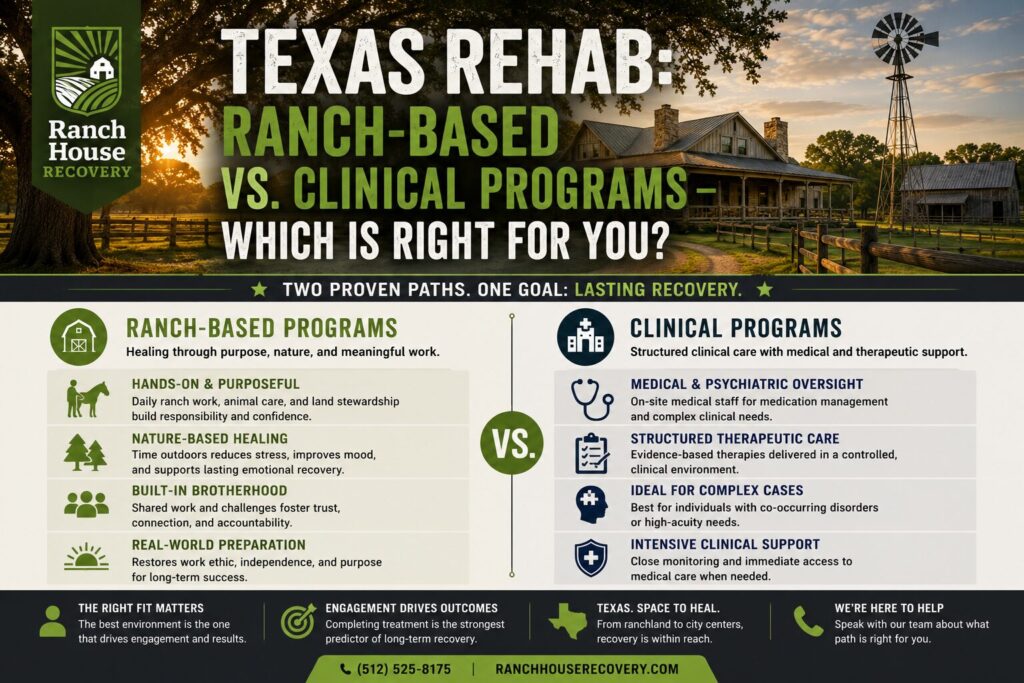
Clinical residential programs in Texas provide medically supervised treatment in a facility setting. The strengths of the clinical model are significant: higher-acuity psychiatric oversight, more immediate access to medical staff for complex medication management, and structured therapeutic programming delivered by licensed clinicians in a controlled environment.
For men with significant medical complexity alongside addiction, for example those who require close monitoring of psychiatric medications, who have serious physical health conditions, or whose addiction presentation is acute enough to require immediate clinical intervention, the clinical setting is often the appropriate starting point.
Clinical programs also tend to have strong established protocols for dual diagnosis treatment, crisis intervention, and medical monitoring that are harder to replicate in a more dispersed ranch setting. If the clinical picture includes significant psychiatric complexity, a clinical program’s medical infrastructure is a genuine advantage.
What Ranch-Based Texas Rehab Adds
Ranch-based programs like Ranch House Recovery integrate physical outdoor work, animal care, and land stewardship as therapeutic tools alongside licensed clinical programming. The therapeutic rationale is grounded in research on nature-based treatment, agricultural therapy, and the documented effects of purposeful physical activity on mood, anxiety, and impulse control.
At Ranch House Recovery, the Regenerative Recovery model treats the ranch environment as a clinical tool rather than a setting. Men who care for the same animals daily develop responsibility, attunement, and relational consistency. Men who do visible physical work on the land build confidence and a sense of productive contribution that many have lost during active addiction. Men who work alongside peers in outdoor physical tasks build the kind of trust through shared experience that clinical group sessions often take much longer to develop.
The ranch model also addresses a problem that clinical programs frequently encounter: passive engagement. A man who sits through group therapy, individual sessions, and psychoeducation groups without feeling genuinely engaged is at high risk for early departure from treatment. The physical demands and daily purpose of ranch life produce a different quality of engagement.
The Engagement Factor: Why It Matters More Than Setting
The most sophisticated clinical program produces no outcome if a man leaves in week two because he is disengaged, bored, or unconvinced that the environment has anything to offer him.
Treatment retention, measured as completing the full intended program length, is one of the strongest predictors of long-term sobriety across all treatment types and settings. A man who completes 90 days of ranch-based treatment with moderate clinical programming will almost always outperform a man who completes 14 days of the highest-quality clinical programming because he could not engage with the environment.
This is the central clinical argument for ranch-based treatment for the right population. For men who have found clinical settings passive, who feel disengaged by the sit-and-talk model of conventional treatment, who are physical, outdoor, or work-oriented in their natural engagement style, the ranch environment produces retention that other settings do not.
For men who are genuinely comfortable in clinical settings, who engage naturally with talk-based therapy, and who do not need the physical engagement of outdoor work to stay present, the clinical model is equally valid and may be preferable.
For more information, see residential treatment options in Texas and how to evaluate programs before deciding on a model.
Who Is Ranch-Based Rehab Best For
Ranch-based residential treatment in Texas is most effective for men who fit one or more of the following profiles.
Men who have tried clinical treatment before and disengaged. If a previous residential or outpatient program failed not because the content was wrong but because the environment did not hold a man’s engagement, a fundamentally different environment is worth trying before writing off treatment entirely.
Men who are physical or outdoor by nature. Men who have spent careers in physical work, who spend their free time outdoors, or who are fundamentally kinesthetic learners often engage with ranch-based treatment in ways they never engaged with clinical programming.
Men whose addiction has been accompanied by a loss of purpose or occupational identity. The working ranch provides immediate daily purpose and visible contribution. For men who have lost their sense of productive identity to addiction, this is often the first experience of meaningful occupation they have had in years, and it is powerfully therapeutic.
Men who are resistant to the clinical model. Some men arrive at treatment skeptical of therapy, resistant to the clinical process, or dismissive of group programming. The ranch environment frequently breaks down this resistance because the engagement starts in a domain that feels familiar and non-threatening.
For more information, see men-only addiction treatment center in Texas that combines ranch-based programming with rigorous clinical care.
Making the Decision for Your Situation
Here is a practical framework. If the primary clinical picture includes significant psychiatric complexity, acute medical management needs, or requires the infrastructure of a clinical facility, start with a clinical program and plan a transition to a ranch-based step-down or outpatient program if appropriate.
If prior clinical treatment has failed due to disengagement, if the man responds to physical work and outdoor environments, or if a sense of daily purpose and contribution is a missing ingredient in previous treatment attempts, ranch-based residential treatment is worth a serious look as the primary treatment option.
When in doubt, speak with the admissions teams at both types of programs. A good admissions team will tell you honestly if their program is not the right fit for the clinical picture and will point you toward a more appropriate option.
For more information, see finding the right Texas rehab center for men.
Frequently Asked Questions
Q: Is ranch rehab in Texas evidence-based?
Yes, when it combines licensed clinical staff and proven therapeutic modalities with the ranch-based programming. Ranch House Recovery integrates CBT, trauma-focused therapies, and Motivational Interviewing alongside the Regenerative Recovery ranch model.
Q: Is ranch-based rehab in Texas more expensive than clinical programs?
Not necessarily. Ranch-based and clinical programs vary in cost independently of each other. Ranch House Recovery is competitively priced within the private-pay residential market. Contact our admissions team at (512) 525-8175 for current pricing.
Q: Can I detox at a ranch-based rehab in Texas?
Ranch House Recovery does not provide on-site medical detox. Men requiring detox first complete that phase at a partner detox facility and then transition to the ranch for residential treatment.
Q: How do ranch-based and clinical programs compare on outcomes?
Outcomes research on nature-based and agricultural therapy programs is growing and generally positive, particularly for treatment retention and long-term sobriety in men who have previously disengaged from clinical settings. The strongest predictor of outcome across all program types remains treatment completion.
About the Author
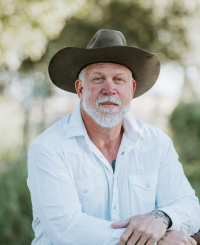
Brandon Guinn
Founder & CEO, Ranch House Recovery
Brandon Guinn founded Ranch House Recovery, a community-centered program for men recovering from addiction on a working ranch in Elgin, Texas. As a father whose family was touched by addiction, he built the program around daily structure, honest work, and lasting community.
Read Brandon’s full bio