What Should the Future of Addiction Treatment Actually Look Like?

Addiction treatment is having a national moment. In January 2026, a presidential executive order launched the White House Great American Recovery Initiative, framing addiction as a chronic and treatable disease and calling for tighter coordination across the many systems that touch recovery. Weeks later, the Department of Health and Human Services announced a $100 million investment through a program called STREETS, aimed at the overlap of addiction and homelessness. And by spring, a proposal to build rural wellness farms, modeled in part on a long-running Italian recovery community called San Patrignano, had moved from the campaign trail into Senate hearings and national reporting.
The coverage has been loud, and at times sharply political. Strip the politics away, though, and a more useful question sits underneath all of it. Not who is right. What actually works. What should the future of addiction treatment in America look like if we build it around evidence instead of headlines?
That is a question worth sitting with. Because the people most affected by the answer are not pundits in a studio. They are families trying to find help that lasts.
Why addiction treatment is still so fragmented
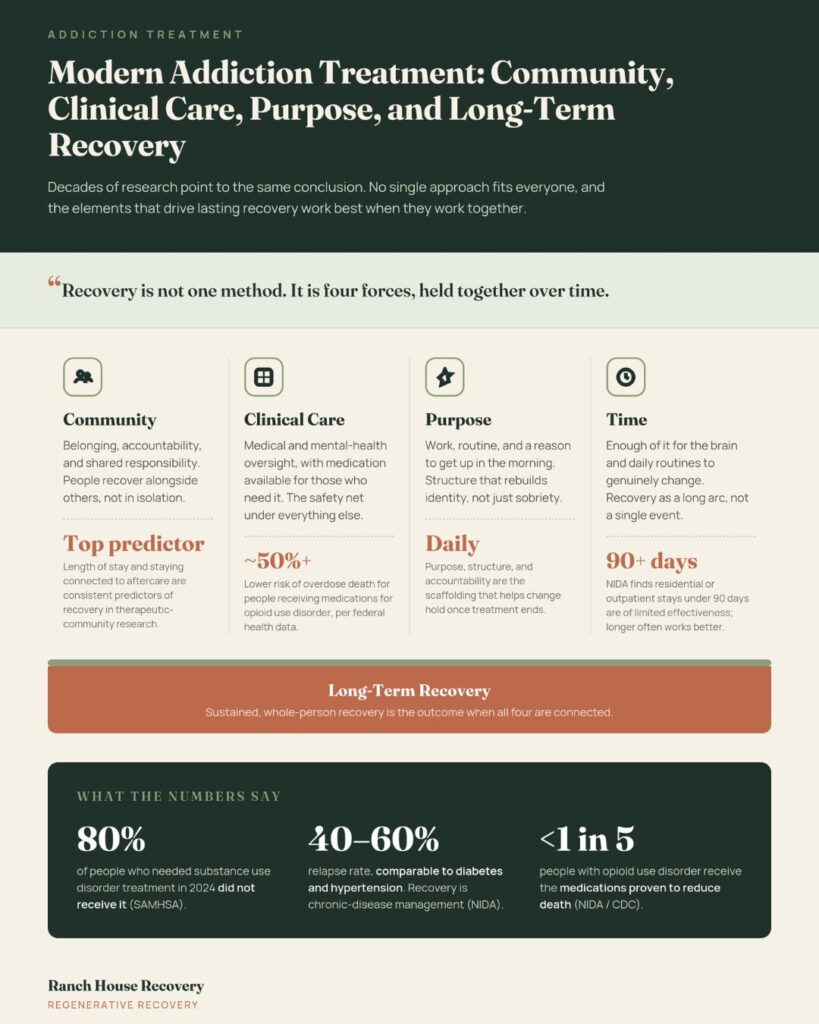
Start with an uncomfortable baseline. According to the federal government’s most recent national survey, roughly 80 percent of people who needed treatment for a substance use disorder in 2024 did not receive it. That gap is not only about access or cost, although both matter enormously. It reflects a system that grew up in pieces.
Detox sits in one place. Residential care in another. Outpatient counseling somewhere else, often with little communication between them. Medical care, mental health care, housing, and family support are frequently run by separate organizations that were never designed to talk to each other. A person can finish one stage of care and fall straight through the gap before reaching the next.
The human cost of that design shows up as a revolving door. Someone completes a short stay, returns to the same environment and the same stressors with no real bridge in place, and is back in crisis within weeks. It looks, from the outside, like personal failure. More often it is a handoff that never happened. When care is built as a series of disconnected episodes, relapse is not a surprise. It is close to the expected outcome.
Short programs compound the problem. The 28 or 30 day model remains common, partly because it is familiar and partly because it fits how insurance has historically paid. Yet decades of research point the other way. The National Institute on Drug Abuse has long held that for residential or outpatient treatment, stays shorter than 90 days tend to be of limited effectiveness, and that longer often works better. Addiction does not resolve on a billing cycle.
The growing pull toward community-based recovery
Some of the renewed interest in recovery farms and therapeutic communities is a direct reaction to that fragmentation. The appeal is intuitive. Instead of an isolated month of treatment, picture an environment where people live together, share responsibility, work with their hands, and rebuild a sense of purpose over time.
The model is not new. San Patrignano, the Italian community now cited in U.S. policy debates, was founded in 1978 and grew into a largely self-sustaining village of hundreds of residents, with its own farm, workshops, and vineyard. Therapeutic communities in the United States reach back even further. And the research on them is more encouraging than skeptics sometimes assume. A body of outcome studies suggests therapeutic communities can be both clinically effective and cost effective for people with severe substance use and co-occurring problems. Two factors stand out as consistent predictors of success: how long someone stays, and whether they remain connected to aftercare afterward.
There is real wisdom there. Purpose, structure, work, accountability, and belonging are not soft extras. For many people they are the scaffolding that makes lasting change possible.
The caution matters just as much. A beautiful setting is not a treatment plan. Community models have drawn criticism when they isolate people, reject medical care, or operate without clinical oversight. The question is never whether community matters. It is whether community is paired with real care.
That, in the end, is what the current debate over wellness farms is really about. Not whether land and work and belonging can help people heal. They clearly can, for many. The sharper question is what happens when a community model stands alone, cut off from medical expertise, mental health care, and the option of medication for those who need it. The most durable version of this idea keeps the warmth of community and adds the safeguards of clinical medicine. It does not ask people to pick one.
Evidence-based care and the abstinence question
This is where the public debate tends to harden into a binary, and where it helps to slow down. One side emphasizes abstinence, faith, and willpower. Another emphasizes medication and harm reduction. The framing implies you have to choose.
The evidence does not support a clean either or. For opioid use disorder in particular, medications such as buprenorphine and methadone are among the most studied tools in all of medicine. Federal health agencies report they substantially reduce the risk of overdose death, with some studies finding the risk cut by roughly half or more for people receiving them. The CDC is also direct that detox on its own, without follow-on treatment, is not recommended for opioid use disorder, because it raises the risk of relapse and fatal overdose. For someone whose life is on the line, that is not an ideological point. It is a safety one.
At the same time, medication is not a complete answer by itself either. A prescription does not rebuild a life. It does not repair relationships, restore a daily rhythm, or hand someone a reason to stay. That is the part community and purpose do well. The most honest reading of the research is that these approaches are not rivals. They are pieces of the same picture, and people tend to do best when the pieces actually fit together.
The ingredients that keep showing up
Look across the strongest studies and a recognizable set of elements appears again and again, no matter the label on the program.
- Time. Enough of it for the brain and the routines of daily life to genuinely change.
- Continuing care. Recovery treated as something that continues after discharge, not a single event with an end date.
- Family involvement. Support systems brought into the process rather than left in the waiting room.
- Purpose and structure. Work, responsibility, and a reason to get up in the morning.
- Individualized care. Treatment matched to the person, not the person bent to fit the program.
This is also why the chronic-disease comparison has gained ground. NIDA notes that relapse rates for substance use disorders sit in roughly the same range as conditions like hypertension and diabetes. We do not call insulin a failure when diabetes flares. We adjust the plan. Recovery deserves the same patience and the same long view.
What modern treatment centers can learn from recovery communities
Put those threads together and a direction comes into focus. The future of addiction treatment probably does not belong to the isolated clinic or the off-grid commune. It belongs to programs that combine the clinical rigor of medicine with the human depth of community.
That is the idea behind the Regenerative Recovery model used at Ranch House Recovery, a working recovery ranch near Austin. The setting is not decoration. Daily work, animals, land, routine, and shared responsibility become part of the therapeutic process, while clinical care supplies the structure and oversight that keep recovery grounded in evidence. The land regenerates. So, ideally, does the person.
For families weighing options in Central Texas, that integration is worth asking about directly. A quality residential treatment program near Austin should be able to explain how its clinical care and its community life actually connect, instead of presenting them as two separate brochures.
The practical test is continuity. Does the program think past discharge day? A center that has absorbed the research will talk openly about what comes after the residential stay: a step-down plan, ongoing support, a way to stay connected to peers, and a role for the family that does not end when the person comes home. The strongest programs treat the first ninety days as a beginning, not a finish line, and they are honest that recovery is a long arc rather than a single clean break.
Why individualized treatment still matters most
None of this means there is a single ideal program waiting to be cloned nationwide. The clearest finding in the entire field may be the least convenient one for policymakers: no single approach works for everyone. The right length of stay, the right role for medication, the right balance of clinical and community support all depend on the person, their substance, their history, and what they are walking back into.
A future built on one model, imposed everywhere, would repeat the mistakes of the past in a new costume. A future built on principles, time, continuity, family, purpose, clinical care, and genuine individualization, has a far better chance of helping more people stay well.
So, what should the future look like?
Less like a debate with two sides. More like a system that finally stops forcing people to choose between care that treats the body and care that rebuilds the life. The headlines will keep moving. The fundamentals, by now, are fairly clear. Treatment works best when it lasts long enough, looks at the whole person, brings the family in, and pairs sound medicine with a community worth returning to treatment in Austin, or you can simply call us. The hardest part is the part you are already doing.
Keep reading, more on modern addiction treatment
If these questions stay with you, a few companion pieces go further on the points that matter most. For a closer look at what separates programs that last from the rest, the breakdown of what makes addiction treatment effective pulls together the long-term research on treatment duration, continuing care, and family involvement.
The role of surroundings gets its own discussion in why environment matters so much during recovery, from peer influence and stress to the structure of an ordinary day. And for the longer view, how addiction treatment has evolved over time traces the path from isolation and confinement to the integrated, community-based care described here.
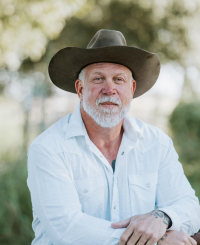
About the Author
Brandon Guinn
Founder & CEO, Ranch House Recovery
Brandon Guinn founded Ranch House Recovery, a community-centered program for men recovering from addiction on a working ranch in Elgin, Texas. As a father whose family was touched by addiction, he built the program around daily structure, honest work, and lasting community.
Read Brandon’s full bio