
RHR Blog
The Evolution of Addiction Treatment: From Isolation to Community-Based Recovery
Modern treatment can feel timeless. It is not. Its history is short, uneven, and surprisingly useful for understanding where the field is heading.
It is easy to assume addiction treatment has always looked roughly the way it does now. It has not. The field is young, its history is uneven, and many of the methods used today were developed only in the last few decades. Understanding that arc is not just trivia. It explains why the current debate over community models and clinical care keeps circling the same questions, and where the field appears to be settling.
The throughline is a slow movement from isolation toward integration. From locking people away, to building communities around them, to combining community with real medicine. The field has not traveled that path in a straight line. But the direction is hard to miss.
The early era: isolation and moral reframing
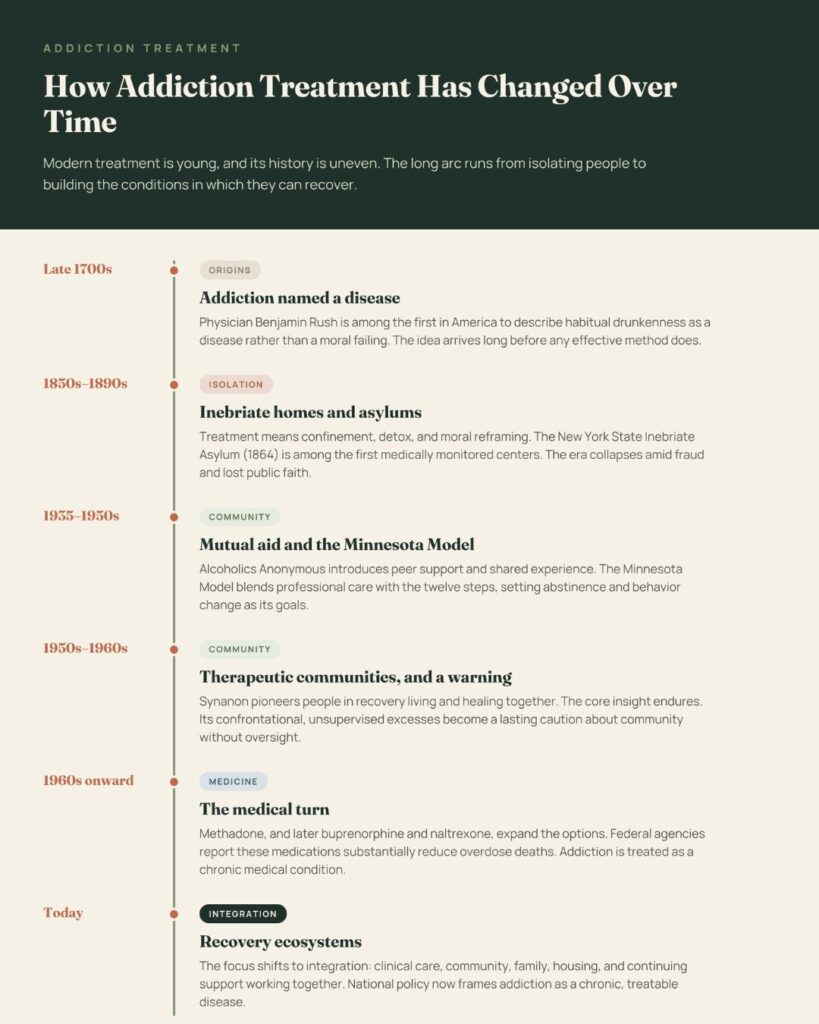
In the late 1700s, the physician Benjamin Rush, a signer of the Declaration of Independence, was among the first Americans to describe habitual drunkenness as a disease rather than simply a moral failing. The idea was ahead of its time. The treatments were not. Early approaches leaned on isolation, confinement, and what amounted to moral reeducation.
By the 1850s, inebriate homes began opening in and around Boston, modeled on the insane asylums of the day, offering detoxification, separation from drinking culture, and moral reframing. In 1864, the New York State Inebriate Asylum became one of the first medically monitored addiction facilities in the country. According to historians of the field documented by Shatterproof, this first generation of treatment largely collapsed by the 1890s amid fraud, stigma, and lost public faith, after which people with addiction were often sent to drunk tanks, jails, and the back wards of hospitals. Isolation, in other words, was the default for a very long time.
It was also an era thick with quackery. Proprietary cures promised to dissolve addiction with secret tonics and bottled remedies, sold aggressively and backed by almost nothing. When those promises failed, as they inevitably did, they took public confidence down with them. The lesson buried in that collapse still echoes. Confident claims and a controlled setting are not the same as effective care, and a field that forgets the difference tends to lose the trust it depends on.
The disease model takes root
The middle of the twentieth century brought a shift in both attitude and method. The founding of Alcoholics Anonymous in 1935 introduced something the asylums never had: mutual support, peer counseling, and a structured path built on shared experience rather than confinement. Optimism about recovery began to return.
Out of that era came the Minnesota Model, developed around the late 1940s and 1950s, which blended professional clinical care with the twelve-step philosophy and set abstinence and behavioral change as its goals. It became one of the most influential templates in American treatment, and its DNA is still visible in many programs today. For the first time, recovery was framed as something people could be guided toward, together.
What made this period a genuine turning point was not any single technique. It was a change in belief. The asylum era had quietly concluded that lasting recovery was unlikely, which is part of why it treated people as problems to contain. The mutual-aid movements and the models they inspired insisted on the opposite, that ordinary people could and did recover, often by helping one another. That cultural shift, more than any specific program, set the stage for everything that followed.
Therapeutic communities emerge, and a cautionary tale
The 1950s also produced the first therapeutic communities for addiction, pioneered by a California group called Synanon. The core idea was genuinely new and genuinely powerful: people in recovery living together, holding one another accountable, and healing through community rather than isolation. Much of what we now know about community as a method traces back to that experiment.
It is also a warning. Synanon’s confrontational practices grew harsh, its leadership grew controlling, and the organization eventually collapsed into what many later described as a cult. The lesson the field took from it is the same one at the center of today’s debates. Community can be a profound engine of recovery. Community without clinical oversight, accountability, and basic safeguards can do real harm. The model and its failures arrived together.
What is striking is how much the field kept even as it rejected the abuses. The insight that people recover powerfully in community, that peers can reach one another in ways professionals cannot, that structure and shared responsibility heal, all of that survived and matured into the modern therapeutic community. The confrontation, coercion, and isolation did not. Later research on therapeutic communities, conducted with proper oversight, found that the model can be effective for people with serious substance use problems. The good idea was real. It just needed guardrails.
The medical turn
Alongside the rise of community models came a parallel medical revolution. Methadone maintenance was introduced in the 1960s, and later buprenorphine and naltrexone expanded the options. These were not replacements for counseling or community. They were tools that, for the right people, kept them alive long enough for everything else to work.
The evidence has only strengthened since. Federal health agencies report that medications for opioid use disorder, especially buprenorphine and methadone, substantially reduce the risk of overdose death. This medical turn cemented a broader shift the field had been moving toward for two centuries: treating addiction as a chronic, treatable medical condition rather than a moral verdict.
The medical era also brought its own blind spot, one the field is still working through. For years, some abstinence-based programs viewed medication with suspicion, treating it as a crutch or a lesser form of recovery. The result was that proven, life-saving treatments stayed underused even as overdose deaths climbed. That tension, between a community-and-abstinence tradition and a medical one, is exactly the divide playing out in today’s public debates. History suggests the resolution is not to pick a side but to stop treating them as opposites.
Today: recovery ecosystems
The current era is defined less by any single method than by integration. Researchers now talk about recovery capital and recovery ecosystems, the web of clinical care, community, family, housing, peer support, and continuing care that surrounds a person over time. The recognition is that no one piece is sufficient, and that the pieces work best connected.
Even national policy reflects the shift. The 2026 Great American Recovery Initiative frames addiction as a chronic, treatable disease and calls for better coordination across the many systems that touch recovery. The language of silos and coordination is, in a sense, the field naming the central lesson of its own history.
The ecosystem idea also reframes relapse and success. If recovery depends on a web of supports rather than a single program, then a setback points less to a person’s failure and more to a gap in the web, a missing connection to aftercare, a return to an unstable home, a community that fell away. That is a more useful way to think, because gaps can be closed. It moves the field’s attention from blaming individuals toward building the conditions in which more people can stay well, which is, arguably, where the entire two-century arc has been heading all along.
From isolation to integration
Stand back and the pattern is clear. The early era isolated people and largely failed them. The community era proved how powerful belonging can be, and how dangerous it becomes without safeguards. The medical era added tools that save lives but cannot, alone, rebuild one. Each correction overcorrected, and the field kept relearning that the answer was rarely one thing.
That is why the most current direction is synthesis. The Regenerative Recovery model is one example of where this leads: the community, structure, and purpose that the best therapeutic communities understood, paired with the clinical care the medical era made non-negotiable. For families looking at a residential program near Austin, the relevant question is no longer community or medicine. It is how well a program brings the two together.
History also offers a quiet caution against the next overcorrection. It is tempting, in any era, to declare that one approach is the answer and to build everything around it. The asylum did that with confinement. Synanon did it with confrontation. Parts of the field did it with abstinence, and others with medication. Each captured something real and then mistook the part for the whole. The most durable lesson of two centuries may simply be humility: hold on to what works in each tradition, stay honest about its limits, and resist the urge to crown a single winner.
A long argument, still being settled
The history of addiction treatment is, in the end, a long argument the field is still working out. It has swung between confinement and community, between willpower and medicine, between isolation and connection. The trajectory, though, points in one direction. Away from treating people as problems to be removed, and toward building the conditions in which they can recover. The future, if it follows the arc, will look less like a single model imposed everywhere and more like integration done well.
About the Author
Brandon Guinn
Founder & CEO, Ranch House Recovery
Brandon Guinn founded Ranch House Recovery, a community-centered program for men recovering from addiction on a working ranch in Elgin, Texas. As a father whose family was touched by addiction, he built the program around daily structure, honest work, and lasting community.
Read Brandon’s full bio