
RHR Blog
Achieve Long Term Sobriety With Proven Addiction Treatment Techniques
Medically reviewed by Cristy De La Rosa, LMFT-A, LCDC, ADHD-CCSP · Last reviewed September 2026
Long-term sobriety is sustained, ongoing freedom from substance use, supported by evidence-based treatment, consistent aftercare, and a dependable support system. It is less a single finish line than a way of living that a person rebuilds one day at a time. For many families, the hardest question is not how to get a loved one into treatment. It is what happens after. A man completes a program, everyone feels hopeful, and then the ordinary pressures of work, relationships, and stress return. Understanding what actually protects recovery over months and years is what turns early progress into lasting change.
This guide explains what long-term sobriety looks like, why addiction is a treatable medical condition, which treatments have the strongest evidence behind them, and how residential care, aftercare, and a strong support network work together. It is written for men who are considering treatment, for the families who love them, and for anyone researching options before making a decision.
Quick answer Lasting recovery rarely comes from one intervention. It comes from a foundation built in structured treatment, reinforced by aftercare, and sustained by relationships and healthy routines. The people who do best tend to treat recovery as an ongoing practice rather than a task they complete once.
What long-term sobriety actually means
Long-term sobriety signifies more than the absence of a substance. It represents a redefined life, one where a person rebuilds identity, relationships, and purpose rather than simply going without. Sobriety that lasts is measured not only in days counted but in the return of things addiction takes away: trust, health, steady work, and self-respect.
Common recovery milestones
Milestones give recovery shape and motivation. They vary from person to person, but often include the following:
- Completing a supervised detox and stabilizing physically.
- Finishing a residential or outpatient program with a clear plan for what comes next.
- Reaching 30 days, 90 days, one year, and beyond of continuous sobriety.
- Repairing a relationship, returning to steady work, or rebuilding financial stability.
- Recognizing a craving or a hard day and using a coping strategy instead of using a substance.
These markers matter because they make invisible progress visible. Celebrating them, even quietly, reinforces the behaviors that keep recovery moving forward.
Addiction is a treatable medical condition, not a moral failing
One of the most important shifts a person and their family can make is to see addiction for what it is. The American Society of Addiction Medicine defines addiction as a treatable, chronic medical disease involving the brain’s circuits for reward, motivation, and memory. This framing is not an excuse. It is the starting point for effective care, and it removes the shame that keeps so many men from asking for help.
Research summarized by the National Institute on Drug Abuse shows that repeated substance use changes brain chemistry, especially in the dopamine pathways tied to pleasure and reward. Over time those changes drive compulsive use even when a person wants to stop. The encouraging part is that the brain is not fixed. Through a process called neuroplasticity, it can gradually recover and rewire during sustained abstinence, which is one reason cognitive function, mood, and decision-making often improve with time in recovery.
Why the first phase of treatment matters
Successful early treatment sets the tone for everything that follows. A strong start usually pairs medically appropriate stabilization with a clear, individualized treatment plan. Effective programs assess the substance involved, how long use has continued, any co-occurring mental health conditions, and a person’s home and social environment, then build a plan around those specifics rather than a one-size template.
The goal of this phase is to equip a person with tools before real-world triggers return: ways to handle cravings, name emotions, and reach for support. When that groundwork is solid, the odds of staying well over the long term rise considerably.
Evidence-based treatments that support lasting recovery
No single method works for everyone, which is why quality programs combine approaches. The following have the strongest research support.
Behavioral therapies
Behavioral therapies help a person identify triggers and build healthier responses. Cognitive behavioral therapy, or CBT, works by restructuring the thought patterns that fuel use. Dialectical behavior therapy, or DBT, adds skills for managing intense emotions. Motivational interviewing helps a person strengthen their own reasons for change. These approaches are especially valuable for men who are also managing depression, anxiety, or unresolved trauma.
Medication-assisted treatment
Medication-assisted treatment, or MAT, combines FDA-approved medications with counseling and behavioral therapy. For opioid use disorder, medications such as buprenorphine, methadone, and naltrexone reduce cravings and lower the risk of relapse and overdose. The Substance Abuse and Mental Health Services Administration describes MAT as a whole-person approach, not a replacement of one substance for another. When appropriate, it can bridge the gap between acute treatment and durable recovery.
Dual diagnosis and co-occurring care
Many people who struggle with substances also live with a mental health condition such as depression, anxiety, or post-traumatic stress. Treating only the addiction while leaving the underlying condition unaddressed is one of the most common reasons recovery stalls. Integrated dual diagnosis care treats both at the same time, which consistently produces better outcomes than treating either alone.
Whole-person and holistic supports
Approaches such as mindfulness practice, physical activity, time outdoors, and nutritional support do not replace clinical treatment, but they strengthen it. They lower stress, improve sleep and mood, and help a person stay present with a craving instead of acting on it. This whole-person emphasis is central to the Regenerative Recovery model at Ranch House Recovery, where the daily rhythm of a working ranch becomes part of how men rebuild.

Understanding levels of care
Recovery is usually delivered along a continuum of care, with a person moving to less intensive support as they stabilize. The right starting point depends on the severity of use, physical health, and home environment. The table below outlines the main levels.
| Level of care | What it involves | Who it tends to fit |
| Medically supervised detox | Short-term, supervised withdrawal management. Ranch House Recovery coordinates this step through trusted partner facilities rather than providing it on site. | People who need physical stabilization before therapeutic work begins. |
| Residential treatment | Full-time, live-in care with structure, therapy, peer community, and daily routine away from old triggers. | Men who need a full reset and a stable environment to build a foundation. |
| Intensive outpatient | Several structured therapy sessions per week while living at home or in sober housing. | Those stepping down from residential or with strong home support. |
| Ongoing outpatient and aftercare | Regular counseling, peer support, and relapse-prevention check-ins over the long term. | Anyone maintaining recovery and reintegrating into daily life. |
If you are weighing options, our guide on what to look for in a residential drug rehab in Austin walks through the questions worth asking before you commit.
The role of residential treatment
Residential treatment offers something outpatient care cannot: full removal from the environment where addiction took hold, replaced by structure, community, and around-the-clock support. For many men, that separation is what finally makes room for honest work on the underlying issues.
Ranch House Recovery is a men’s residential program set on a working ranch in Elgin, Texas, about thirty minutes east of Austin. The setting is intentional. Physical work, routine, and a supportive peer community give men a place to reset and rebuild. Detox is coordinated through trusted partner facilities rather than provided on site, so that stabilization happens under appropriate medical supervision before residential work begins. You can learn more on the admissions page.
Aftercare and relapse prevention
Aftercare is what carries recovery from the structure of a program back into ordinary life, and it is one of the strongest predictors of lasting sobriety. It includes ongoing counseling, peer support, alumni connection, and a written plan for the moments that carry the most risk.
Building a relapse prevention plan
A good plan is specific to the person. It names individual triggers and high-risk situations, lists early warning signs, and spells out concrete responses: who to call, where to go, and what to do when a craving hits. Building it with a counselor, then revisiting it as life changes, keeps it useful rather than theoretical.
Understanding relapse without shame
It helps to know the odds honestly. The National Institute on Drug Abuse notes that relapse rates for addiction are similar to those for other chronic conditions such as hypertension and asthma, roughly 40 to 60 percent. A return to use does not mean treatment failed. It signals that the plan needs adjustment, much as a flare of a chronic illness signals a change in treatment rather than a moral collapse. Recognizing early warning signs, such as growing isolation, mood shifts, or skipped routines, gives a person a window to act before a slip becomes a full return.
Building a support system for lasting recovery
Recovery is not a solitary effort. The men who sustain it are almost always surrounded by people who hold them accountable and remind them why they started.
- Peer support. Groups of others in recovery offer empathy, accountability, and hard-won practical wisdom that is difficult to find anywhere else.
- Family involvement. When families understand addiction and learn healthier communication, they become a source of stability rather than stress. Family counseling and education strengthen those bonds.
- Sober friendships. New relationships built around shared interests and healthy routines replace the social patterns that once encouraged use.
- Professional support. Continued work with counselors and therapists helps a person adjust strategies and address new challenges before they grow.
Healthy coping and daily structure
Cravings and stress do not disappear in recovery, so the practical skill is learning to meet them differently. A few habits do most of the work.
- Know your triggers. Track the situations, people, and emotions that precede cravings so you can plan ahead instead of reacting.
- Manage stress deliberately. Breathing exercises, mindfulness, and regular physical activity lower stress hormones and steady mood.
- Keep a routine. Predictable days reduce decision fatigue and leave fewer openings for old patterns to return.
- Care for the body. Steady sleep, movement, and nutrition support the brain chemistry recovery depends on.
Is residential treatment the right fit?
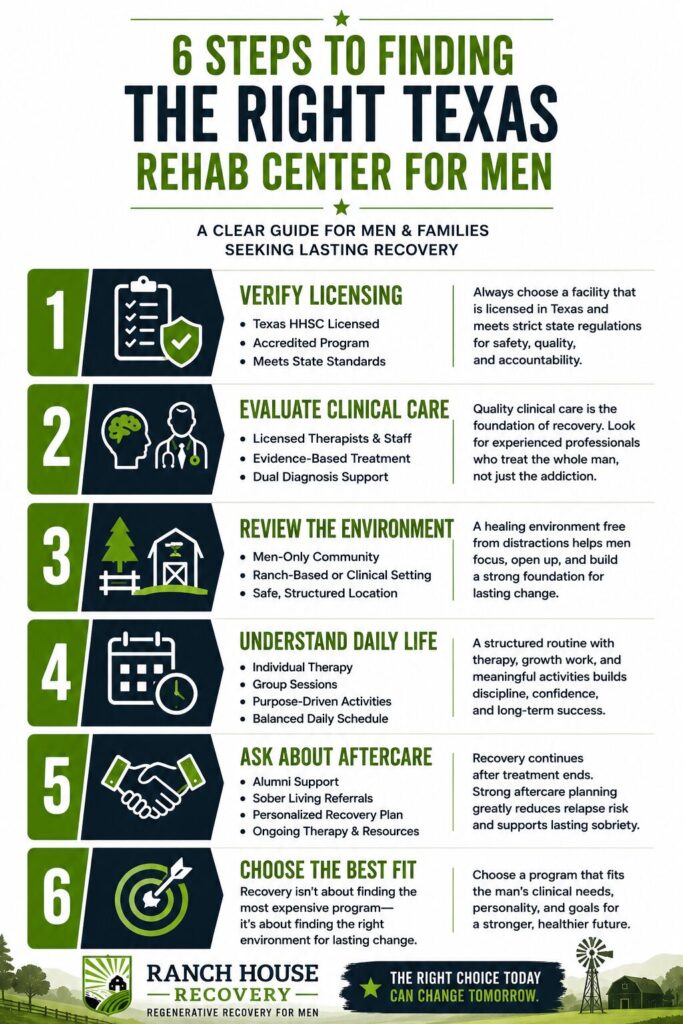
Residential treatment is a strong fit for a man who needs a full reset: someone whose home environment makes sobriety difficult, who has tried outpatient support without lasting results, or who benefits from structure and distance from daily triggers. It also suits those managing a co-occurring mental health condition who need concentrated, integrated care.
It may not be the right first step for everyone. A person in acute medical withdrawal needs supervised detox before residential care. Someone with strong home support and milder use may do well starting with intensive outpatient treatment. And because Ranch House Recovery is a men’s program and does not accept insurance, it is worth confirming that the setting and the private-pay model fit your situation before enrolling. Our guide on how to choose the right rehab in Texas can help you compare, and an honest conversation with an admissions specialist is the fastest way to find out.
Common myths about addiction and recovery
- Myth: relapse means treatment failed. Recovery is often not linear. A slip is a signal to adjust the plan, not proof that change is impossible.
- Myth: a person has to hit rock bottom first. Earlier treatment generally leads to better outcomes. There is no benefit in waiting for things to get worse.
- Myth: willpower is enough. Addiction changes brain function. Structured treatment and support address what willpower alone cannot.
- Myth: once treatment ends, recovery is over. The period after a program is when aftercare and support matter most.
Frequently asked questions
How long does it take to reach long-term sobriety?
There is no fixed timeline, because recovery is ongoing rather than a single destination. Many programs describe the first year as foundational, with the risk of relapse decreasing as sustained abstinence, healthy routines, and support systems become established. What matters more than a specific number is continued engagement with treatment and aftercare.
What is the difference between detox and treatment?
Detox is the short, medically supervised process of clearing a substance from the body and managing withdrawal safely. Treatment is the longer therapeutic work that follows, addressing the causes of addiction and building skills for lasting change. Detox alone rarely leads to sustained recovery, which is why it is a first step rather than the whole journey.
Does long-term recovery require lifelong support?
Many people find that ongoing support, whether through peer groups, counseling, or alumni connection, is what keeps recovery strong over the years. The intensity often decreases with time, but staying connected to support is one of the most reliable protectors against relapse.
What causes relapse, and does it mean treatment failed?
Relapse is usually driven by a mix of stress, unresolved emotions, and exposure to old people or places tied to use. It does not mean treatment failed. Addiction is a chronic condition, and a return to use is a sign to adjust the recovery plan and re-engage with support, not a reason for shame.
How does residential treatment differ from outpatient care?
Residential treatment provides full-time, live-in care with structure, therapy, and community away from daily triggers. Outpatient care lets a person live at home while attending scheduled sessions. Residential care suits those who need a complete reset, while outpatient care suits those with strong home support or those stepping down from a higher level of care.
Can someone recover if they also have a mental health condition?
Yes. Co-occurring conditions such as depression, anxiety, or post-traumatic stress are common, and integrated dual diagnosis care treats both the addiction and the mental health condition at the same time. Addressing both together consistently leads to better and more durable outcomes.
How can families support a loved one in recovery?
Families help most when they learn about addiction, communicate honestly without enabling, and take part in family counseling when it is offered. Caring for their own wellbeing matters too, since a steady, informed family is a powerful source of support.
Conclusion
Long-term sobriety is built, not found. It begins with understanding addiction as a treatable medical condition, takes shape through evidence-based treatment and the right level of care, and endures through aftercare, healthy routines, and people who show up. Setbacks are part of many recovery stories, and they do not erase progress. With structure, support, and time, a full and meaningful life in recovery is not only possible, it is what treatment is designed to make reachable.
Take the next step
If you or a man you love is ready to build a foundation for lasting recovery, Ranch House Recovery is here to help. Our men’s residential program near Austin, Texas offers structure, community, and evidence-based care through our Regenerative Recovery model. Speak with an admissions specialist to ask questions and schedule an assessment, with no pressure and no judgment.
Call (512) 525-8175 or visit our admissions page to begin the conversation.If you need immediate, free, and confidential help at any hour, the SAMHSA National Helpline is available at 1-800-662-HELP (4357).

About the Author
Brandon Guinn
Founder & CEO, Ranch House Recovery
Brandon Guinn founded Ranch House Recovery, a community-centered program for men recovering from addiction on a working ranch in Elgin, Texas. As a father whose family was touched by addiction, he built the program around daily structure, honest work, and lasting community.
Read Brandon’s full bio