12-Step Addiction Recovery in Texas: How It Works in 2026

The 12 steps are 90 years old this year. Bill Wilson and Dr. Bob Smith met in Akron in 1935, and the model they built has since spread to more than 180 countries, served tens of millions of people, and quietly become the most widely practiced framework for addiction recovery on earth. It’s also one of the most misunderstood.

If you’re researching 12-step addiction recovery in Texas right now, you’ve probably already encountered the basic confusion: Is it a religion? Is it a therapy? Does it actually work? Is it compatible with medication-assisted treatment? With modern clinical care? With evidence-based medicine?

This guide walks through what 12-step recovery actually is, what the research says about it, how it fits into a modern Texas treatment program, and how to know whether the spiritual and community elements are the right fit for you or a loved one. If you’re in immediate crisis, call SAMHSA’s National Helpline at 1-800-662-HELP (4357). It’s free, confidential, and available 24/7.

What the 12 steps actually are

The 12 steps are a structured sequence of personal and interpersonal work that people in recovery move through, usually with the help of a sponsor. They include taking honest inventory of one’s life, making amends for harm caused, developing a personal sense of meaning and spiritual practice (in whatever form that takes), and committing to ongoing service to others in recovery. The work is usually done in community: meetings, sponsor relationships, and a fellowship that extends outside the meeting room.

Alcoholics Anonymous is the original 12-step program. Narcotics Anonymous, Cocaine Anonymous, Heroin Anonymous, Crystal Meth Anonymous, and dozens of other adaptations apply the same framework to different substances. There are also non-substance fellowships (Al-Anon for family members of alcoholics, Adult Children of Alcoholics, and others). The structure is fundamentally the same.

The official Alcoholics Anonymous website has the original Twelve Steps and Twelve Traditions, the Big Book, and meeting finders. AA itself is not a treatment center, doesn’t charge fees, and has no opinion on what specific clinical treatment a person should pursue. It’s a recovery fellowship.

What the research says about 12-step effectiveness

For decades, 12-step recovery was treated as cultural folklore by much of the academic medical community. That has changed.

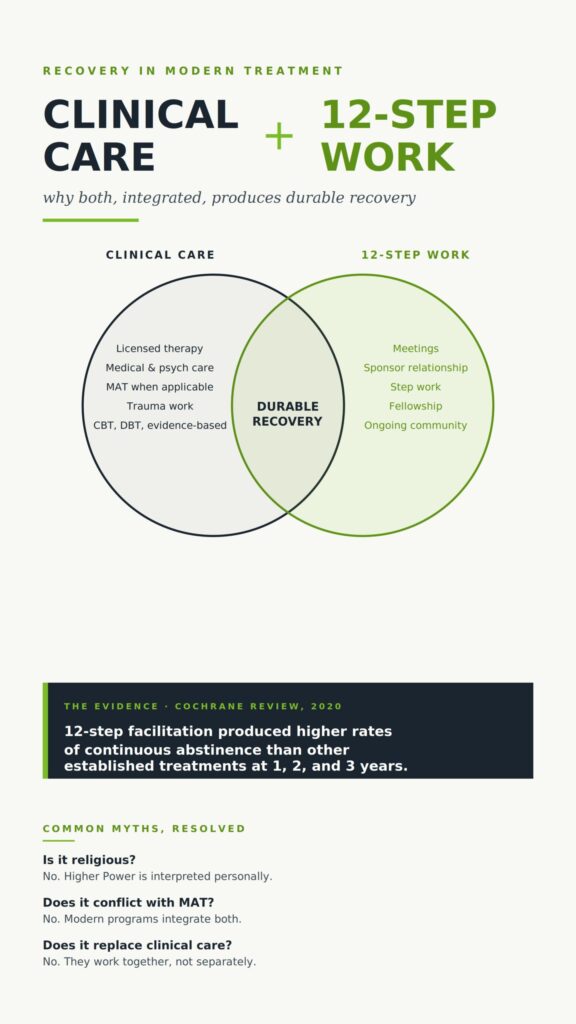
In 2020, the Cochrane Collaboration published a systematic review of Alcoholics Anonymous and 12-step facilitation programs. Cochrane reviews are considered among the most rigorous evidence syntheses in medicine. The finding: AA and 12-step facilitation produced higher rates of continuous abstinence than other established treatments at the one-year, two-year, and three-year marks for people with alcohol use disorder. It was the first systematic review to give 12-step recovery this level of credentialed empirical support.

The National Institute on Drug Abuse recognizes 12-step facilitation as an evidence-based clinical approach alongside CBT, motivational interviewing, and contingency management. It’s not folk medicine. It’s a tested intervention with a substantial outcome literature.

What 12-step recovery is especially good at is producing the long-term, durable, community-supported recovery that’s hardest to achieve through clinical treatment alone. The meetings don’t end at discharge. The sponsor relationship doesn’t end at discharge. The fellowship doesn’t end at discharge. This is part of why the model has survived for nearly a century.

The spiritual question

The biggest source of confusion about 12-step work is the “spiritual” language. Steps 2, 3, 5, 6, 7, and 11 reference a “higher power” or “God as we understood him.” For some people, especially those coming from secular or skeptical backgrounds, this is a stopping point.

A few things worth knowing:

  • AA’s own foundational text is explicit that the higher power can be conceived in whatever way works for the individual: the group itself, the natural world, the principles of the program, or a traditional religious conception. The framework is intentionally non-doctrinal.
  • A substantial portion of long-term 12-step members, particularly in urban and coastal areas, identify as agnostic, atheist, or non-religious and have found ways to work the steps that don’t require any specific theological commitment.
  • The “spiritual awakening” the steps describe is generally interpreted as a fundamental shift in self-understanding, values, and relationships, not necessarily a religious conversion.

That said, some Texas programs are explicitly Christian and integrate Christian theology directly into their version of 12-step work. Others are deliberately ecumenical. Knowing which type of program you’re considering matters.

12-step recovery vs. Christian rehab vs. spiritual programs

These terms get used interchangeably in marketing but mean different things:

12-step programs follow the AA/NA framework, which is non-denominational and accommodating of varied spiritual or non-religious frameworks.

Christian rehab programs integrate Christian theology, Bible study, prayer, and pastoral care as core treatment components. Some use the 12 steps; many use distinct frameworks like Celebrate Recovery (which is explicitly Christian and uses a Christ-centered adaptation of the steps).

Spiritual recovery programs for men is a broader category that can include 12-step, Christian, Eastern (mindfulness-based), or eclectic approaches that prioritize meaning-making, contemplative practice, and identity reconstruction as part of recovery.

The right fit depends on the person. Someone with a strong existing Christian faith may do best in an explicitly Christian program. Someone with a complicated history with organized religion may do better in a non-denominational 12-step framework. Someone for whom the spiritual language is a barrier may do better with SMART Recovery or a clinically-driven program with 12-step participation as one option among several.
How 12-step recovery fits into a clinical treatment program

A good residential treatment program in Texas typically integrates 12-step participation as one component among several. The clinical work happens in licensed therapy sessions. The medical work happens with the medical and psychiatric staff. The 12-step work happens in meetings, in step work with a sponsor, and in the recovery community.

The integration matters because each piece does something the others can’t. Clinical therapy addresses trauma, co-occurring mental health conditions, and the psychological underpinnings of the addiction. Medical care manages withdrawal, MAT where appropriate, and co-occurring physical conditions. 12-step work provides the community, the framework for ongoing recovery, and the practical structure (sponsor, meetings, step work) that continues after discharge.

A program that’s purely 12-step with no licensed clinical work isn’t a clinical treatment program. A program that’s purely clinical with no recovery community connection isn’t preparing people for the long-term work. The integration is the point.

You can see how this looks in practice at Ranch House Recovery’s 12-step program in Texas, which combines daily 12-step work with licensed clinical care, family work, and the experiential modalities of ranch-based recovery.

The MAT question

One common misconception is that 12-step recovery is incompatible with medication-assisted treatment (MAT) for opioid use disorder. This was true of some traditional AA culture decades ago and is still occasionally true of individual meetings or sponsors. It is not true of mainstream 12-step recovery in 2026.

NA’s official literature explicitly does not take a position on MAT, and most contemporary clinicians integrating 12-step recovery with treatment for opioid use disorder do so with no clinical or philosophical conflict. The combination of buprenorphine maintenance and active 12-step participation produces outcomes that are very hard to beat for severe opioid use disorder. If a treatment program tells you that you have to choose between MAT and 12-step recovery, that’s a program operating on outdated dogma rather than current evidence.

What a 12-step-informed residential day looks like

A residential treatment program with integrated 12-step work typically has:

  • Morning structure that often includes a meditation or reading from recovery literature.
  • Individual or group therapy with licensed clinicians during the clinical day.
  • A daily 12-step meeting (in-house, off-site, or both).
  • Step work done with a sponsor or in groups, depending on phase of treatment.
  • Service activities in the community.
  • Family work that often parallels the family’s own engagement with Al-Anon or similar fellowships.

You can see how this translates into a specific weekly schedule on our programming page, which lays out a typical week including clinical, experiential, and 12-step components.

How to find 12-step recovery in Texas

A few starting points:

  • AA Texas and NA Texas regional directories maintain meeting lists statewide, accessible through the meeting locator on the main Alcoholics Anonymous website referenced earlier.
  • The federal FindTreatment.gov treatment locator includes filters for treatment philosophy and is a non-commercial alternative to lead-generation sites.
  • Most Texas residential treatment programs that incorporate 12-step recovery will say so explicitly on their website and will be transparent about how they balance clinical work and 12-step participation.

Where Ranch House Recovery fits

Ranch House Recovery is a long-term residential addiction treatment program for men in the Austin area. The 12 steps are foundational to the model, integrated with licensed clinical care, therapeutic farming, animal-assisted recovery work, and the daily structure of a working ranch. The program is non-denominational and works with men from a wide range of spiritual and religious backgrounds, including men with no prior religious framework.

For the thinking behind why we built the program this way, our philosophy page is the most honest two-minute read on the site. To see what a day-by-day residential stay looks like, the residential program page walks through the structure.

The bottom line

The 12 steps work for an enormous number of people. They don’t work for everyone, and they don’t replace clinical care. But for the right person, in an integrated treatment program, the combination of licensed clinical work and active 12-step participation produces durable recovery at rates that are very hard to match through clinical work alone.

If you’re considering whether a 12-step-integrated residential program is the right fit for you or your loved one, the conversation starts with a phone call. Reach our admissions team here when you’re ready. If we’re not the right fit, we’ll say so and try to point you to a program that is.d try to point you to a program that is.

What Is a Wellness Farm? The Recovery Model, Explained

The phrase “wellness farm” has gone from an obscure clinical term to something close to a national conversation in the last two years. Some of that is policy: federal proposals have brought wellness farms into the public addiction-treatment debate. Some of it is cultural: a generation watching the failure of short-term, urban, medicalized rehab has started looking at older, slower, land-based models with fresh interest.

So what actually is a wellness farm? Is it a real treatment model or a marketing rebrand of something else? Does the research support it? Who is it right for?

This guide answers those questions directly. If you or someone you love is in crisis right now, call SAMHSA’s National Helpline at 1-800-662-HELP (4357). It’s free, confidential, and runs 24/7.

What a wellness farm actually is

A wellness farm is a residential treatment setting (typically for addiction, sometimes for mental health, sometimes for both) that uses agricultural work, animal care, time in nature, and a working-farm daily structure as integrated parts of the clinical model. The defining features:

  • A working agricultural environment with real crops, animals, gardens, or livestock that residents care for as part of their daily routine.
  • A residential setting where residents live on-site for weeks or months, not a day-program format.
  • Integrated clinical care with licensed therapists, medical and psychiatric oversight, and a structured treatment program.
  • A community model where residents work, eat, and recover together over an extended stay.
  • Distance from urban using environments, which itself functions as a clinical variable.

The model is sometimes called “therapeutic farming,” “farm-based rehab,” “ranch rehab,” “regenerative recovery,” or “horticultural therapy” depending on which features are emphasized. The underlying clinical logic is the same: setting and daily structure are themselves treatment, not background.

Where the model comes from

Wellness farms aren’t a new invention. The therapeutic-community tradition of the 1960s and 1970s included farm-based recovery settings (Synanon’s various rural campuses, Daytop Village, Phoenix House, and others ran agricultural components for decades). Before that, the late-19th and early-20th-century inebriate asylum movement frequently used farm settings as a treatment environment, drawing on still older monastic and Quaker traditions of recovery work done in rural community.

What’s new in 2026 is the integration of the historical farm-based model with modern, licensed, evidence-based clinical care. Programs that work today aren’t doing 1970s therapeutic-community work, and they aren’t doing 19th-century moral-treatment work. They’re combining the strengths of the agricultural setting and community structure with the clinical rigor of contemporary addiction medicine and licensed mental health care.

Why the daily structure of a farm matters clinically

The clinical case for wellness farms doesn’t rest on aesthetics. It rests on several specific mechanisms that the research base has been clarifying for the last two decades.

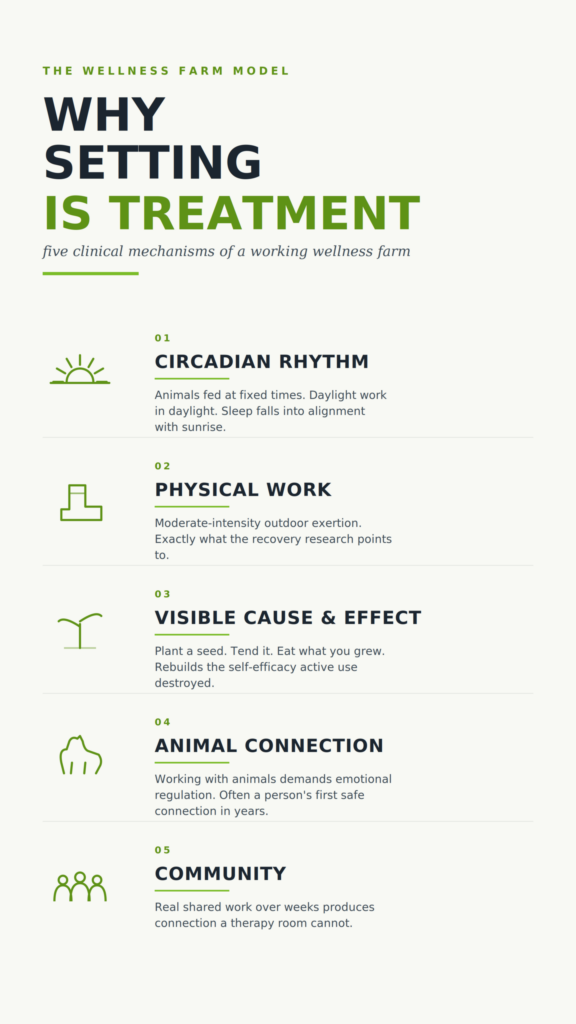
Circadian regulation

Early recovery brains do poorly with disrupted sleep and irregular schedules. Animals need to be fed at specific times. Daylight work has to happen during daylight. Sleep falls into alignment with sunrise and sunset whether the person plans it that way or not. The National Institutes of Health’s research on sleep, circadian rhythms, and addiction has documented how badly substance use disrupts sleep architecture, and how much sleep regularization matters for early recovery. A working farm imposes a circadian discipline that’s nearly impossible to replicate in an indoor clinical setting.

Physical work and the recovery brain

A growing body of evidence supports physical activity as a clinically meaningful component of substance use treatment, with effects on mood, craving, anxiety, sleep, and overall recovery trajectory. Farm work happens to be exactly the kind of moderate-intensity, sustained, outdoor physical activity that this literature points to. The National Institute on Drug Abuse recognizes the role of comprehensive lifestyle interventions in producing durable recovery outcomes.

The visible cause-and-effect of growing food

This sounds soft, but the clinical effect is real. People in active addiction have usually lost the experience of consistent, visible cause-and-effect between effort and result. Growing food restores it: you plant a seed, you tend it, in a few months you eat what you grew. Repeat with chickens, with a garden bed, with a season of corn. The USDA’s research literature on agritherapy and care-farming, as well as horticultural therapy programs studied in clinical settings, documents specific psychological and physical health benefits of sustained agricultural participation.

For men in early recovery, in particular, who often arrive with a profoundly damaged sense of competence and self-efficacy, this matters more than it sounds like it should.

Animal-assisted work

Most working farms involve animals, and the clinical literature on human-animal interaction in mental health and addiction settings is substantial. Working with animals requires emotional regulation that’s hard to fake, demands clear nonverbal communication, and produces relational experiences (with horses, with dogs, with livestock) that often function as the first non-judgmental safe connection a person in early recovery has had in years.

Community and shared work

Recovery requires connection. Active addiction destroys it. A working farm structure puts a small group of people in real, shared, daily work over weeks and months. The connections that form in that context are different in kind from the connections that form in a group-therapy room. Both matter. The farm context tends to produce a particular density of relationship that traditional rehab settings can’t.

Wellness farm vs. luxury rehab vs. traditional residential

These three categories are often confused. The distinctions:

Luxury rehab is typically defined by amenities: private rooms, spa facilities, gourmet food, oceanfront views, equine therapy as one of many adjunctive activities. The setting is curated; the daily work is not built around it. Clinical quality varies independently of amenity level.

Traditional residential is the standard industry model: a building, a clinical schedule, group therapy, individual sessions, and 12-step or other recovery meetings. Setting and daily structure are largely indoor and clinical.

Wellness farm or therapeutic farm uses the agricultural setting and daily structure as integrated clinical work, not as adjunctive activity. Residents are participating in real farm operations, not visiting a working farm.

The differences matter. A person who needs to physically separate from an urban using environment and rebuild basic self-regulation through structured outdoor work is usually a much better fit for a real wellness farm than for a luxury rehab or a clinical residential building, however nice the building is.

Who wellness farms work well for

The clinical fit tends to be strongest for:

  • People with moderate-to-severe substance use disorders, particularly involving fentanyl, methamphetamine, or polysubstance use, who need the full setting and structural change.
  • People whose home environment is high-risk for relapse (using social circles, easy access, urban using contexts).
  • Men in early recovery, who often respond particularly well to combined physical work, animal interaction, and community-based clinical work.
  • People who have tried shorter-term, conventional residential treatment that didn’t hold.
  • People for whom indoor, group-only treatment formats have historically been difficult to engage with.

Wellness farms are typically less optimal for people who need acute psychiatric stabilization, people whose home environment is already strong and supportive enough for outpatient care to work, and people with specific medical needs that require constant hospital-level care.

What to look for in a wellness farm program

Not every program with chickens is a wellness farm in the clinical sense. The markers of a real, integrated program:

  • Licensed clinicians on staff with master’s or doctoral-level credentials.
  • A clinical model the staff can describe in one sentence. Buzzword salad is a yellow flag.
  • Agricultural and animal work integrated into the clinical day, not parallel to it. If the farm activity is once a week and everything else is standard residential, the farm part is cosmetic.
  • Extended length of stay. Real wellness farms typically aren’t 30-day stays. The work the setting enables takes longer than 30 days to do.
  • Verifiable photos and tours. Real farms show their actual operation.
  • A specific clinical population they serve well. Programs trying to be everything for everyone usually aren’t great for anyone.

For a deeper look at the day-to-day at a real wellness farm program, Ranch House Recovery’s wellness farm page walks through what residents actually do and how the agricultural work integrates with clinical care.

What it costs and what insurance covers

Wellness farm pricing is roughly in line with other residential treatment in Texas, with cash-pay rates for a 30-day stay typically running $15,000 to $45,000, and extended stays priced proportionally. Most reputable programs work with commercial insurance for some portion of the stay. Verification of benefits should be free, pre-admission, and ideally in writing. Federal parity laws require most commercial plans to cover substance use treatment at parity with medical care, so denials of medically necessary residential treatment are often appealable.

The federal FindTreatment.gov treatment locator can help identify accredited programs and confirm they accept particular payment types. It’s the non-commercial alternative to the lead-generation sites that dominate the search results.

How wellness farms fit into broader ranch and farm-based recovery

Wellness farms overlap heavily with other land-based recovery models. Therapeutic farming for addiction is the specific clinical modality of using agricultural work as part of treatment. Ranch rehab is a broader category that includes wellness farms but also includes ranch-based programs that emphasize livestock and equine work over crop agriculture. The labels matter less than the underlying clinical integration.

What unites all of these is the recognition that setting is not background. For the right person, in the right phase of recovery, a working land-based environment can do clinical work that an indoor setting cannot.

Where Ranch House Recovery fits

Ranch House Recovery is a long-term residential addiction treatment program for men, located on a working ranch outside Austin. The wellness-farm components (gardens, animals, daily agricultural work) are integrated with licensed clinical care, 12-step recovery, family work, and an extended length of stay built around what the research actually supports for durable recovery.

For the thinking behind why we built the program this way, our philosophy page is the most honest two-minute read on the site. When you’re ready to talk about whether the program is the right fit for you or your loved one, you can reach admissions here.

The bottom line

Wellness farms aren’t a trend, and they aren’t a luxury. They’re a treatment model with deep historical roots, increasing clinical credibility, and a particular fit for people who need the kind of comprehensive setting change that an indoor program can’t provide. For the right person, in the right phase of recovery, a real wellness farm can be the change that finally takes.

If shorter, indoor, conventional treatment hasn’t held, the variable to change isn’t the willpower of the person in recovery. It’s the model. The wellness farm approach exists because, for a meaningful subset of people in addiction, what they need most is the daily structure of a working farm, the company of other men in recovery, and the time it takes to actually heal.

Alcohol Withdrawal and Detox: What Men Need to Know Before Starting Treatment

In recent years, innovative approaches to addiction treatment have gained popularity as more people seek healing beyond traditional clinical settings. One such approach is the addiction treatment wellness farm, a unique model that combines nature, holistic practices, and a supportive community to foster lasting recovery. In this article, we’ll explore the concept of a wellness farm, discuss what makes a ranch rehab stand out, and delve into the benefits of holistic addiction treatment.

From First Call to Move-In Day: How Rehab Admissions Actually Work in Austin

The hardest phone call in addiction is the first one, and part of what makes it hard is not knowing what happens after someone answers. Families imagine paperwork mazes, interrogations, weeks of waiting, or a hard sell. People considering treatment for themselves imagine worse.

Here is the entire process, demystified, from the moment you dial to the moment someone moves in. Timelines, costs, what to bring, what to ask, and where families get stuck. It is written about admissions generally, in the Austin market specifically, because the person making this call deserves to know the road before driving it at night.

The First Call: What Actually Happens

When you call a legitimate treatment program, the person who answers is typically an admissions coordinator, and the first conversation usually runs twenty to forty minutes. Expect questions, not a pitch: what substances, how much, how long, any previous treatment, medical conditions, mental health history, current living situation, and whether the person is in immediate danger. This is the beginning of a clinical screening, and the questions are how the program figures out whether it can actually help.

Two things to know about this call. First, you do not need the person who needs treatment on the line to start it. A large share of first calls come from mothers, wives, and brothers, and good admissions teams are practiced at working with families on logistics and approach before the person themselves is ready to talk. Second, you are interviewing them as much as they are screening you. Notice whether they ask real clinical questions or jump straight to your insurance card. Notice whether they will say the words “we might not be the right fit.” Programs that screen honestly on day one tend to treat honestly on day sixty. If you want a neutral starting point instead, SAMHSA’s free, confidential helpline at 1-800-662-4357 operates around the clock and refers without selling anything.

The Assessment: Matching the Level of Care

After the initial call comes a fuller clinical assessment, sometimes the same day by phone, sometimes scheduled within a day or two. A counselor walks through substance use history in detail, withdrawal risk, co-occurring mental health conditions, motivation, and environment. The purpose is the placement decision the National Institute on Drug Abuse calls foundational: matching the person to the right level of care, because no single setting fits everyone.

Three outcomes are common. The program admits at its own level. The program refers out for medical detox first, standard when alcohol, benzodiazepines, or heavy opioid use makes withdrawal medically risky, with residential admission planned for the day detox completes. Or the program refers elsewhere entirely because the fit is wrong, which, when it happens, should raise your opinion of them, not lower it. If you are still mapping what the levels mean, our overview of addiction treatment in Austin covers the full continuum from detox through aftercare.

Money: The Conversation Nobody Enjoys

Cost is where families brace, so here is the straight version. Programs verify insurance benefits, usually within hours, by contacting your insurer directly; you provide the policy details and they come back with what is covered, at what level of care, for roughly how long, and what your out-of-pocket exposure looks like. Federal parity law requires most plans to cover substance use treatment comparably to medical care, and HealthCare.gov is the plainest official explainer of those coverage rules. Coverage still varies enormously in practice, especially on length of stay, so get the verification in writing and ask specifically what happens if clinical staff recommend more time than the insurer initially approves.

For private-pay programs, and for the private-pay portion of insured stays, ask three questions: the all-in cost with nothing excluded, what payment structures exist, and what the refund policy is if someone leaves early. Legitimate programs answer all three without flinching. Be cautious of any program that demands full payment before completing a clinical assessment; money before screening is a sales operation’s order of operations, not a treatment provider’s.

The Waiting Period: Days, Not Weeks, Usually

In the Austin market, the gap between first call and admission at private residential programs typically runs from same-day to about a week, driven by bed availability, detox sequencing, and insurance authorization. Publicly funded beds run longer waits. This window is the most dangerous stretch of the whole process: motivation is perishable, and a person who said yes on Tuesday may unsay it by Saturday.

Good programs manage the window actively, with daily contact, a concrete move-in date, and help arranging detox or transportation. Families can help by keeping logistics moving, removing decision points, and not treating the yes as settled until the door closes behind him. If a program leaves you in silence for days after the assessment, that is operational sloppiness, and operational sloppiness rarely confines itself to admissions.

While you wait, verify what should be verified: the facility’s state license through the Texas Health and Human Services Commission lookup and its listing on FindTreatment.gov take ten minutes combined and eliminate the worst category of mistake before move-in day.

Move-In Day: What to Bring and What Happens

Packing is simpler than people expect. Comfortable clothes for the climate and the setting, and at a working ranch program that means clothes you can sweat in and boots you do not mind ruining, basic toiletries without alcohol as a primary ingredient, a list of current medications in original bottles, identification and insurance cards, and a short list of phone numbers that matter, since personal phone access is restricted in early treatment nearly everywhere. Leave at home: anything mood-altering, expensive valuables, and the assumption that you can run back for forgotten items. Every program publishes its own list; ask for it and follow it, because intake searches are universal and standard.

The first day itself runs in a predictable arc: paperwork and consents, a search of belongings, medical intake including medication reconciliation, a room assignment, an orientation to schedule and rules, and introductions to the community. Most programs assign a peer buddy in the first days. The dominant first-day emotion is not what families expect; underneath the anxiety, what most men report is relief. The decision is made. The phone is off. The hiding is over.

How Families Should Use the Process

A few hard-won notes for the people making calls on someone’s behalf. Call two or three programs, not fifteen; analysis paralysis kills momentum, and after three conversations the differences are usually clear. Take notes, because exhausted memory blurs. Ask every program the same questions so the answers compare cleanly: who delivers clinical care and at what frequency, typical length of stay and the reasoning, what families are told and when, and what aftercare actually consists of. For deeper comparison work, our residential drug rehab in Austin guide goes program-feature by program-feature, and our page on residential drug and alcohol rehab in Austin details what residential care involves once admitted.

And start before everyone feels ready. Readiness in addiction is a window, not a destination, and admissions processes exist to move fast when the window opens.

Starting With Us

At Ranch House Recovery, the process above is roughly our process: an honest first call, a real clinical screening, straight answers about money, and a move-in day that ends with a man assigned to a bunk, a schedule, and, before long, some animals that will expect him at dawn. Our services page covers what the treatment itself includes; when you are ready, you can start the admissions process with a phone call that obligates you to nothing except an honest conversation.

The first call is the hardest. Everything after it is just logistics, and logistics are our job, not yours.

Special Situations: Courts, Jobs, and Long Distance

Three circumstances complicate enough admissions to deserve their own section, because each one feels disqualifying to families and is, in practice, routine.

Court involvement. Pending charges, probation conditions, or an upcoming hearing do not generally prevent admission, and judges frequently view voluntary treatment entry favorably, sometimes decisively so. Established programs handle this constantly: they document enrollment for attorneys, provide attendance and progress verification within consent rules, and coordinate with probation officers on reporting requirements. What you should do is disclose the legal situation completely in the first call, connect the admissions team with the defense attorney early, and get clarity on what the program will and will not report. What you should not do is wait for the legal process to resolve first; entering treatment before the hearing is almost always the stronger position, legally and clinically.

Jobs and careers. Federal law gives many employees real protection here. The Family and Medical Leave Act allows eligible workers at covered employers up to twelve weeks of job-protected leave for serious health conditions, which substance use disorder treatment qualifies as, and the Americans with Disabilities Act constrains how employers may treat someone seeking recovery. Many men also discover that HR departments handle these requests with more discretion and less drama than feared, because they have handled them before. Practical sequence: review FMLA eligibility, involve a doctor’s certification, and let the treatment program’s admissions team help with documentation, which they produce weekly.

Long distance. A meaningful share of admissions to Austin-area programs come from out of state, and the logistics are solved problems: airport pickup arrangements, escorted travel when relapse risk during transit is high, and family programming delivered by video for relatives who cannot fly in monthly. Distance even carries a quiet clinical advantage, putting real miles between a man and the people, places, and phone numbers his addiction answers to. Ask any program how they run family sessions remotely and what the travel plan looks like for move-in day; fluent answers mean they have done it hundreds of times, because they have.

Frequently Asked Questions About Rehab Admissions

How long does rehab admission take? At private residential programs in the Austin area, typically same-day to about one week from first call to move-in, depending on bed availability, whether medical detox must happen first, and insurance authorization. The clinical screening itself often happens on the first call. Publicly funded programs run longer. If a program cannot give you a concrete timeline after assessment, that vagueness is information.

Can a family member start the admissions process? Yes, and a large share of admissions start exactly this way. Families can complete the initial conversation, gather insurance verification, arrange logistics, and plan the approach before the person ever picks up a phone. The person must ultimately consent and participate in their own clinical assessment, but waiting for them to make the first call is often waiting for the hardest version of events.

What should I not bring to rehab? Anything mood-altering, including over-the-counter products with alcohol high in the ingredients; weapons; expensive valuables; and, at most programs, outside food and drink. Medications must arrive in original labeled bottles for reconciliation. Every program publishes a specific list; ask for it and follow it literally, because intake searches are universal and items outside the list go home or into storage.

Can I keep my phone in rehab? Usually not during the early phase. Most residential programs restrict personal phone access in the first weeks, then reintroduce contact in structured ways. This is clinical design rather than punishment: early recovery needs distance from dealers, drama, and the reflex to manage everyone’s impressions. Programs differ in specifics, so ask, and ask how families get updates in the meantime.

What if insurance denies coverage? Denials and short authorizations are common and appealable. Programs verify benefits before admission precisely to surface this early, and good admissions teams will map the realistic funding picture in writing, including appeal support, private-pay portions, and step-down sequencing. Federal parity rules require most plans to cover substance use treatment comparably to medical care, which gives appeals real teeth.

Can someone leave rehab early? Adults in voluntary treatment can leave, yes, and programs cannot imprison anyone. What good programs can do is slow the moment down: clinical conversations, family involvement, and structured pauses between the impulse and the parking lot, because the urge to leave is usually a treatment event rather than a decision. Ask programs how they handle it; the answer reveals their clinical depth.

Texas Rehab Licensing and Accreditation Explained: What HHSC, Joint Commission, and CARF Actually Verify

Every rehab website in Texas has a row of badges near the footer. Licensed. Accredited. Certified. Verified. The badges are doing persuasive work, and most families have no idea what any of them actually mean, which is precisely what makes them persuasive.

This article decodes the badges. What state licensing actually inspects, what the major accreditations actually measure, what none of them can tell you, and how to verify all of it yourself in about ten minutes. Treatment is a high-stakes purchase made by exhausted people; the least the industry owes you is a translation of its own credentials.

The Floor: Texas State Licensing

In Texas, any facility providing chemical dependency treatment must be licensed by the Texas Health and Human Services Commission. This is not optional, not an honor, and not a quality award. It is the legal floor. The license means the facility met state standards for things like staffing credentials, client rights, safety procedures, treatment planning, record keeping, and physical plant requirements, and that it is subject to state inspection and complaint investigation.

Two practical points. First, verify it yourself rather than trusting the badge. HHSC maintains a public license lookup, and a facility’s absence from it ends the conversation. While you are at it, check the federal layer: SAMHSA’s FindTreatment.gov lists licensed providers nationally, and legitimate Texas programs appear there too. Second, understand what the license does not mean. It does not mean the program is good, that its model fits your situation, or that its outcomes are strong. Licensing is pass-fail and the bar is the floor. Roughly speaking, a license tells you the facility is legal. It tells you nothing about whether it is right.

One more distinction that confuses families: sober living homes in Texas generally do not require this license because they do not provide treatment. A house calling itself a recovery program with no HHSC license may be operating legally as housing, but no one there is licensed to treat anyone. Know which thing you are buying.

The Voluntary Layer: Joint Commission and CARF

Above licensing sit the two big voluntary accreditations you will see on Texas rehab websites: The Joint Commission (the gold seal) and CARF, the Commission on Accreditation of Rehabilitation Facilities.

The Joint Commission accredits hospitals and behavioral health organizations against detailed standards covering clinical processes, safety, medication management, staff competency, and continuous quality improvement, with on-site surveys on a recurring cycle. CARF does similar work with roots specifically in rehabilitation and behavioral health, emphasizing person-centered planning, outcomes measurement, and program-level standards. Both involve real scrutiny, real documentation burdens, and real costs, which is why their presence does signal something: the organization volunteered for outside inspection it could have skipped, and passed.

What accreditation verifies, then, is process maturity. Policies exist and are followed. Records are kept properly. Staff files are in order. Quality problems get tracked and addressed. What accreditation does not verify is the thing you most want to know: whether people get well there. Neither accreditor certifies outcomes, ranks programs, or compares effectiveness. Two accredited facilities can differ enormously in clinical quality, culture, and fit. Treat accreditation as a meaningful tiebreaker and a sign of organizational seriousness, not as the answer.

The Badges That Mean Less Than They Look

A quick field guide to the rest of the footer. LegitScript certification relates primarily to advertising; it lets treatment providers run ads on major platforms and screens against deceptive marketing, which is worth something given this industry’s history, but it is an advertising gate, not a clinical evaluation. Insurance network participation means the facility negotiated rates with payers, nothing more. Industry association memberships are often purchased. Awards from lead-generation websites, “Top 10 Rehabs in Texas” style, are frequently pay-to-play and should be weighted at zero. And five-star review widgets curate; the state complaint record does not.

None of these is disqualifying. The point is hierarchy: state license is mandatory, major accreditation is meaningful, the rest is wallpaper.

What No Credential Can Tell You

Here is the uncomfortable center of this article. Everything above verifies inputs and processes. Nothing in the badge row verifies fit, and fit is what determines outcomes for a specific person.

No credential tells you whether the program’s level of care matches the severity in front of you, whether a residential rehab center or an outpatient track is the right starting point, or whether the man you are calling about needs the 90-plus days that research from the National Institute on Drug Abuse associates with durable results rather than the 30 days his insurance prefers. No credential tells you whether the clinical culture will reach him, whether the program’s approach to 12-step work, trauma, or co-occurring conditions matches his actual needs, or whether he will still be connected to anyone there a year after discharge.

And no credential polices language. “Holistic,” “luxury,” “evidence-based,” and “individualized” appear on licensed and accredited websites with wildly different meanings behind them. A licensed facility can offer holistic addiction treatment in Texas that is rigorous and integrated, or it can use the same word for a yoga mat and a smoothie bar. We have written separately about what holistic treatment actually means when the word is earning its keep; the credential row will not make that distinction for you. You have to.

The Ten-Minute Verification Routine

Before any tour and before any deposit, run this sequence. Search the facility in the HHSC license lookup and confirm an active license under the legal name, noting any enforcement history. Confirm the listing on FindTreatment.gov. Check claimed accreditations directly on the Joint Commission’s and CARF’s own public directories rather than trusting the website badge, since badges occasionally outlive the accreditation. Then make the phone call that no database can replace and ask three questions: who, by name and credential, delivers the clinical care; what does a typical length of stay look like and why; and what happens after discharge.

The pattern you are looking for is consistency. Real programs answer in specifics that match their paperwork: names, credentials, numbers, and reasoning that line up with what the databases just told you. Marketing operations answer in adjectives that do not connect to anything checkable, and the gap between the badge row and the phone call is where they get caught.

Credentials Are the Beginning of Diligence, Not the End

Use the badges for what they are: a fast way to eliminate the illegitimate and identify the organizationally serious. Then do the harder, more human work of evaluating fit, which is where the actual decision lives. Our full guide to choosing the best rehab in Texas walks through that second stage in detail, from level-of-care matching to the questions that expose weak programs, including how to think about long-term treatment when the history says short stays have not held.

We hold our license like everyone legitimate does, and we will hand you everything checkable about us before you ask, because a family doing real diligence is a family we want to work with. The badges open the door. Walk through it asking better questions than the badges can answer, and you will end up somewhere worthy of the person you are doing this for.

How to Read an Enforcement Record Without Panicking

Checking a facility’s history will sometimes surface violations, and families tend to react in one of two unhelpful ways: treating any finding as disqualifying, or waving everything off because the website looked professional. Regulatory records reward a calmer reading.

First, distinguish categories. State findings range from administrative and documentation deficiencies, late paperwork, incomplete records, training files out of date, to operational issues like staffing ratios, to the serious tier: client harm, rights violations, falsification, or operating outside license scope. The first category is common across every regulated industry, including excellent hospitals, and a clean decade is rarer than marketers imply. The serious tier is different in kind, not just degree, and deserves full weight.

Second, look for pattern and trajectory rather than existence. One documentation finding three years ago, corrected on schedule, tells you the inspection system works. The same finding repeated across multiple surveys tells you the organization does not fix things. Recency matters too: a facility with problems under prior ownership and clean surveys since is a different bet than one whose newest inspection is its worst.

Third, use the record as conversation material, because the response tells you more than the citation. Ask the facility directly: I saw the finding from the state survey, can you walk me through what happened and what changed? Mature organizations answer specifically, name the fix, and often volunteer more context than you asked for, because they treated the citation as information rather than insult. Defensive organizations minimize, blame the surveyor, or act surprised you looked. That reaction is a preview of how they will respond the first time you raise a concern about your son.

Finally, weigh the record alongside everything else rather than instead of it. A facility with a flawless regulatory file, vague clinical answers, and a hard-sell admissions process is a worse choice than one with a corrected paperwork citation and complete transparency. The record is one instrument on the panel. The point of learning to read it is exactly that: reading, not flinching.

Frequently Asked Questions About Rehab Credentials

How do I verify a rehab’s license in Texas? Use the Texas Health and Human Services Commission’s public license lookup and search the facility’s legal name, which sometimes differs from its marketing name; ask for the legal name on the phone. Confirm the license is active and note any enforcement actions. Then cross-check the federal layer at FindTreatment.gov. The whole exercise takes minutes and eliminates the worst category of mistake.

What does Joint Commission accreditation mean for a rehab? It means the organization volunteered for recurring on-site surveys against detailed behavioral health standards covering clinical processes, safety, medication management, staffing, and quality improvement, and passed. It signals organizational seriousness and process maturity. It does not measure outcomes, rank programs, or guarantee fit, and two accredited facilities can differ enormously in actual clinical quality.

What is CARF accreditation? CARF, the Commission on Accreditation of Rehabilitation Facilities, is the other major voluntary accreditor in behavioral health, with standards emphasizing person-centered planning, program-level quality, and outcomes measurement processes. Functionally, treat CARF and Joint Commission as equivalent signals: real external scrutiny, voluntarily undertaken, verifying process rather than results.

Are sober living homes licensed in Texas? Generally no, because they provide housing rather than treatment, and Texas does not require licensure for housing. This makes operator reputation, voluntary certification through recovery residence associations, and referrals from licensed treatment programs your main quality signals. Any residence claiming to deliver treatment, however, needs an HHSC license you can verify, full stop.

What is LegitScript certification? An advertising gate. LegitScript certifies treatment providers for eligibility to advertise on major platforms, screening against deceptive marketing practices. Given this industry’s history of predatory advertising, the screen has value, but it evaluates marketing conduct, not clinical care. Weight it accordingly: meaningful for what it is, mute on whether anyone gets well.

Can a rehab lose its license? Yes. HHSC investigates complaints and can impose corrective actions, suspensions, and revocations, and enforcement history is part of the public record. A facility with repeated substantiated violations has told you something its website never will. Checking history, not just current status, is the difference between verifying and glancing.

Do accredited rehabs have better outcomes? Accreditation correlates with organizational discipline, and disciplined organizations tend to run better programs, but no accreditor certifies or publishes comparative outcomes, so the badge cannot answer the question directly. The outcome-shaped questions remain yours to ask: length of stay versus the research, aftercare structure, alumni engagement at one year, and how the program defines and tracks success.

Why Men’s-Only Rehab Works: The Evidence Behind Single-Gender Treatment

Men die of overdoses at more than twice the rate women do. Men develop substance use disorders at higher rates, enter treatment later, and drop out more often. And yet men are dramatically less likely to seek help for the mental health conditions tangled up with their addiction. These are not talking points from a men’s program brochure. They are the consistent findings of federal data from the CDC, SAMHSA’s national surveys, and the National Institute on Drug Abuse.

So the question is worth taking seriously rather than rhetorically: if men’s addiction follows distinct patterns, should men’s treatment? Single-gender rehab is sometimes dismissed as either old-fashioned or a marketing niche. The research, and a couple of decades of watching it work, suggest it is neither. Here is the actual case.

How Men Use Differently

Start with the epidemiology. According to NIDA’s work on sex and gender differences, men are more likely than women to use almost all types of illicit drugs, more likely to use them in heavier patterns, and more likely to end up in emergency departments or dead as a result. CDC overdose data shows male overdose death rates running well over double the female rate across nearly every drug category.

The pathways in differ too. Men’s substance use more often escalates through risk-taking, peer culture, and the slow normalization of heavy use in male social environments, the job site, the team, the unit, the bar after work, places where using hard is read as strength and stopping is read as weakness. By the time a man’s use is undeniable, it has usually been load-bearing in his identity for years. He is not just quitting a substance. He is resigning from a version of manhood.

How Men Hide Differently

The second body of evidence concerns help-seeking, and it is bleak. The National Institute of Mental Health has documented for years that men are far less likely than women to seek treatment for depression, anxiety, and related conditions, even though those conditions drive and accompany addiction. Men are socialized, with remarkable consistency, to convert pain into anger, silence, work, or intoxication, anything but disclosure.

This shapes what happens inside treatment, not just before it. Put a man whose entire conditioning says never show weakness into a mixed group, and he often performs. He manages impressions. He competes, defers, charms, or shuts down, depending on the audience. None of this is conscious manipulation; it is reflex, trained since boyhood. But therapy runs on disclosure, and a man performing is a man not disclosing. Clinicians have a phrase for what fills the gap: treatment compliance without treatment engagement. He attends everything and reveals nothing, graduates politely, and relapses quietly.

What Removing the Audience Changes

Single-gender treatment is best understood as removing the audience the performance was built for. Research reviews available through the National Institutes of Health on gender-specific treatment find advantages for programs designed around gender-specific needs, including improved engagement and retention, with the effects strongest for clients whose barriers to treatment are themselves gendered, which describes a large share of men.

What it looks like in the room is harder to quantify but unmistakable. In a men’s group, the first man to talk about his shame, his father, what he did to his family, gives every other man in the circle permission. Vulnerability becomes contagious instead of costly. The group develops the thing male socialization rarely allows and men quietly starve for: a place where the rules of the performance are suspended and what remains is honest brotherhood. Men who have been through our program describe this, in their own words, as the part they did not see coming, more than the therapy, more than the land. The first room of men they ever told the truth in.

There is also a practical, unglamorous benefit: romantic and sexual dynamics, a well-documented complication and relapse vector in early-recovery settings, are simply absent. Early recovery is a poor time to fall in love and an excellent time to be unable to.

Why Men’s Treatment Pairs So Well with Work

Here is the piece most analyses miss. Men’s-only is not just about who is absent from the room. It is about designing treatment around how many men actually process and change, and a large body of clinical experience says men often do their best therapeutic work shoulder to shoulder rather than face to face.

Ask a man to sit across from a stranger and discuss his feelings, and you frequently get the performance. Put the same man next to a peer fixing a fence, feeding cattle before dawn, or working a row of vegetables, and the conversation that would not happen in the circle happens over the wire. Purposeful physical work lowers the stakes of speech, generates immediate evidence of competence, and gives structure to days that addiction had dissolved into chaos. This is the logic behind therapeutic farming in a men’s program: the land is not a metaphor, it is a method. A man who has been useless to everyone, by his own account, watches something grow because he tended it. That experience argues with his shame more effectively than any counselor could.

Layer a structured 12-step program onto that foundation and the elements reinforce each other: the steps demand the honesty the brotherhood makes possible, and the work provides the daily proof that he is becoming someone whose word means something.

The Honest Caveats

Single-gender treatment is an approach, not a magic word. A bad program for men is still a bad program. The clinical spine, licensed counselors, individualized treatment planning, co-occurring mental health care, adequate length of stay, matters more than the gender policy, and a men’s program lacking that spine is just a bunkhouse. SAMHSA’s treatment locator can verify licensure for any facility you are considering, men’s-only or otherwise.

It is also true that some men do fine in mixed settings, and that single-gender care is not a claim that women’s treatment matters less; women’s programs exist for precisely symmetrical reasons. The argument is narrower and stronger: for men whose central obstacle is the performance, the audience matters, and removing it is a clinical intervention, not a preference.

What to Ask a Men’s Program

If you are evaluating a addiction treatment center for men, in Austin or anywhere, ask questions that test whether the gender focus is design or branding. How is the programming actually built for men, beyond the absence of women? How does the program handle the man who attends everything and says nothing? What role does physical work play, and how is it connected to the clinical day? How long do men typically stay, and what does the research say about that length? What happens to the brotherhood after discharge, alumni community, or just a goodbye?

Programs that built the model on purpose answer those questions with specifics and stories. Our answers run through everything we do on the recovery ranch outside Austin, where the entire structure of our Regenerative Recovery model, the work, the herd, the steps, the brotherhood, exists because of how men actually get well rather than how anyone wishes they did.

The federal data says men are dying faster and asking for help slower. The treatment field’s job is to build doors men will actually walk through. For a lot of men, the door looks like other men, a hard day’s work, and the first honest room of their lives. If that sounds like the man you are worried about, SAMHSA’s free helpline at 1-800-662-4357 is open now, and so are we.

The Objections Men Raise, and the Honest Answers

Anyone who has tried to get a man into treatment knows the conversation rarely founders on logistics. It founders on a handful of objections, repeated almost word for word across thousands of families. They deserve honest answers rather than ambushes.

“I can handle this myself.” The respectful response is that the experiment has already been run, usually for years, with full effort and real intelligence behind it. Willpower is not the missing ingredient; men who battle addiction are frequently the most willful people in their families. The question is not whether he is strong enough to fight it alone but why the strongest version of that fight keeps producing the same result. Treatment is not a verdict on his strength. It is a change of strategy after the current one has reported its data.

“Rehab is for weak men.” Invite an actual comparison of difficulty. Sitting in a room of men and telling the truth about what you have done is harder than any day of using ever was. Feeding animals at dawn through a Texas August, working a fourth step, making amends face to face, none of this is what weakness looks like. Most men discover within weeks that treatment is the most demanding thing they have attempted sober, and that the demand is precisely what makes it work.

“I can’t leave work for months.” Sometimes this is real and points to outpatient options; often it is the most respectable-sounding form of no. The honest counter-question is what the job, the license, or the business looks like after another year on the current trajectory, because addiction has never once honored a career plan. Many employers, prompted by federal leave protections and their own experience, handle treatment absences better than men predict.

“A ranch? I’m not a cowboy.” Nobody is, on arrival. The work is taught, scaled, and supervised, and the men who roll their eyes hardest in week one are reliably the ones running crews by month three. The ranch does not need his experience. It needs his mornings, and it gives back the evidence, daily and undeniable, that he can be counted on. For men, that evidence is the argument.

Frequently Asked Questions About Men’s Rehab

What is a men’s-only rehab? A residential treatment program that admits only men and, when done properly, designs the entire clinical and daily structure around how men engage, disclose, and change, rather than simply excluding women from a generic program. That typically means men’s group work, male peer accountability, physical and purposeful work, and staff experienced in the specific ways men hide.

Why do men relapse more often after treatment? Several patterns stack: men enter treatment later with more entrenched use, are less likely to continue mental health care for the depression and trauma underneath, and are more likely to leave programs early. Men also disproportionately complete treatment without ever genuinely engaging, the compliance-without-disclosure pattern, which produces graduates who were never actually treated. Programs built for men attack exactly that pattern.

Is men’s-only rehab better than co-ed treatment? Better for many men, not all. Research on gender-responsive treatment supports improved engagement and retention when programs are designed around gender-specific barriers. The strongest case is for men whose core obstacle is performance: if previous co-ed treatment produced polite attendance and quiet relapse, removing the audience is a clinical intervention worth taking seriously, not a preference.

What does gender-specific treatment for men include? Beyond the single-gender community: group therapy built for how men disclose, often shoulder to shoulder through shared work rather than only face to face; direct work on shame, anger, fathers, and provider identity; brotherhood and mentorship structures; and frequently physical, purposeful labor that generates the material therapy needs. The absence of women is the least of it; the design is the point.

How long do men’s programs last? The good ones run long, commonly 90 days to six months, because the male patterns described in this article, late arrival, deep performance habits, slow trust, take time to outlast. A men’s program selling 30-day transformation is selling the demographic without the mechanism.

Does insurance cover men’s-only rehab? Yes, the same way it covers any licensed residential treatment; gender composition does not change billing categories or coverage rules. Verification of benefits, authorized length of stay, and network status work identically. The questions worth adding are about design rather than coverage: ask how the program is actually built for men, and listen for specifics rather than slogans.

Months Two Through Six: What Long-Term Rehab Adds That 30 Days Never Could

The case against 30-day rehab has been made so often it has become a cliché, and like most clichés it is true. The National Institute on Drug Abuse has said for years that treatment lasting less than 90 days is of limited effectiveness for most people with serious addiction, and that longer engagement predicts better outcomes. We have made the argument ourselves, in detail, in our piece on why 30 days isn’t enough.

But “longer is better” raises an obvious question that almost nobody answers: what actually happens in those extra months? Families deciding between a 30-day program and a six-month commitment deserve more than a statistic. They deserve to know what the additional time contains, because if months two through six were just month one repeated, the skeptics would be right to balk at the cost.

They are not month one repeated. Each stage does different work, and the work gets more important, not less, as the months pass. Here is the honest stage-by-stage account, drawn from watching hundreds of men move through it.

Month One: Stabilization, Not Transformation

Call month one what it is: triage. The body is detoxing or freshly detoxed. Sleep is wrecked. Cravings are loud. The brain, quite literally, is not working right yet; research compiled by the National Institutes of Health shows that the cognitive impairments of heavy substance use, in attention, memory, and decision-making, persist for weeks to months into abstinence, with significant recovery of function continuing well past the first month.

What month one accomplishes is real but modest. The client learns the schedule, meets the community, begins individual and group therapy, and gets through days without using, mostly because the structure makes using impossible. Insight at this stage is mostly borrowed; he can repeat what counselors say before he believes it. This is necessary. It is also exactly where 30-day programs stop, which means they discharge people at the moment the actual work becomes possible. Sending a man home at day 30 is not finishing treatment early. It is ending treatment at the starting line.

Months Two and Three: The Honeymoon Dies, and Therapy Begins

Somewhere in the second month, the novelty wears off, and this is the first thing long-term treatment adds: the program is still there when the client stops performing.

Early sobriety often includes a pink-cloud phase, a burst of relief and optimism that families mistake for recovery. In months two and three it collapses on schedule. Boredom arrives. Old grief and anger surface now that nothing is anesthetizing them. The client who was a model resident in week three becomes irritable, resistant, or flat in week seven. In a short program, no one ever meets this man. In a long-term one, he is the whole point, because he is the man who relapses if no one works with him.

This is when therapy gets traction. The cognitive fog has lifted enough for real work. Trust with counselors and peers has had time to form, so the stories behind the addiction, the trauma, the family history, the things said in no previous treatment episode, finally get said. Structured 12-step work deepens in the same window; step four inventories written in month three contain truths that month-one versions politely omitted. SAMHSA’s framework for recovery emphasizes purpose and connection as pillars, and months two and three are where those stop being words on a poster and start being practiced.

On our ranch, this stage has a physical dimension. The animals and the land keep making their daily demands regardless of mood, and the daily programming holds steady while the inner weather swings. Men learn, through repetition rather than lecture, that feelings are survivable and that commitments outlast moods. That lesson, more than any single therapeutic breakthrough, is what the middle months install.

Months Four and Five: Responsibility and Rehearsal

By month four, something visible changes in how a man carries himself, and good long-term programs change with him. The work shifts from excavation to construction.

Clients take on real responsibility inside the community: mentoring newer residents, leading work crews, holding roles the program actually depends on. This is not busywork. A man who has spent years being managed, by family, by consequences, by the substance itself, gets the experience of being relied upon and coming through. Self-respect built this way is sturdier than the affirmed kind, because it has evidence behind it.

This stage is also rehearsal for the world. Family work intensifies, and the hardest conversations, amends, boundaries, the renegotiation of trust, happen with clinical support rather than over a strained holiday dinner. Practical reconstruction begins: employment plans, legal cleanup, finances, the unglamorous wreckage. Cravings and triggers get tested in graduated doses, with passes and outings that function as practice runs reviewed afterward like game film. The National Institute on Alcohol Abuse and Alcoholism notes that relapse risk remains elevated long past the early weeks; months four and five exist to meet that risk with rehearsed skill instead of untested resolve.

Month Six and Beyond: The Slow Handover

The final stage of a long-term program is a deliberate handover from external structure to internal structure. The schedule loosens by design. The client manages more of his own time, work, and recovery practice while still inside a community that will notice drift within a day. Aftercare stops being a plan on paper: the sponsor exists and is called, the home-group is chosen and attended, sober housing or a return-home plan is stress-tested, the alumni relationship is alive before discharge rather than promised after it.

The CDC describes recovery as a process measured in years, supported by community, and the end of a long-term program is built around that reality. The goal is not to send out a finished man; there is no such thing. The goal is to send out a man with six months of practiced sober living, a tested support web, and the lived knowledge that he can do hard things daily, because he has been doing them daily since spring.

What This Means for Your Decision

If you are comparing programs, ask each one not how long it lasts but what its later months contain. A program that cannot describe distinct stages is selling duration, not development. Ask how the schedule evolves, when family work happens, how responsibility increases, what gets rehearsed before discharge, and what the alumni relationship looks like at one year.

The men who come through our long-term rehab center near Austin are not better people than the ones who cycled through short programs first; many of them are the same people. The difference is time, structured well, in a community organized around a philosophy of total life transformation rather than symptom interruption. Thirty days interrupts. Six months rebuilds.

If cost or logistics make a long commitment feel impossible, say that out loud to the programs you call; honest ones will help you solve for it rather than downsell you into a stay too short to matter. SAMHSA’s free helpline at 1-800-662-4357 can also help you map options. However you proceed, hold onto the core fact the research and the cliché agree on: the calendar is a treatment tool, and months two through six are where it does its work.

What Families Should Do During Each Stage

The stages above have a family-side counterpart, and families who understand it stop accidentally working against the treatment they are paying for.

During month one, the assignment is restraint. Resist the urge for daily contact and reassurance; the early restriction on communication that most programs enforce is not hiding anything from you, it is removing the reflex to manage everyone’s feelings, including yours. Use the month to start your own work: Al-Anon or similar family recovery communities, and the program’s family education sessions if offered. The man is not the only person the addiction trained.

During months two and three, expect the dip and do not rescue it. This is the window for the angry phone call, the sudden conviction that the program is terrible, the request to come home, timed almost to the week. Families who have been warned recognize it as the predictable collapse of the honeymoon; families who have not been warned book flights. The right response is calm, boring solidarity with the treatment plan: I love you, I hear you, finish the week and talk to your counselor. Programs should be coaching you through this in real time, and a program that leaves families unprepared for the month-two call has skipped a known chapter.

During months four and five, show up. This is when family sessions carry real weight, when amends conversations happen with clinical support in the room, and when the renegotiation of trust gets its first honest drafts. Come having done your own reading and, ideally, your own meetings, because the sessions go better between two people who have each been working than between one patient and one auditor.

During month six, prepare the environment, not the party. Walk through the practical questions with the program: what changes at home, where alcohol lives, what the first ninety days of meetings and check-ins look like, what everyone does at the first sign of slippage. The welcome-home banner is optional. The plan is not.

Frequently Asked Questions About Long-Term Rehab

How long is long-term rehab? Anything beyond the traditional 28 to 30 days qualifies in marketing, but in clinical practice long-term usually means 90 days to six months of residential care, sometimes longer, often followed by step-down phases. The research threshold that matters is 90 days; the National Institute on Drug Abuse notes that shorter participation shows limited effectiveness for many people with serious addiction.

Is a 90-day program really better than 30 days? For severe or long-standing addiction, the evidence says yes, consistently. The reasons are physiological and practical: cognitive recovery from heavy use unfolds over months, the performance phase of early treatment takes weeks to exhaust, and skills only become habits through repetition that a single month cannot hold. Thirty days interrupts a pattern. Ninety days and beyond rebuilds the person who kept choosing it.

What is the success rate of long-term rehab? Honest programs will not quote you a single tidy number, because outcomes hinge on engagement, aftercare, and what gets measured. What the research supports confidently is the direction: longer treatment engagement predicts better outcomes, and continuous involvement in recovery community after discharge predicts them further. Ask programs how they track alumni at one year rather than asking for a percentage invented for brochures.

Can you work or study during long-term rehab? Generally not during the early residential months, by design; the structure is the treatment. Later phases often reintroduce work, school, or job seeking deliberately, as rehearsal under support. Some programs include vocational rebuilding directly. If maintaining a career through treatment is essential, that is an outpatient conversation, with honest acknowledgment of what that trade-off costs in structure.

Does insurance cover six months of treatment? Rarely all of it in one authorization. Insurers typically approve residential care in increments, reviewing continued stay against medical necessity, then favor step-downs to PHP or IOP. Long stays usually get funded through a combination of insurance phases, private pay, and program payment structures. Ask admissions teams to map the realistic funding sequence before you commit, in writing.What happens after long-term rehab ends? The handover the final months were rehearsing: sober housing or a tested return-home plan, outpatient or step-down care, an active sponsor and home group, and a living alumni relationship. The defining feature of good long-term programs is that discharge day changes the address more than the life; the structure continues, owned now by the man instead of the schedule.

How Detox Works Before Residential Rehab and What Happens After

In recent years, innovative approaches to addiction treatment have gained popularity as more people seek healing beyond traditional clinical settings. One such approach is the addiction treatment wellness farm, a unique model that combines nature, holistic practices, and a supportive community to foster lasting recovery. In this article, we’ll explore the concept of a wellness farm, discuss what makes a ranch rehab stand out, and delve into the benefits of holistic addiction treatment.

What Does Residential Rehab Cost in Texas and What Are You Actually Paying For

In recent years, innovative approaches to addiction treatment have gained popularity as more people seek healing beyond traditional clinical settings. One such approach is the addiction treatment wellness farm, a unique model that combines nature, holistic practices, and a supportive community to foster lasting recovery. In this article, we’ll explore the concept of a wellness farm, discuss what makes a ranch rehab stand out, and delve into the benefits of holistic addiction treatment.

How Environment Shapes the Journey to Recovery

Addiction is not simply a matter of willpower or poor decision-making. It’s a deeply rooted condition influenced by biology, psychology, and environment. While much attention is often given to therapy modalities and medications, one of the most overlooked yet powerful elements in recovery is the environment in which healing takes place.

At Ranch House Recovery, we’ve seen firsthand how a healing environment can serve as a foundation for lasting transformation. This blog explores why the environment matters, how it impacts recovery, and what to look for when choosing a treatment setting.

Why Environment Matters in Recovery

Environment affects everything: our mood, motivation, sense of safety, and capacity to grow. For someone struggling with addiction, the environment can either reinforce harmful patterns or foster meaningful change.

How the Right Environment Supports Recovery:

  • Reduces exposure to triggers: Distance from people, places, and things tied to substance use
  • Promotes routine and stability: Helps the brain and body establish healthier rhythms
  • Encourages connection and accountability: Builds community among others working toward similar goals
  • Supports emotional healing: Nature, privacy, and safety all support processing trauma and stress

We’ve built our residential drug and alcohol rehab program around these environmental principles, because structure and support aren’t optional in the early stages of healing.

The Role of Nature and Physical Setting

A peaceful, natural environment does more than provide a nice backdrop it can directly support the recovery process. Time spent in nature has been shown to:

  • Lower cortisol (stress hormone) levels
  • Improve mood and reduce symptoms of anxiety and depression
  • Boost attention and mental clarity
  • Increase feelings of connection and purpose

At Ranch House Recovery, our drug and alcohol wellness farm in rural Texas gives residents the opportunity to step away from the chaos of addiction and reconnect with themselves. This space, free from distractions and pressures, allows for deeper work and inner stillness.

What the Research Actually Says About Environment and Relapse

The environmental argument is not just intuition; it is one of the better-documented findings in addiction science. Research compiled by the National Institute on Drug Abuse identifies environmental cues, the people, places, stressors, and routines associated with past use, as among the most reliable triggers of craving and relapse, because the brain learns context as deeply as it learns the substance itself. A man’s nervous system does not distinguish between walking past the old bar and being offered a drink; both light up the same learned circuitry.

This is why “just come home and use willpower” fails so predictably, and why the early months of recovery go better at a meaningful distance from the geography of the addiction. Distance does not heal anyone by itself. What it does is lower the volume of the cues long enough for treatment to install something new: different routines, different associations, different people attached to different places. By the time a man returns to his old zip code, the goal is that he returns as someone whose days, reflexes, and relationships were rebuilt somewhere the old wiring could not reach him.

Community: A Vital Part of the Environment

Recovery thrives in the presence of community. Isolation often feeds addiction, while connection fosters accountability, purpose, and belonging.

What a Healthy Recovery Community Looks Like:

  • Peer support based on shared experiences
  • Consistent structure with clear boundaries
  • Group responsibilities and collaboration
  • Open communication without judgment

Our program and therapeutic community for men are intentionally designed to promote these dynamics. We believe men recovering together, holding each other accountable, and doing daily life side-by-side create a strong support system that can outlast treatment itself.

Emotional Safety and Predictability

Trauma and emotional instability often accompany addiction. A chaotic or unpredictable environment can make healing impossible. That’s why emotional safety is a cornerstone of effective treatment.

Creating Emotional Safety Involves:

  • Clear boundaries and expectations
  • Trained staff who lead with empathy and consistency
  • Space for individuals to express, process, and heal

Predictable routines provide a sense of order and control something many people in early recovery haven’t experienced in years. Our approach integrates elements of 12-step recovery and structured daily living to promote this kind of safety.

Environment as a Catalyst for Identity Change

Addiction shapes identity over time. People often come into treatment with a deep sense of shame, disconnection, or loss of self. The right environment helps individuals rebuild who they are without substances.

Environmental Factors That Support Identity Shift:

  • Role modeling from staff and peers in recovery
  • Immersive experiences that foster self-worth (work, service, skill-building)
  • Time and space for reflection
  • Opportunities to make meaningful contributions to the community

Programs like our therapeutic farming initiative allow residents to experience the value of responsibility, consistency, and progress—critical elements in identity reconstruction.

Choosing a Treatment Setting: What to Look For

When researching programs for yourself or a loved one, consider the physical and emotional environment just as seriously as the therapies offered.

Questions to Ask:

  • Is the facility peaceful, clean, and well-maintained?
  • Are there opportunities to engage with nature?
  • Does the program offer a supportive, structured community?
  • Is emotional safety prioritized?
  • How are staff trained to support healing relationships?

Explore our long-term rehab center in Austin, Texas to see how our setting is uniquely built to meet these needs.

Changing Your Environment Is Not Running Away

One objection comes up in nearly every admissions call: leaving town for treatment feels like escaping the problem instead of facing it. It deserves a straight answer, because the hesitation is honest.

The answer is that environment change and inner change are not competitors; they are sequenced partners. The inner work of recovery, the therapy, the steps, the amends, the rebuilt character, is the whole point, and none of it is avoidable on a ranch. If anything, a working property 30 minutes east of Austin offers fewer places to hide than a treatment center with a television lounge. What the changed environment provides is conditions: enough distance from the old cues, enough structure in the days, and enough honest company that the inner work can actually start instead of being interrupted every afternoon by the world that built the addiction. Men do not come here to escape their lives. They come here to get strong enough to go back to them.

A Foundation for Lasting Recovery

The environment in which someone heals can shape the rest of their recovery journey. At Ranch House Recovery, we’ve intentionally created a space where men can step away from the noise, rediscover purpose, and develop the tools they need to live a life of freedom.

A peaceful setting. A strong brotherhood. A chance to begin again.

If you or someone you love is ready for a new environment one built for healing we’re here to help. Reach out to learn more about our personalized addiction treatment services.

Learn more about how professional interventions help break through denial with structure, dignity, and support.

Frequently Asked Questions

Does changing your environment really help with addiction recovery? Yes, and the mechanism is well understood: environmental cues tied to past use are among the strongest relapse triggers, so reducing exposure to them during early recovery gives treatment room to work. Environment change supports recovery; combined with structured treatment, it compounds it.

Is it better to go to rehab away from home? For many people, yes, especially when the home environment contains active use, heavy triggers, or relationships organized around the addiction. The trade-off is distance from family, which good programs bridge with scheduled calls, family sessions, and remote participation. For stable, low-trigger home situations, local outpatient care can be reasonable.

What makes a treatment environment “healing”? The reliable ingredients are structure, safety, distance from triggers, daily purpose, and a community oriented around recovery. Scenery alone is none of these. A beautiful property with weak programming is a resort; a working ranch with integrated clinical care is an environment doing therapeutic work all day.

How long should someone stay in a new environment? Long enough for new routines to become reflexes, which research on treatment duration consistently places at 90 days or more for serious addiction. The brain that returns home after several months of rebuilt daily life meets the old cues with new wiring.